
GuestPostingSites
Marketing
If you're looking for one of the most effective off-page SEO strategies to increase your website's visibility, article submission sites remain a valuable tactic when used correctly. Although Google's algorithms have evolved significantly, publishing high-quality content on reputable platforms can still help improve brand awareness, referral traffic, authority, and natural backlinks.
In this comprehensive guide, you'll learn what article submission sites are, how they work, their SEO benefits, common mistakes to avoid, and the best practices for getting long-term results. We'll also explain how guest posting sites differ from free article submission sites, helping you choose the right strategy for your business.
Whether you're a beginner, digital marketer, blogger, or SEO professional, this guide will help you build a smarter content promotion strategy.
What Are Article Submission Sites?
Article submission sites are online platforms where individuals and businesses can publish original articles on various topics. These websites allow authors to share knowledge while gaining exposure, referral traffic, and potential backlinks to their own websites.
Unlike publishing only on your own blog, article submission expands your content's reach by introducing it to an established audience.
Common categories include:
Digital marketing
Technology
Business
Health
Education
Finance
Lifestyle
Travel
Fashion
Some platforms are open to everyone, while others require editorial approval before publication.
Why Article Submission Sites Still Matter for SEO
Many marketers believe article submission became obsolete after Google's Penguin update. That's only partially true.
Low-quality article directories created solely for backlinks no longer provide value. However, publishing useful, well-written articles on authoritative websites continues to offer several SEO benefits.
These include:
Increased brand visibility
Referral traffic
Faster content discovery
Improved topical authority
Natural backlink opportunities
Better online reputation
Enhanced trust signals
The key difference today is quality over quantity.
Google rewards content that demonstrates expertise, experience, authority, and trustworthiness (EEAT). If your articles genuinely help readers, article submission remains a worthwhile strategy.
How Article Submission Sites Help Build Authority
Search engines evaluate more than backlinks.
They also look at your overall online presence.
Publishing valuable content across multiple trusted platforms helps search engines recognize your expertise in a particular industry.
For example:
A cybersecurity consultant regularly publishes educational articles on respected technology websites. Over time, readers begin recognizing the author's expertise, and other websites naturally reference their work. This creates stronger authority than publishing dozens of low-quality articles solely for backlinks.
This approach aligns closely with Google's focus on helpful content.
📝 Publish Smarter, Rank Higher
Article Submission Sites vs Guest Posting Sites
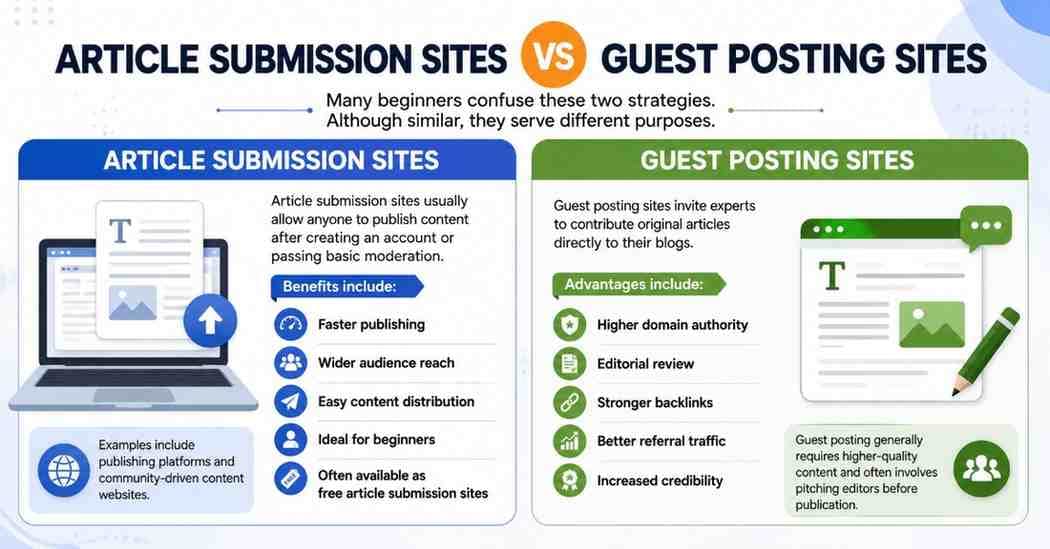
Many beginners confuse these two strategies.
Although similar, they serve different purposes.
Article Submission Sites
Article submission sites usually allow anyone to publish content after creating an account or passing basic moderation.
Benefits include:
Faster publishing
Wider audience reach
Easy content distribution
Ideal for beginners
Often available as free article submission sites
Examples include publishing platforms and community-driven content websites.
Guest Posting Sites
Guest posting sites invite experts to contribute original articles directly to their blogs.
Advantages include:
Higher domain authority
Editorial review
Stronger backlinks
Better referral traffic
Increased credibility
Guest posting generally requires higher-quality content and often involves pitching editors before publication.
Free Article Submission Sites: Are They Worth It?
Yes—but only when chosen carefully.
Not every free platform provides SEO value.
Focus on websites that have:
Active readership
Strong editorial standards
Regularly updated content
Good domain authority
Indexed pages in Google
Real user engagement
Avoid websites filled with duplicate content, spam, excessive advertisements, or automatically generated articles.
Quality always beats quantity.
Publishing five outstanding articles on respected websites is significantly more valuable than publishing fifty low-quality submissions.
Benefits of Using Article Submission Sites
Improve Organic Visibility
Publishing informative articles increases your digital footprint.
The more quality content associated with your brand, the easier it becomes for potential customers to discover you.
Generate Referral Traffic
Readers who find your content valuable often click through to learn more about your business.
Highly targeted referral visitors usually spend more time on your website because they already have interest in your topic.
Earn Quality Backlinks
Although many article submission websites use nofollow links, they still contribute to a natural backlink profile.
Editorial backlinks from respected websites remain one of Google's strongest ranking signals.
Build Brand Authority
Consistent publishing establishes your expertise.
When readers repeatedly encounter your insights across multiple trusted platforms, your credibility naturally increases.
Reach New Audiences
Your own website has a limited audience.
Article submission allows your content to appear before entirely new readers who may never have discovered your brand otherwise.
🔗 Find the Best Submission Sites
How to Choose the Best Article Submission Sites
Before submitting your article, evaluate each website carefully.
Look for:
High Domain Authority
Although Domain Authority isn't a Google ranking factor, it provides a useful benchmark for identifying reputable websites.
Generally, higher-authority websites attract stronger trust.
Relevant Niche
Always choose websites related to your industry.
A finance article belongs on business or finance websites—not travel blogs.
Topical relevance strengthens SEO value.
Editorial Guidelines
Professional websites maintain quality standards.
Read submission guidelines carefully before writing.
Following instructions increases your approval rate.
Organic Traffic
A website receiving consistent organic traffic offers better visibility than one with little or no audience.
Real readers matter more than backlink counts.
Active Community
Look for websites where readers:
Leave comments
Share articles
Ask questions
Engage with authors
Community engagement often leads to better brand exposure.
How to Write Articles That Get Accepted
Many submissions are rejected because they're overly promotional.
Editors want educational content—not advertisements.
Follow these practices:
Write Original Content
Never reuse existing articles.
Duplicate content reduces credibility and lowers acceptance chances.
Create Attention-Grabbing Headlines
Strong headlines improve click-through rates.
Instead of writing:
"SEO Tips"
Write:
"15 Practical SEO Strategies That Deliver Long-Term Organic Growth"
Specific headlines perform better.
Solve Real Problems
Ask yourself:
"What question does my reader want answered?"
Every section should provide practical value.
Support Claims with Statistics
Credible data builds trust.
Examples include:
Industry research
Government reports
Case studies
Market surveys
Academic publications
Whenever possible, use recent statistics.
Add Practical Examples
Readers understand concepts more easily when they see real scenarios.
Example:
Instead of saying,
"Internal linking improves SEO."
Explain:
"A software company added contextual internal links across 120 blog posts and increased organic page views by 38% within six months."
Examples create clarity.
Best Practices for Article Submission SEO
To maximize results:
Focus on user intent first.
Write comprehensive content.
Naturally include your primary keyword.
Use descriptive headings.
Add relevant internal links when permitted.
Link only to trustworthy external sources.
Optimize images before uploading.
Include an engaging author bio.
Publish consistently.
Update older articles regularly.
SEO today is about providing value—not manipulating rankings.
Common Mistakes to Avoid
Many marketers reduce their SEO performance by making avoidable errors.
Don't:
Submit duplicate articles.
Stuff keywords unnaturally.
Use irrelevant anchor text.
Publish on spam websites.
Buy bulk article submission packages.
Ignore editorial guidelines.
Write overly promotional content.
Neglect proofreading.
Remember:
One excellent article always outperforms dozens of weak submissions.
Article Submission Strategy That Actually Works
Instead of chasing hundreds of backlinks, use a structured strategy.
Step 1
Research reputable article submission websites.
Step 2
Understand each platform's audience.
Step 3
Write original content specifically for that audience.
Step 4
Include one or two natural references to your website where allowed.
Step 5
Promote your published article on social media and email newsletters.
Step 6
Monitor performance using analytics tools.
Track:
Referral traffic
Organic rankings
Backlink growth
Engagement
Conversion rate
Continuous improvement delivers better long-term SEO results.
Do Article Submission Sites Still Work After Google's Helpful Content Updates?
Yes—but only when your content demonstrates real expertise and satisfies user intent.
Google increasingly rewards content that:
Answers user questions thoroughly.
Demonstrates first-hand experience.
Provides unique insights.
Offers actionable advice.
Shows credibility through accurate information.
Publishing thin, AI-generated, or keyword-stuffed articles is unlikely to produce meaningful SEO benefits.
Instead, prioritize quality, originality, and usefulness.
EEAT: The Key to Successful Article Submission
Google evaluates content using the EEAT framework:
Experience
Share first-hand knowledge whenever possible.
Example:
Instead of repeating generic SEO advice, explain strategies you've personally tested.
Expertise
Demonstrate deep understanding of your subject.
Support recommendations with evidence.
Authoritativeness
Publish consistently across trusted websites.
Build a recognizable online presence.
Trustworthiness
Maintain factual accuracy.
Cite reliable sources.
Be transparent about your expertise.
Trust is often the deciding factor between average content and top-ranking content.
Frequently Asked Questions
1. What are article submission sites?
Article submission sites are websites that allow users to publish original articles online. They help increase brand exposure, referral traffic, and can contribute to a natural backlink profile when used appropriately.
2. Are article submission sites good for SEO?
Yes. High-quality article submission sites can support SEO by improving online visibility, building authority, generating referral traffic, and attracting natural backlinks. However, low-quality or spammy directories should be avoided.
3. What is the difference between article submission sites and guest posting sites?
Article submission sites generally allow broader public submissions with basic moderation, while guest posting sites require editorial approval and often maintain stricter publishing standards. Guest posts usually provide stronger branding and SEO opportunities.
4. Are free article submission sites safe to use?
Yes, provided you choose reputable platforms with quality editorial standards. Avoid websites filled with duplicate, low-quality, or spam content.
5. How many article submission sites should I use?
Quality is far more important than quantity. Publishing consistently on a handful of reputable websites will generally produce better results than submitting to hundreds of low-quality directories.
6. Can article submission generate backlinks?
Yes. Many platforms allow author bio links or contextual links where relevant. Even when links are marked as nofollow, they can still drive referral traffic, improve brand visibility, and contribute to a diversified backlink profile.
7. How often should I publish articles?
Consistency matters more than volume. Publishing one or two high-quality articles each month on trusted platforms is often enough to strengthen your content marketing and SEO strategy over time.
Final Thoughts
Article submission sites continue to play an important role in modern SEO when used as part of a quality-focused content marketing strategy. Rather than chasing hundreds of backlinks, concentrate on publishing original, informative, and experience-driven articles on reputable platforms that genuinely serve your audience.
Combine free article submission sites with high-authority guest posting sites to create a balanced off-page SEO approach. Over time, this strategy can improve your brand visibility, strengthen topical authority, generate qualified referral traffic, and support sustainable organic growth.
The most successful marketers don't publish everywhere—they publish where their audience already spends time and consistently deliver valuable content. If you want lasting SEO results, start by identifying reputable article submission sites, create content that demonstrates expertise and trust, measure your performance, and refine your strategy with every publication.
Why Trust Our Review
Our recommendations are based on in-depth research, publicly available information, feature comparisons, user experience, device compatibility, pricing transparency, and overall usability. We strive to provide balanced, accurate, and regularly updated content that helps readers make informed decisions rather than promoting any single provider.
Author: Priyanshi Webix
Reviewed by: Editorial Team
Last Updated: July 14, 2026


Images have become one of the most valuable assets in modern SEO. Whether you're running a blog, an eCommerce store, or a business website, sharing high-quality visuals on reputable Image Submission Sites can increase your online visibility, attract referral traffic, improve brand recognition, and support your overall off-page SEO strategy.
Although image submission alone won't guarantee top Google rankings, it complements other proven SEO techniques such as content marketing, guest posting sites, and quality link building. When optimized correctly with descriptive file names, alt text, and relevant descriptions, images can rank in Google Images and drive highly targeted visitors to your website.
In this guide, you'll discover the 12 best Image Submission Sites for 2026, learn how image submission benefits SEO, and explore practical strategies that help maximize your results while avoiding common mistakes.
What Are Image Submission Sites?
Image Submission Sites are online platforms where individuals and businesses upload, share, and organize images for public viewing. These websites allow search engines to discover visual content while helping users find relevant images through search.
Many of these platforms also allow profile links, image descriptions, tags, and website URLs, making them valuable for increasing brand awareness and generating referral traffic.
Some image-sharing websites focus on photography, while others cater to designers, marketers, bloggers, or businesses promoting products and services.
When used strategically, free image submission sites become an important part of an effective off-page SEO campaign.
Why Image Submission Matters for SEO in 2026
Search engines are becoming increasingly visual.
Google Images processes billions of image searches every day, and visual search technologies continue to improve with AI-powered recognition systems.
Submitting optimized images helps search engines understand your content while creating additional opportunities for people to discover your website.
Image submission also supports several SEO goals:
Builds brand visibility
Generates referral traffic
Improves content discoverability
Diversifies backlink sources
Supports image indexing
Increases engagement across multiple platforms
Rather than relying solely on backlinks from guest posting sites, combining guest posting with image submissions creates a more natural and diversified off-page SEO profile.
Key Benefits of Image Submission Sites
Improve Search Engine Visibility
Well-optimized images can appear in Google Image Search, giving your website another opportunity to attract organic visitors.
Instead of competing only in traditional search results, your visuals can rank independently.
Increase Referral Traffic
Many image-sharing platforms allow users to visit your website directly from your profile or image description.
This additional traffic often comes from users already interested in your niche, leading to better engagement.
Build Brand Authority
Publishing original, high-quality visuals consistently helps establish your business as an industry authority.
Over time, people begin recognizing your logo, design style, and visual identity.
Support Content Marketing
Every blog post can generate multiple pieces of visual content.
For example:
Infographics
Charts
Tutorials
Product images
Before-and-after comparisons
Custom graphics
These visuals can be distributed across multiple Image Submission Sites, extending the reach of a single article.
Strengthen Off-Page SEO
Image submission works best when combined with:
Content marketing
Social media promotion
Digital PR
Guest posting sites
Local citations
Business directories
Together, these strategies create a balanced SEO profile that appears more natural to search engines.
How Image Submission Works
The process is straightforward but requires proper optimization.
Step 1: Create Original Images
Unique visuals perform significantly better than stock photos.
Examples include:
Infographics
Custom illustrations
Product photos
Screenshots
Branded graphics
Step 2: Optimize File Names
Instead of:
IMG00045.jpg
Use:
best-image-submission-sites-2026.jpg
Descriptive filenames provide additional context for search engines.
Step 3: Compress Images
Large images slow loading times.
Use modern formats like:
WebP
Optimized JPEG
Optimized PNG
Fast-loading images improve user experience and support SEO performance.
Step 4: Write Keyword-Rich Descriptions
Include your primary topic naturally.
Example:
Discover the best Image Submission Sites for improving SEO, increasing visibility, and generating referral traffic in 2026.
Avoid keyword stuffing.
Step 5: Add Relevant Tags
Tags help users discover your images.
Example tags:
SEO
Digital Marketing
Image SEO
Content Marketing
Off-page SEO
Step 6: Link Back Naturally
If the platform allows website links, point users toward:
Related blog posts
Product pages
Service pages
Portfolio pages
Always prioritize relevance over excessive linking.
How to Choose the Best Image Submission Sites
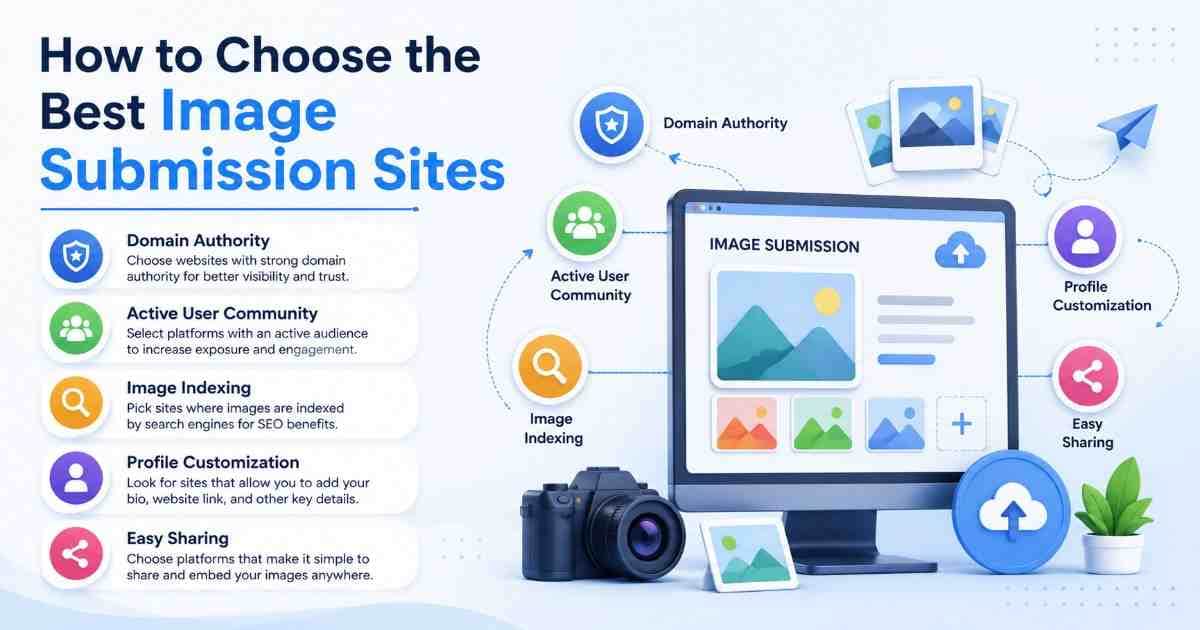
Not every platform provides equal SEO value.
When selecting websites, consider the following factors.
Domain Authority
Choose reputable websites trusted by search engines.
High-authority platforms generally offer better visibility and increased credibility.
Active User Community
Platforms with millions of active users provide greater opportunities for image discovery, engagement, and referral traffic.
Image Indexing
Select platforms where images are indexed by search engines.
Indexed content has a higher chance of appearing in image search results.
Profile Customization
Good platforms allow you to include:
Website URL
Business information
Portfolio
Brand description
These features strengthen your online presence.
Easy Sharing
Platforms with built-in social sharing features can significantly increase your content's reach.
12 Best Image Submission Sites
1. Pinterest
Pinterest remains one of the most effective Image Submission Sites for SEO and long-term traffic generation.
Unlike traditional social media platforms, Pinterest functions as a visual search engine where pins can continue driving visitors months or even years after publication.
Best Features
Massive global audience
Strong search functionality
Rich Pins support
Website verification
Long content lifespan
Best For
Bloggers
Affiliate marketers
eCommerce stores
Recipe websites
DIY creators
Travel blogs
SEO Tip
Design vertical images with compelling titles and keyword-rich descriptions to improve discoverability.
2. Flickr
Flickr has maintained its reputation as one of the largest photo-sharing communities.
It offers excellent visibility for photographers, businesses, and brands looking to showcase original images.
Best Features
High-quality image hosting
Albums and collections
Creative Commons options
Large photography community
Best For
Professional photographers
Travel bloggers
Designers
Businesses
SEO Tip
Include descriptive titles, optimized tags, and a complete profile linking back to your website.
3. Imgur
Imgur is widely known for viral images, memes, and community-driven visual content.
While it may not be a traditional SEO platform, engaging images can generate substantial referral traffic.
Best Features
Huge monthly audience
Easy image uploading
Community engagement
Fast image loading
Best For
Infographics
Tutorials
Memes
Educational visuals
SEO Tip
Focus on informative graphics that encourage sharing rather than promotional content.
4. DeviantArt
DeviantArt is one of the world's largest online communities for artists and digital creators.
Businesses in creative industries can use it to build brand recognition while showcasing unique visual work.
Best Features
Active creative community
Portfolio management
Artwork collections
Professional artist exposure
Best For
Graphic designers
Illustrators
Digital artists
Creative agencies
SEO Tip
Write detailed artwork descriptions with relevant keywords and maintain a complete profile for greater visibility.
5. Behance
Behance is one of the best platforms for showcasing creative work and building a professional portfolio. Owned by Adobe, it attracts millions of designers, marketers, and creative professionals worldwide.
If your business creates infographics, UI designs, branding projects, or marketing visuals, Behance is one of the most valuable Image Submission Sites to include in your SEO strategy.
Best Features
Professional portfolio creation
Adobe ecosystem integration
High-authority platform
Project-based image galleries
Large creative community
Best For
Graphic designers
Branding agencies
Digital marketers
UI/UX designers
Freelancers
SEO Tip
Instead of uploading a single image, create a complete project showcasing your work process. Include keyword-rich titles, detailed descriptions, and a link to your website where appropriate.
6. 500px
500px is a premium photography platform trusted by professional photographers and photography enthusiasts.
While its primary focus is photography rather than SEO, publishing original, high-quality images can increase brand visibility and drive qualified referral traffic.
Best Features
High-resolution image hosting
Photography licensing
Strong community engagement
Professional portfolios
Photography contests
Best For
Travel bloggers
Nature photographers
Product photographers
Tourism businesses
SEO Tip
Use descriptive image titles and detailed captions instead of generic filenames. Original photography performs significantly better than stock images.
7. Dribbble
Dribbble is one of the most respected communities for designers.
Creative agencies, SaaS companies, and startups often use it to showcase interface designs, illustrations, branding projects, and marketing graphics.
Best Features
Designer-focused audience
Portfolio management
Project showcases
Community interaction
Recruitment opportunities
Best For
Web designers
UI/UX designers
Logo designers
Branding experts
SEO Tip
Upload complete design case studies rather than isolated graphics. Detailed project descriptions improve engagement and credibility.
8. Instagram
Instagram remains one of the largest image-sharing platforms in the world.
Although most links are "nofollow," it still plays an important role in increasing brand awareness, generating referral traffic, and encouraging content sharing.
For businesses that regularly create visual content, Instagram complements traditional Image Submission Sites by expanding your reach.
Best Features
Massive global audience
Reels and Stories
Business profiles
Product tagging
High engagement
Best For
eCommerce stores
Bloggers
Agencies
Personal brands
Local businesses
SEO Tip
Use consistent branding, optimized captions, and relevant hashtags. Encourage users to visit your website through your profile link.
9. Tumblr
Tumblr combines blogging with image sharing, making it useful for publishing visual content alongside supporting text.
Unlike many image-sharing websites, Tumblr allows longer descriptions that provide additional keyword relevance.
Best Features
Blog-style publishing
Image galleries
Community sharing
Multimedia support
Best For
Bloggers
Creative businesses
Artists
Lifestyle brands
SEO Tip
Publish image collections supported by informative articles rather than uploading standalone images.
10. Pearltrees
Pearltrees helps users organize visual resources into collections.
Businesses can curate valuable industry content while promoting their own visual assets.
Best Features
Content organization
Visual collections
Collaborative sharing
Educational resources
Best For
Educators
Bloggers
Researchers
Digital marketers
SEO Tip
Organize your images into niche-specific collections to improve discoverability and user engagement.
11. PostImage
PostImage is a simple image hosting platform known for fast uploads and reliable image storage.
Although it lacks advanced community features, it is useful for sharing optimized images across websites and forums.
Best Features
Quick uploads
Free image hosting
Direct image links
No complicated setup
Best For
Bloggers
Forum users
Small businesses
SEO Tip
Only upload images that provide value and include meaningful filenames before uploading.
12. ImageShack
ImageShack has been a trusted image hosting service for years.
Businesses can use it to store, organize, and share high-quality images while maintaining a professional image library.
Best Features
Cloud storage
Image organization
High-resolution support
Secure hosting
Best For
Businesses
Agencies
Product catalogs
Marketing teams
SEO Tip
Keep your image library organized with descriptive folder names and optimized file names for easier management.
Best Practices for Image Submission Sites
Uploading images alone isn't enough. To maximize the SEO benefits of Image Submission Sites, follow these proven practices.
Create Original Images
Unique visuals consistently outperform stock photos.
Examples include:
Custom infographics
Data visualizations
Product photography
Before-and-after comparisons
Step-by-step tutorials
Original illustrations
Original content also strengthens your site's EEAT by demonstrating first-hand expertise.
Optimize Image File Names
Avoid default names like:
IMG_1024.jpg
Instead, use descriptive keywords:
image-submission-sites-guide-2026.jpg
This helps search engines understand your image before it is even indexed.
Write Meaningful Titles and Descriptions
Every upload should include:
A descriptive title
A concise summary
Relevant keywords
Natural language
Don't repeat the same keyword excessively. Write for users first.
Use Relevant Tags
Tags improve discoverability on most image-sharing platforms.
Example tags:
Image SEO
Digital Marketing
Content Marketing
Off-Page SEO
Visual Search
Blogging
Choose only tags that accurately describe your content.
Compress Images Before Uploading
Large images reduce loading speed and negatively impact user experience.
Recommended tools include:
TinyPNG
Squoosh
ImageOptim
Compressed images maintain quality while improving performance.
Maintain Consistent Branding
Use the same:
Logo
Brand colors
Website URL
Profile description
Social links
Consistency helps users recognize your brand across multiple platforms.
Publish Regularly
Uploading one image every few months won't produce meaningful results.
Create a publishing schedule, such as:
2–3 images per week
One infographic each month
New product images after every launch
Blog graphics for every published article
Consistency builds long-term visibility.
Common Mistakes to Avoid
Many businesses fail to achieve results because they overlook basic optimization.
Avoid these common mistakes.
Uploading Low-Quality Images
Blurry or poorly designed visuals reduce credibility and receive less engagement.
Always prioritize quality over quantity.
Ignoring Image SEO
Skipping optimized filenames, descriptions, and titles limits your visibility in search results.
Every image should be optimized before uploading.
Using Copyrighted Images
Only upload images you own or have permission to use.
Copyright violations can damage your reputation and even result in legal issues.
Keyword Stuffing
Adding the keyword Image Submission Sites repeatedly makes descriptions look unnatural.
Instead, write for users while incorporating keywords naturally.
Posting the Same Image Everywhere
Uploading identical content to every platform reduces uniqueness.
Consider creating:
Different sizes
Alternate titles
Unique descriptions
Platform-specific captions
This approach improves engagement and avoids repetitive content.
Practical Example: How Image Submission Supports SEO
Imagine you publish a blog post titled:
"Complete Local SEO Checklist for Small Businesses."
Instead of promoting only the article, you can also create:
An infographic summarizing the checklist
A comparison chart
A step-by-step workflow
A branded social media graphic
A statistics infographic
A visual checklist
Next, distribute these assets across multiple Image Submission Sites like Pinterest, Behance, Flickr, and Instagram.
Then support the same article by publishing content on relevant guest posting sites, linking back to your guide where appropriate.
This multi-channel strategy helps you:
Reach new audiences
Increase referral traffic
Build brand awareness
Earn natural backlinks
Improve content visibility
Rather than relying on a single promotion method, you're creating multiple pathways for users to discover your content.
Advanced Tips to Maximize Results
Once you've mastered the basics, these advanced techniques can further improve your performance.
Repurpose Every Blog Post
Turn each article into multiple visual assets instead of relying on text alone.
Use Infographics for Link Building
Well-designed infographics are frequently referenced by bloggers and journalists, increasing your chances of earning backlinks.
Monitor Referral Traffic
Use Google Analytics to identify which image platforms send the most visitors and focus your efforts there.
Refresh Older Images
Update outdated graphics with current statistics, improved branding, or new design elements to keep them relevant.
Combine Multiple Off-Page Strategies
The strongest SEO campaigns integrate:
Image Submission Sites
guest posting sites
Social media marketing
Business directory listings
Digital PR
Content marketing
A diversified strategy builds a more natural and resilient backlink profile.
Image SEO Statistics You Should Know
The following statistics highlight why visual content deserves a place in your SEO strategy:
Google Images accounts for a significant share of overall Google search activity, making image optimization an important traffic source.
Articles with original visuals generally receive higher engagement than text-only content.
Infographics are among the most shared forms of visual content because they present information in an easy-to-understand format.
Pages that include optimized images often experience better user engagement, including longer time on page and lower bounce rates.
Visual content is frequently reused by bloggers, journalists, and publishers, creating opportunities to earn natural backlinks when properly credited.
Takeaway: Image submission should support your overall SEO efforts—not replace them. When combined with valuable content and strategic promotion, it can increase visibility, referral traffic, and brand recognition.
Featured Snippet: What Are Image Submission Sites?
Image Submission Sites are online platforms where users upload and share images to increase their online visibility. For SEO, these websites help businesses promote visual content, attract referral traffic, improve brand awareness, and support image indexing in search engines when images are properly optimized with descriptive filenames, titles, and tags.
Featured Snippet: Do Image Submission Sites Help SEO?
Yes. Image Submission Sites can support SEO by:
Increasing brand visibility
Driving referral traffic
Helping images appear in Google Image Search
Supporting content marketing campaigns
Diversifying your off-page SEO strategy
Complementing backlinks earned through guest posting sites and other trusted sources
While they are not a direct ranking factor on their own, they contribute to a stronger overall digital presence.
Quick Checklist Before Uploading an Image
Use this checklist every time you submit an image:
✅ Create an original, high-quality image.
✅ Rename the file using descriptive keywords.
✅ Compress the image for faster loading.
✅ Write a clear, keyword-rich title.
✅ Add a helpful description.
✅ Include relevant tags.
✅ Use consistent branding.
✅ Link to a relevant page on your website (where allowed).
✅ Choose reputable free image submission sites.
✅ Track referral traffic and engagement.
Following these steps helps maximize the SEO value of every image you publish.
Frequently Asked Questions (FAQs)
1. What are the best Image Submission Sites for SEO?
Some of the most trusted platforms include Pinterest, Flickr, Behance, Imgur, DeviantArt, 500px, Dribbble, Instagram, Tumblr, Pearltrees, PostImage, and ImageShack. These websites offer strong visibility, active communities, and opportunities to showcase high-quality visual content.
2. Are free image submission sites effective for SEO?
Yes. Many free image submission sites have high domain authority and large user bases. When you upload optimized, original images with relevant descriptions, they can help improve brand exposure, referral traffic, and image search visibility.
3. How often should I submit images?
There is no fixed rule, but consistency matters. Publishing new images whenever you release a blog post, product update, or case study helps maintain an active online presence and keeps your visual content fresh.
4. Can image submission generate backlinks?
Some platforms allow you to include a website URL in your profile or image description. While not every link passes SEO value, image submissions can still drive referral traffic, increase brand awareness, and support a diversified off-page SEO strategy.
5. Should I use the same image on every platform?
It's better to adapt your content for each platform. You can use the same core image but customize titles, descriptions, tags, and dimensions to improve engagement and avoid repetitive content.
6. What image format is best for SEO?
WebP is generally recommended because it provides excellent image quality with smaller file sizes. Optimized JPEG and PNG files are also suitable, depending on the type of image.
7. Do Image Submission Sites replace guest posting?
No. Image Submission Sites and guest posting sites serve different purposes. Guest posting helps build authority and backlinks through written content, while image submission increases the reach of your visual assets. Using both strategies together creates a stronger and more balanced off-page SEO campaign.
8. What types of images perform best?
Original visuals tend to achieve the best results, including:
Infographics
Product photos
Custom illustrations
Step-by-step tutorials
Before-and-after comparisons
Data charts
Branded graphics
These formats are more engaging and are often shared more widely than generic stock photos.
Final Thoughts
Image Submission Sites continue to play an important role in off-page SEO by helping businesses expand their online visibility, attract referral traffic, and strengthen their brand presence. While they are not a shortcut to higher rankings, they work exceptionally well when combined with quality content, technical SEO, and other proven link-building methods.
To achieve the best results in 2026, focus on publishing original, optimized visuals rather than uploading large quantities of low-value images. Every image should provide value to users, include descriptive metadata, and align with the content it supports.
For long-term SEO success, combine image submission with content marketing, social media promotion, and guest posting sites. This integrated approach creates multiple opportunities for your audience to discover your brand while building a stronger and more sustainable online presence.
Why Trust Our Review
Our recommendations are based on thorough research, publicly available information, feature comparisons, user experience, device compatibility, pricing transparency, and overall usability. We strive to provide balanced, accurate, and regularly updated content that helps readers make informed decisions rather than promoting a single provider.
Author: Priyanshi Webix
Reviewed by: Editorial Team
Last Updated: July 13, 2026
Article submission sites continue to be one of the most effective off-page SEO techniques when used correctly. Publishing valuable, original content on high-authority Article Submission Sites helps businesses improve search visibility, build quality backlinks, attract targeted readers, and strengthen their online authority. While search engine algorithms have become smarter, quality content published on trusted platforms still contributes to long-term SEO success.
Unlike outdated link-building methods, modern article marketing focuses on providing genuine value to readers. Whether you run a business, manage a blog, or work as an SEO professional, choosing reputable platforms and creating informative content can generate sustainable organic traffic. Many marketers also combine guest posting sites with free article submission sites to diversify their backlink profile and reach a wider audience.
In this comprehensive guide, you'll learn how article submission works in 2026, why it still matters, how to choose the best platforms, and the best practices for maximizing SEO results.
Table of Contents
What Are Article Submission Sites?
Why Article Submission Still Matters in 2026
Benefits of Using Article Submission Sites
How Search Engines Evaluate Submitted Articles
How to Choose the Best Article Submission Sites
Free vs Paid Article Submission Sites
Best Practices Before Publishing
Common Mistakes to Avoid
FAQs
Conclusion
What Are Article Submission Sites?
Article Submission Sites are online platforms where writers, bloggers, businesses, and marketers publish informative articles to reach a broader audience. These websites allow authors to showcase expertise while earning backlinks that support their overall SEO strategy.
Rather than publishing promotional content, successful article submission focuses on solving readers' problems through educational and well-researched content.
How They Work
The process is simple:
Write an original, high-quality article.
Submit it to a reputable platform.
Include relevant internal and external references.
Add a natural author bio with your website link.
Wait for editorial approval.
Share and promote the published article.
The goal isn't simply obtaining backlinks—it's building trust and authority with readers.
Why Article Submission Still Matters in 2026
Many people believe article directories no longer work for SEO. The truth is more nuanced.
Low-quality directories filled with duplicate or AI-generated content provide little value. However, authoritative publishing platforms remain effective because they help websites demonstrate expertise and earn editorially relevant backlinks.
Google's Focus Has Changed
Modern SEO prioritizes:
Helpful content
User experience
Topical authority
Trustworthiness
Expert-written information
Natural backlinks
High-quality article submissions align with these priorities when they educate readers instead of manipulating rankings.
Builds Topical Authority
Publishing consistently about your niche signals expertise.
For example:
A cybersecurity company regularly publishes articles about ransomware prevention, cloud security, and password management across reputable publishing platforms.
Over time, search engines recognize the company's expertise in cybersecurity, increasing the likelihood of ranking for related topics.
Benefits of Using Article Submission Sites
When executed properly, article submission offers advantages beyond backlinks.
1. Increase Organic Visibility
Publishing useful content exposes your brand to audiences who may never have discovered your website through search alone.
More visibility often leads to:
Increased branded searches
More referral traffic
Better content discovery
Improved online reputation
2. Earn High-Quality Backlinks
Backlinks remain an important ranking factor.
Submitting articles on reputable platforms can generate links that:
Improve domain authority
Support keyword rankings
Strengthen your backlink profile
Increase indexing frequency
Quality always matters more than quantity.
3. Establish Industry Authority
Readers trust websites that consistently publish educational content.
Sharing practical advice, research, and case studies helps position your brand as an expert rather than simply another business selling products or services.
This is why many companies invest in both guest posting sites and trusted article publishing platforms.
4. Generate Referral Traffic
Many articles continue attracting visitors months or even years after publication.
Unlike paid advertising, evergreen articles provide long-term value without ongoing advertising costs.
5. Improve Brand Recognition
Appearing on respected publishing websites increases brand awareness.
Even readers who don't immediately visit your website may remember your business when they need related services later.
6. Support Your Content Marketing Strategy
Article submission extends the reach of your existing content.
For example:
Turn a blog post into a detailed educational article.
Expand a case study into an industry guide.
Repurpose research into an informative article.
This approach maximizes the value of every piece of content you create.
How Search Engines Evaluate Submitted Articles
Understanding how search engines assess published content helps you create articles that perform better.
Content Quality
Search engines reward articles that:
Solve real problems
Provide accurate information
Include original insights
Demonstrate expertise
Offer practical value
Thin content rarely performs well.
Originality
Duplicate content significantly reduces SEO value.
Always create unique articles instead of copying existing blog posts word for word.
A fresh perspective increases your chances of editorial approval and stronger rankings.
Relevance
Backlinks from websites related to your niche are generally more valuable than links from unrelated sources.
For example:
A finance article published on a financial publication is typically more beneficial than the same article appearing on an unrelated entertainment website.
Author Expertise
Search engines increasingly value content written by knowledgeable authors.
Strengthen credibility by including:
Professional author bio
Relevant experience
Industry certifications
Company information
Links to authoritative resources
This supports Google's emphasis on Experience, Expertise, Authoritativeness, and Trustworthiness (EEAT).
User Engagement
Positive engagement signals include:
Longer reading time
Lower bounce rates
Social sharing
Comments
Repeat visitors
Well-structured articles with clear headings and concise paragraphs are more likely to keep readers engaged.
How to Choose the Best Article Submission Sites
Not every publishing platform is worth your time. Focus on quality over quantity.
Domain Authority
Choose websites that have established authority and consistently publish valuable content.
High-authority platforms often pass more trust than low-quality directories.
Editorial Standards
The best platforms review submissions before publishing.
Editorial review usually indicates higher content quality and a better user experience.
Avoid websites that automatically publish every submission without moderation.
Relevant Audience
Select platforms that attract readers interested in your industry.
A marketing article belongs on digital marketing websites—not random general directories.
Relevant audiences are more likely to engage with your content and visit your website.
Organic Traffic
A website with steady organic traffic offers more opportunities for:
Referral visitors
Brand exposure
Content discovery
Long-term SEO benefits
Traffic quality matters more than traffic volume.
Link Policies
Before submitting an article, check whether the platform allows:
Author bio links
Contextual backlinks
Do-follow or no-follow links
External references
Natural linking practices are always preferable to excessive self-promotion.
Publishing Frequency
Choose active websites that regularly publish fresh content.
Regularly updated platforms are generally crawled more frequently by search engines, helping new content get indexed faster.
Free vs Paid Article Submission Sites
Both free and paid article submission platforms can support your SEO strategy, but they serve different purposes depending on your business goals, budget, and content marketing approach.
Free article submission sites are ideal for beginners, bloggers, startups, and small businesses that want to build visibility without spending money. These platforms are usually easy to join and allow users to publish content quickly. However, the quality of free platforms can vary significantly, so it is important to choose authoritative websites with active audiences and editorial standards.
Paid publishing platforms, on the other hand, often provide stronger editorial review, higher brand credibility, and access to larger or more targeted audiences. Because these platforms typically have stricter content guidelines, articles published there may carry greater authority and generate better long-term SEO value. They are commonly used by established brands, agencies, and businesses investing heavily in content marketing.
Free Article Submission Sites
Best for beginners
Cost: Free to use
Accessibility: Easy to join and publish
Editorial Quality: Varies from platform to platform
SEO Value: Good when the website is authoritative
Brand Exposure: Moderate
Best For: Bloggers, startups, and small businesses
Paid Publishing Platforms
Best for brands
Cost: Requires a publishing fee or approval process
Accessibility: Often more selective
Editorial Quality: Generally higher
SEO Value: Often stronger because of stricter standards
Brand Exposure: Typically higher
Best For: Established brands, agencies, and businesses focused on authority building
Best Practices Before Publishing
Following a few simple practices can significantly improve the performance of your submitted articles.
Research Search Intent
Understand what readers are actually searching for and ensure your article answers their questions comprehensively.
Write for Humans First
Focus on clarity and usefulness rather than keyword stuffing. Search engines increasingly reward content that satisfies user intent.
Use Clear Formatting
Break up content with:
Short paragraphs
Descriptive headings
Bullet points
Numbered lists
Tables where appropriate
This improves readability on both desktop and mobile devices.
Add Credible References
Support important claims with reputable sources, industry reports, or original data whenever possible. This enhances trust and aligns with EEAT principles.
Optimize Naturally
Include your primary keyword in strategic locations such as the title, introduction, headings, and conclusion, but always prioritize natural language over repetition.
Top Article Submission Sites for SEO in 2026
Not every platform offers the same SEO value. Instead of submitting your content to every website you find, focus on platforms that have strong editorial standards, consistent organic traffic, and a good reputation. Publishing on trusted websites can improve your brand visibility, help you earn quality backlinks, and establish your expertise within your industry.
Below are some of the best Article Submission Sites to consider in 2026.
1. Medium
Best For: Thought leadership and in-depth articles
Medium is one of the most popular publishing platforms for writers, marketers, and businesses. It allows you to share high-quality content with a large audience while building your online presence. Although backlinks are typically nofollow, Medium is excellent for increasing brand awareness and referral traffic.
Free Option: Yes
Editorial Review: Yes
2. LinkedIn Articles
Best For: Professional networking and B2B content
LinkedIn Articles help professionals showcase their expertise and connect with industry audiences. Publishing informative articles here can improve personal branding and generate engagement from business professionals and decision-makers.
Free Option: Yes
Editorial Review: Yes
3. EzineArticles
Best For: Educational and informative content
EzineArticles has been a trusted article directory for years. It maintains editorial guidelines that encourage quality submissions, making it a useful platform for sharing informative content and expanding your reach.
Free Option: Yes
Editorial Review: Yes
4. Sooper Articles
Best For: General niche articles
Sooper Articles accepts content across a wide range of industries. It is suitable for businesses looking to publish original articles and gain additional online exposure.
Free Option: Yes
Editorial Review: Yes
5. ArticleCube
Best For: Multiple niches
ArticleCube welcomes content from various industries, making it a versatile option for bloggers, marketers, and businesses. Publishing well-written articles here can help diversify your content distribution strategy.
Free Option: Yes
Editorial Review: Yes
6. HubPages
Best For: Evergreen content
HubPages is well known for publishing evergreen articles that continue attracting readers over time. Quality content can generate long-term referral traffic and strengthen your online authority.
Free Option: Yes
Editorial Review: Yes
7. Blogger
Best For: Brand publishing
Blogger is Google's free blogging platform that allows users to publish content easily. While it doesn't provide editorial review, it is useful for creating supporting content and building your online presence.
Free Option: Yes
Editorial Review: No
8. WordPress com
Best For: Personal branding and business blogs
WordPress com offers an easy way to publish articles and build a professional online presence. It is widely used by bloggers, freelancers, and businesses looking to share valuable content.
Free Option: Yes
Editorial Review: No
9. Tumblr
Best For: Community engagement and multimedia content
Tumblr combines blogging with social networking, making it suitable for creative content and community interaction. It can help increase content visibility when used strategically.
Free Option: Yes
Editorial Review: No
10. Vocal Media
Best For: Storytelling and niche content
Vocal Media is a publishing platform that supports writers across various categories, including technology, business, lifestyle, and personal development. It offers opportunities to reach engaged readers through quality storytelling.
Free Option: Yes
Editorial Review: Yes
Step-by-Step Article Submission Strategy
Publishing an article is only one part of a successful SEO strategy. Following a structured process helps maximize your results.
Step 1: Perform Keyword Research
Choose keywords that have:
Good search volume
Low to medium competition
Informational intent
Clear relevance to your business
Instead of targeting only broad terms, include long-tail keywords that answer specific user questions.
Step 2: Write Helpful Content
Google rewards articles that solve problems.
Ask yourself:
Does this answer the reader's question?
Is the information accurate?
Does it provide something unique?
Would someone bookmark or share this article?
Aim to educate rather than promote.
Step 3: Optimize Your Article
Before submitting, make sure your article includes:
SEO-friendly title
Clear H2 and H3 headings
Short paragraphs
Internal references (when applicable)
Relevant external sources
Optimized images with descriptive alt text
Natural keyword placement
Avoid stuffing the phrase Article Submission Sites into every paragraph. Write naturally and focus on readability.
Step 4: Add an Effective Author Bio
Your author bio should build trust without sounding overly promotional.
Include:
Your name
Professional expertise
Company or website
One natural website link
Social media or portfolio (if allowed)
A strong author profile supports EEAT by demonstrating real-world experience.
Step 5: Promote Your Published Content
Publishing isn't the finish line.
Share your article through:
Social media platforms
Email newsletters
Industry communities
Professional forums
Content roundups
The more engagement your article receives, the greater its long-term visibility.
Common Mistakes to Avoid
Many marketers make simple mistakes that reduce the SEO value of article submissions.
Publishing Duplicate Content
Copying the same article across dozens of websites provides little value and can create indexing challenges.
Instead:
Rewrite content
Add new examples
Update statistics
Change the structure
Each submission should offer something unique.
Choosing Low-Quality Websites
Thousands of directories exist solely for link building.
Avoid websites that:
Publish spam
Have excessive advertisements
Lack editorial review
Contain thin or copied content
Have little user engagement
Quality always beats quantity.
Keyword Stuffing
Using the same keyword repeatedly makes articles difficult to read.
Instead, naturally include related phrases like:
article publishing
content marketing
online publishing
digital marketing
SEO content
guest blogging
This creates a more natural reading experience.
Ignoring Reader Experience
Good SEO starts with satisfied readers.
Improve readability by using:
Short sentences
Clear headings
Bullet points
Tables
Examples
Visual content where appropriate
Building Links Too Aggressively
Adding multiple promotional links may trigger editorial rejection.
A better approach is to include:
One contextual link (where appropriate)
One author bio link
Focus on providing value rather than acquiring backlinks.
Expert Tips to Maximize SEO Results
If you want better long-term performance, go beyond basic article submission.
Build Topic Clusters
Instead of publishing unrelated articles, create a series around one subject.
For example:
Digital Marketing
Beginner's SEO Guide
Technical SEO Checklist
Link Building Strategies
Content Marketing Tips
Local SEO Best Practices
This strengthens topical authority.
Update Existing Articles
Refresh published content every few months.
Update:
Statistics
Screenshots
Examples
Industry trends
Broken links
Fresh content often performs better over time.
Repurpose Your Content
One article can become several assets.
For example:
LinkedIn post
Newsletter
Infographic
Presentation
Social media thread
Video script
Repurposing extends your reach without starting from scratch.
Measure Performance
Track important metrics using analytics tools.
Monitor:
Organic traffic
Referral traffic
Keyword rankings
Click-through rate (CTR)
Bounce rate
Time on page
Backlink growth
Conversion rate
These insights help you refine your content strategy.
Original Insights: What Works in 2026?
After years of algorithm updates, one trend is clear:
Search engines reward helpful content, not mass submissions.
A smaller number of high-quality articles on trusted websites often delivers better results than publishing hundreds of low-value articles across weak directories.
Successful SEO campaigns typically combine:
High-quality blog content
Strategic guest posting sites
Selective free article submission sites
Digital PR
Resource page outreach
Content partnerships
This balanced approach creates a natural backlink profile while building genuine authority.
Quick Checklist Before You Submit
Use this checklist to ensure your article is ready for publication.
Original and plagiarism-free
Informative and reader-focused
SEO-friendly title
Clear heading structure
Natural keyword placement
Mobile-friendly formatting
Internal review completed
Author bio added
Relevant links included
Proofread for grammar and readability
Frequently Asked Questions (FAQs)
1. Are Article Submission Sites still effective for SEO in 2026?
Yes. High-quality Article Submission Sites continue to support SEO by increasing visibility, earning authoritative backlinks, and helping establish topical expertise. The key is to publish original content on reputable platforms rather than relying on low-quality directories.
2. Which are the best free article submission sites?
Some of the most popular free article submission sites include Medium, LinkedIn Articles, HubPages, EzineArticles, ArticleCube, Blogger, and WordPress com. Choose platforms with active audiences and strong editorial standards whenever possible.
3. What's the difference between article submission and guest posting?
Article submission involves publishing content on platforms that accept contributions from multiple authors. Guest posting sites typically require you to contribute content directly to another website or blog within your niche, often offering stronger editorial control and highly relevant backlinks.
4. How many backlinks should I include in an article?
For most submissions, one contextual backlink (if permitted) and one author bio link are sufficient. Overloading an article with promotional links may reduce its credibility and increase the chances of editorial rejection.
5. Can duplicate articles hurt SEO?
Yes. Publishing identical content across multiple websites can reduce its effectiveness and create duplicate content issues. Rewrite and tailor each article for the platform where it will be published.
6. How often should I publish articles?
Consistency is more important than volume. Publishing one or two high-quality articles each month on authoritative websites generally delivers better long-term SEO results than frequent low-quality submissions.
Conclusion
Article Submission Sites remain a valuable component of a modern SEO strategy when approached with quality, relevance, and user value in mind. Instead of chasing hundreds of backlinks, focus on publishing original, well-researched content that educates readers and demonstrates your expertise.
By combining authoritative article publishing with guest posting sites, leveraging reputable free article submission sites, and following SEO best practices, you can strengthen your backlink profile, increase brand visibility, and build lasting topical authority.
Remember that successful SEO is a long-term investment. Consistently creating helpful content, choosing trusted publishing platforms, and measuring your performance will deliver better results than shortcuts or outdated tactics.
Why Trust Our Review
Our recommendations are based on in-depth research, practical SEO knowledge, publicly available data, feature comparisons, user experience, pricing transparency, and overall usability. Every article is carefully reviewed to ensure the information is accurate, up to date, and genuinely helpful for bloggers, marketers, business owners, and SEO professionals.
We regularly update our content to reflect the latest Google algorithm changes, industry trends, and SEO best practices. Our goal is to provide unbiased, well-researched information that helps readers make informed decisions rather than promoting a particular product or service.
Author: Priyanshi Webix
Reviewed by: Editorial Team
Last Updated: July 11, 2026Author Bio
Priyanshi Webix is an SEO content writer and digital marketing researcher specializing in SEO, content marketing, guest posting, link building, and website growth strategies. She creates well-researched, user-focused content that follows Google's EEAT principles and the latest SEO best practices. Her goal is to help businesses, bloggers, and marketers improve their online visibility through practical, actionable, and trustworthy content.
Search engine optimization has changed significantly over the last decade, but one strategy continues to deliver value when used correctly—Article Submission Sites. While search engines now prioritize quality over quantity, publishing original content on reputable platforms remains an effective way to expand your online reach, build authority, and attract relevant visitors.
Many marketers mistakenly believe article directories no longer work because of outdated spam tactics. In reality, the right platforms combined with high-quality content can strengthen your digital presence, generate referral traffic, and create opportunities for natural backlinks. Instead of submitting the same article everywhere, successful businesses focus on trusted publishing websites that value informative and original content.
This guide explains how article submission works in modern SEO, why it still matters in 2026, how to choose the right websites, and the best practices that produce long-term results. You'll also discover expert tips, practical examples, and a carefully researched list of platforms later in this guide.
What Are Article Submission Sites?
Article Submission Sites are online publishing platforms where individuals, businesses, and marketers can publish informative articles for a broader audience. Depending on the platform, authors may receive an author profile, referral traffic, brand exposure, and opportunities to earn contextual backlinks or links in their author bio.
Unlike traditional blogging on your own website, article submission allows your content to reach audiences who may never have discovered your brand through search alone.
Today, these platforms are used for much more than link building. They help businesses:
Increase online visibility
Demonstrate industry expertise
Reach new readers
Build trust with potential customers
Support a broader content marketing strategy
When combined with reputable guest posting sites, article submissions become a valuable part of a diversified off-page SEO campaign.
Why Article Submission Still Matters for SEO
Search engines reward websites that consistently demonstrate expertise, authority, and trustworthiness. Publishing useful content on reputable platforms helps reinforce these signals while expanding your online footprint.
Here are some of the biggest SEO advantages.
Increase Brand Visibility
Every quality article introduces your business to a new audience. Readers who find value in your content often explore your website, subscribe to newsletters, or follow your brand across other channels.
Over time, this consistent exposure strengthens brand recognition and supports long-term organic growth.
Earn High-Quality Referral Traffic
One of the most overlooked benefits of article marketing is referral traffic.
Instead of relying entirely on Google rankings, your articles can attract visitors directly from publishing platforms where your target audience already spends time.
These readers often have higher engagement because they intentionally chose to read your content.
Build Authority Through Valuable Content
Google increasingly favors websites that demonstrate real expertise.
Publishing detailed, well-researched articles on respected websites helps establish your reputation within your industry. The more consistently you share useful knowledge, the stronger your perceived authority becomes.
This aligns closely with Google's EEAT principles:
Experience
Expertise
Authoritativeness
Trustworthiness
Rather than focusing solely on backlinks, businesses should focus on becoming recognized sources of helpful information.
Support Natural Link Building
High-quality articles naturally attract citations, mentions, and editorial links from other websites.
While links should never be the only reason for publishing content, they often become a valuable by-product of creating genuinely useful resources.
Many businesses also combine article marketing with free article submission sites to diversify their backlink profile while maintaining quality standards.
How Article Submission Works in 2026
Article marketing has evolved considerably.
Years ago, marketers copied the same article onto hundreds of directories simply to create backlinks. That strategy no longer works and may even harm SEO performance.
Modern article submission focuses on originality and value.
The process typically looks like this:
Research reputable publishing platforms.
Create an original article that solves a real problem.
Follow each website's editorial guidelines.
Add relevant internal and external references.
Include a professional author bio.
Promote the published article across your marketing channels.
Measure traffic, engagement, and conversions.
The emphasis is now on quality rather than quantity.
Publishing ten outstanding articles on trusted websites is generally more valuable than publishing one hundred low-quality articles on weak directories.
How to Choose the Best Article Submission Platform
Not every publishing website deserves your time.
Before submitting an article, evaluate each platform carefully.
Domain Authority and Reputation
A well-established website with consistent editorial standards generally provides more value than newly created directories.
Look for websites that publish useful, original, and professionally edited content.
Relevant Audience
Publishing on a website related to your niche increases the chances of attracting engaged readers.
For example:
Marketing businesses should publish on digital marketing websites.
Health brands should choose health-focused publications.
Technology companies should target software or IT communities.
Relevance matters more than publishing everywhere.
Editorial Standards
Good platforms review submissions before publication.
Editorial screening often indicates higher content quality and greater trust from readers.
Avoid websites that automatically publish every submission without review.
Content Quality
Browse several published articles before submitting your own.
Ask yourself:
Are articles informative?
Is the content original?
Are headings easy to read?
Are sources cited?
Does the website appear trustworthy?
If the platform is filled with duplicate or poorly written articles, it is usually best to look elsewhere.
Expert Insight: Why Quality Beats Quantity
One of the biggest misconceptions in SEO is that more backlinks automatically lead to higher rankings.
In reality, a handful of mentions from respected websites often provide greater long-term value than hundreds of low-quality links.
Imagine two businesses.
Business A publishes one comprehensive article on a respected industry publication. The article receives shares, comments, and earns additional citations from other websites.
Business B submits the same generic article to 150 low-quality directories with little editorial oversight.
Although Business B creates more backlinks initially, Business A is far more likely to build lasting authority, attract qualified visitors, and strengthen its organic visibility.
This illustrates why modern SEO emphasizes relevance, originality, and user value rather than sheer volume.
Key Benefits at a Glance
Here is a quick summary of why article marketing continues to be effective:
Expands brand visibility
Builds topical authority
Supports EEAT signals
Generates referral traffic
Creates long-term marketing assets
Encourages natural backlinks
Diversifies your content distribution strategy
Reaches new audiences beyond search engines
Strengthens your overall digital presence
Complements content marketing and guest posting sites strategies
100+ Article Submission Sites for SEO in 2026
Choosing the right publishing platform is just as important as writing a great article. The websites below have been categorized to help you find the best opportunities based on authority, niche, and submission model.
Note: Domain Authority (DA) changes over time as SEO metrics are updated. Use these values as approximate ranges rather than fixed numbers.
High-Authority Article Submission Sites
These platforms have established reputations and large audiences, making them excellent choices for publishing high-quality content, increasing brand awareness, and building online authority.
Medium
Approx. DA: 95+
Niche: Multi-Niche
Submission Type: Free
LinkedIn Articles
Approx. DA: 99
Niche: Business
Submission Type: Free
HubPages
Approx. DA: 90+
Niche: Multi-Niche
Submission Type: Free
Vocal Media
Approx. DA: 80+
Niche: Multi-Niche
Submission Type: Free & Paid
EzineArticles
Approx. DA: 85+
Niche: General
Submission Type: Free
Sooper Articles
Approx. DA: 60+
Niche: General
Submission Type: Free
ArticleCube
Approx. DA: 55+
Niche: General
Submission Type: Free
SelfGrowth
Approx. DA: 70+
Niche: Self Improvement
Submission Type: Free
Buzzle Archive
Approx. DA: Archive
Niche: General
Submission Type: Limited
Tumblr
Approx. DA: 85+
Niche: Blogging
Submission Type: Free
Business & Marketing Platforms
These websites are ideal for marketers, agencies, entrepreneurs, startups, and business professionals looking to share industry insights.
Business 2 Community
Approx. DA: 80+
Submission Type: Free
Thrive Global
Approx. DA: 85+
Submission Type: Free
Data Driven Investor
Approx. DA: 70+
Submission Type: Free
Hacker Noon
Approx. DA: 85+
Submission Type: Free
Tech Bullion
Approx. DA: 75+
Submission Type: Free & Paid
Customer Think
Approx. DA: 70+
Submission Type: Free
Site Pro News
Approx. DA: 70+
Submission Type: Free
Marketing Profs Community
Approx. DA: 80+
Submission Type: Limited
D Zone
Approx. DA: 85+
Submission Type: Free
Dev
Approx. DA: 80+
Submission Type: Free
Technology & Developer Platforms
If you're in the software, SaaS, or technology industry, these platforms are excellent for reaching technical audiences.
Git Connected
Approx. DA: 70+
Submission Type: Free
Hashnode
Approx. DA: 80+
Submission Type: Free
Code Project
Approx. DA: 80+
Submission Type: Free
GeeksforGeeks Articles
Approx. DA: 90+
Submission Type: Limited
Daily dev Community
Approx. DA: 75+
Submission Type: Free
Codementor Community
Approx. DA: 70+
Submission Type: Free
CodeNewbie
Approx. DA: 65+
Submission Type: Free
Java Code Geeks
Approx. DA: 70+
Submission Type: Free
TechGig Blogs
Approx. DA: 65+
Submission Type: Free
OpenSource
Approx. DA: 80+
Submission Type: Limited
General Article Publishing Websites
These platforms accept content from a wide variety of industries and topics.
ArticleBiz
Approx. DA: 50+
Submission Type: Free
Amazines
Approx. DA: 50+
Submission Type: Free
ArticlesFactory
Approx. DA: 45+
Submission Type: Free
ArticleCity
Approx. DA: 45+
Submission Type: Free
ArticleAlley
Approx. DA: 50+
Submission Type: Free
StorifyMe
Approx. DA: 50+
Submission Type: Free
Write as
Approx. DA: 70+
Submission Type: Free
LiveJournal
Approx. DA: 90+
Submission Type: Free
Bloglovin
Approx. DA: 90+
Submission Type: Free
Scoop it
Approx. DA: 90+
Submission Type: Free & Paid
Education & Knowledge Sharing Platforms
These websites are well suited for educational, research-based, and informational content.
Academia edu
Approx. DA: 90+
Submission Type: Free
ResearchGate
Approx. DA: 90+
Submission Type: Free
SlideShare
Approx. DA: 95+
Submission Type: Free
Issuu
Approx. DA: 94+
Submission Type: Free
Scribd
Approx. DA: 94+
Submission Type: Free
Quora Spaces
Approx. DA: 93+
Submission Type: Free
Goodreads Articles
Approx. DA: 92+
Submission Type: Free
Wattpad
Approx. DA: 93+
Submission Type: Free
Edutopia Community
Approx. DA: 80+
Submission Type: Limited
Zenodo
Approx. DA: 85+
Submission Type: Free
Startup & Entrepreneur Communities
Perfect for startup founders, entrepreneurs, and SaaS businesses looking to build authority.
Indie Hackers
Approx. DA: 80+
Submission Type: Free
Product Hunt Discussions
Approx. DA: 92+
Submission Type: Free
BetaList Community
Approx. DA: 75+
Submission Type: Free
GrowthHackers
Approx. DA: 80+
Submission Type: Free
Founder Institute Blog
Approx. DA: 70+
Submission Type: Limited
Y Combinator Community
Approx. DA: 90+
Submission Type: Limited
SaaS Hub
Approx. DA: 60+
Submission Type: Free
Failory
Approx. DA: 65+
Submission Type: Free
StartupNation
Approx. DA: 70+
Submission Type: Free
Startup Grind Community
Approx. DA: 80+
Submission Type: Free
Best Free Article Submission Sites
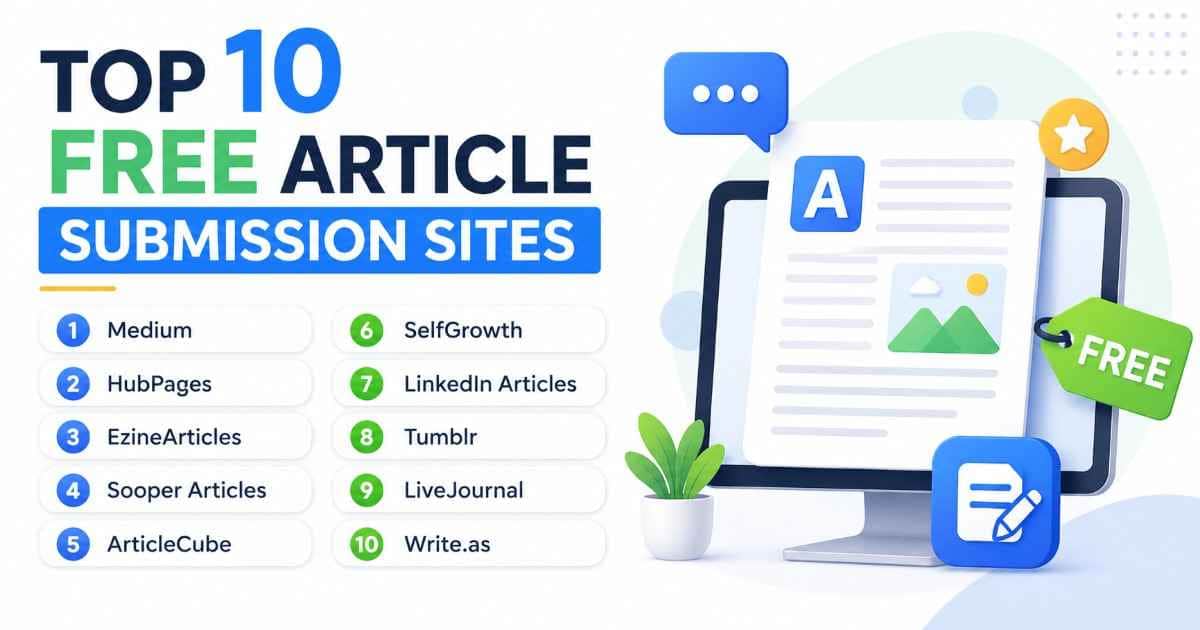
If you're looking for platforms that don't charge submission fees, consider these options:
Medium
HubPages
EzineArticles
Sooper Articles
ArticleCube
SelfGrowth
LinkedIn Articles
Tumblr
LiveJournal
Write as
Dev to
Hashnode
HackerNoon
DZone
CodeProject
Quora Spaces
Scoop it
Vocal Media
ArticleBiz
ArticlesFactory
Additional Article Submission Platforms
To further diversify your content marketing strategy, explore these publishing platforms:
ArticleBase Archive
PRLog
The OmniBuzz
MerchantCircle
Local com Blogs
Blogger
WordPress com
Weebly Blog
Wix Blog
Substack
Ghost
Publish0x
Tealfeed
NewsBreak Contributor
Flipboard Creator
Behance Articles
Dribbble Stories
Vocal Creators
Minds
Hive blog
Steemit
PublishDrive Blog
Notion Sites
Bear Blog
Feather so
Read cash
Mirror xyz
Peerlist
Daily dev
Cakeresume Blog
Newsvine Archive
Blogarama
Blog Engage
Growth Mentor
eLearning Industry
SitePoint Community
Smashing Magazine Community
DesignFloat
Moz Community
Search Engine Journal (Contributor)
Search Engine Land (Contributor)
Social Media Today
CMSWire
TechTarget Community
VentureBeat Contributor
ReadWrite
Entrepreneur Leadership Network
Fast Company Executive Board
Forbes Councils
Business com
Terkel
Help A B2B Writer
WriterAccess Blog
Contently
ClearVoice
Copyblogger Community
Digital Journal
Benzinga Contributor
CoinMonks
Hackster io
How to Get the Best Results from These Platforms
Publishing your content is only the first step. To maximize the value of your efforts:
Write original, in-depth articles tailored to each platform.
Follow the site's editorial guidelines before submitting.
Include relevant internal and external references where appropriate.
Use a compelling headline and engaging introduction.
Add a professional author bio with a link to your website if allowed.
Promote your published articles through social media, email newsletters, and your own blog.
Track referral traffic and engagement using analytics tools to understand which platforms perform best.
Best Practices for Article Submission That Delivers Real SEO Results
Publishing content on multiple platforms can be beneficial, but success depends on how you approach the process. Search engines reward original, user-focused content rather than repetitive articles created solely for backlinks.
Follow these proven best practices to maximize the value of every submission.
Create Original Content Every Time
One of the biggest mistakes marketers make is publishing the same article across dozens of websites.
Instead, write unique content for each platform. Even if you're covering the same topic, change the:
Headline
Introduction
Examples
Structure
Conclusion
Original content is more valuable to readers and reduces the risk of duplicate content issues.
Example
Instead of publishing one article titled:
10 SEO Tips for Beginners
Create variations like:
Beginner's Guide to SEO in 2026
Common SEO Mistakes New Websites Make
Simple SEO Strategies for Small Businesses
How to Build Organic Traffic Without Paid Ads
Each article targets a similar audience while offering fresh value.
Prioritize Helpful Content Over Backlinks
A common misconception is that article marketing exists only to build links.
The real goal should be helping readers solve problems.
Ask yourself before publishing:
Does this answer a real question?
Is the information accurate?
Would someone bookmark or share it?
Does it offer unique insights?
When readers find genuine value, backlinks, shares, and engagement often follow naturally.
Choose Relevant Publishing Platforms
Relevance matters more than authority alone. Publishing your content on websites that closely match your industry helps you reach the right audience, improve engagement, and build stronger topical authority.
Here are some examples of choosing the right platform based on your niche:
Digital Marketing: Marketing blogs and digital marketing publications.
Finance: Business websites, financial magazines, and investment platforms.
Healthcare: Medical websites, healthcare publications, and wellness blogs.
Technology: Developer communities, tech blogs, and software-focused platforms.
Education: Educational websites, learning platforms, and academic communities.
Travel: Travel blogs, tourism websites, and destination guides.
By selecting niche-relevant publishing platforms, you can connect with readers who are genuinely interested in your content. This not only increases engagement and referral traffic but also strengthens your website's topical authority, making your overall SEO strategy more effective.
Write Headlines That Encourage Clicks
Your headline determines whether people read your article.
Strong headlines should:
Solve a problem
Include numbers
Create curiosity
Stay clear and specific
Good Examples
15 SEO Mistakes That Cost You Traffic
Beginner's Guide to Content Marketing
How Small Businesses Can Increase Organic Traffic
Proven Ways to Build Website Authority
Avoid clickbait that doesn't match the content.
Improve Readability
Readers often scan content before reading every word.
Make your articles easy to consume by using:
Short paragraphs
Clear headings
Bullet points
Numbered lists
Bold text for important ideas
Simple language
This improves user experience on both desktop and mobile devices.
Include Credible Sources
Supporting your claims with reliable data increases trust.
Whenever possible, reference:
Industry research
Government publications
Academic studies
Official company reports
Google documentation
Reliable sources strengthen your content's credibility and support EEAT principles.
Optimize Your Author Bio
Your author profile is often the first place readers learn about you.
Include:
Your name
Professional expertise
Company
Website
Social profiles (if allowed)
A well-written bio helps establish authority while encouraging readers to explore your website.
Common Article Submission Mistakes to Avoid
Even experienced marketers occasionally make mistakes that reduce SEO value.
Here are the most common ones.
Publishing Duplicate Content
Copying the same article across dozens of websites offers little value today.
Instead, create unique content tailored to each audience.
Ignoring Editorial Guidelines
Every publishing platform has different requirements.
Some specify:
Word count
Formatting
Image rules
Link limits
Writing style
Following these guidelines increases your approval rate.
Overusing Keywords
Keyword stuffing hurts readability and may negatively affect rankings.
Instead of forcing keywords into every paragraph, write naturally.
Search engines now understand context much better than exact repetition.
Focusing Only on Domain Authority
High authority is useful—but relevance matters just as much.
A niche website with an engaged audience can outperform a larger but unrelated publication.
Using Low-Quality AI Content
AI can assist with research and drafting, but articles should always be reviewed, edited, and improved by humans.
Readers value:
Original experience
Practical advice
Personal insights
Real examples
Quality always wins over quantity.
Forgetting to Promote Published Articles
Many marketers publish an article and never share it again.
Instead:
Share it on LinkedIn
Post it on X (Twitter)
Include it in newsletters
Add it to your website
Link to it from future articles
Promotion helps extend the lifespan of your content.
Practical Example: A Smarter Submission Strategy
Imagine you run a digital marketing agency.
For example, if you run a digital marketing agency, you can tailor your content to different platforms based on their audience:
Medium: SEO Trends for 2026
LinkedIn Articles: Building Brand Authority Through Content
HackerNoon: Technical SEO for SaaS Companies
HubPages: Beginner's Guide to Local SEO
Business 2 Community: Content Marketing Strategies for Small Businesses
Each article targets a different audience while reinforcing your expertise.
This approach generates:
Higher engagement
More referral traffic
Better brand recognition
Stronger authority
Sustainable SEO growth
Expert Tips for Long-Term Success
Professionals who consistently succeed with article marketing follow a structured process rather than publishing randomly.
Build a Publishing Calendar
Plan one or two quality articles each month instead of rushing multiple submissions in a single week.
Consistency builds momentum over time.
Refresh Existing Content
Update older articles with:
New statistics
Recent examples
Improved formatting
Updated screenshots
Better calls to action
Fresh content often performs better than constantly creating new articles.
Measure Performance
Track key metrics such as:
Organic traffic
Referral traffic
Bounce rate
Average engagement time
Conversions
Backlinks earned
Use these insights to identify which platforms deliver the best results.
Repurpose Your Content
A single article can become multiple pieces of content.
For example:
LinkedIn post
Newsletter
Infographic
YouTube script
Podcast outline
Social media thread
Repurposing extends the reach of your work without starting from scratch.
Focus on Building Relationships
Editors and publishers appreciate contributors who consistently provide valuable content.
Maintain professional communication, submit high-quality articles, and engage with readers through comments or discussions. Strong relationships often lead to recurring publishing opportunities.
Featured Snippet: Do Article Submission Sites Still Work for SEO?
Yes, article submission sites can still improve SEO when used correctly. The key is to publish original, informative content on reputable websites that are relevant to your niche. Instead of chasing hundreds of backlinks, focus on building authority, attracting referral traffic, and providing genuine value to readers. High-quality submissions support a well-rounded content marketing strategy and can contribute to long-term organic growth.
Frequently Asked Questions (FAQs)
The following questions are inspired by Google's People Also Ask section and address the most common concerns about article marketing and SEO.
1. What are article submission sites?
Article submission sites are online platforms where individuals and businesses can publish informative articles to reach a wider audience. These platforms help increase brand awareness, generate referral traffic, and establish industry authority when used as part of a well-planned content marketing strategy.
2. Do article submission sites still help SEO?
Yes, they can still support SEO when you publish original, high-quality content on reputable websites. Instead of focusing solely on backlinks, modern article marketing improves visibility, builds topical authority, and attracts engaged readers who may later become customers.
3. Are free article submission sites worth using?
Many free publishing platforms are valuable, provided they maintain strong editorial standards and have an active audience. Before submitting content, review the site's quality, relevance, and publishing guidelines to ensure it aligns with your marketing goals.
4. How often should I submit articles?
Consistency is more important than volume. Publishing two to four well-researched articles each month is generally more effective than submitting dozens of low-quality posts. A steady publishing schedule helps build authority and keeps your content marketing efforts sustainable.
5. Can article submission replace guest posting?
No. Article submission and guest posting sites serve different purposes and work best together. Guest posting usually involves publishing on niche blogs with editorial oversight, while article submission platforms allow broader content distribution. Combining both strategies creates a stronger and more diverse off-page SEO profile.
6. What makes a good article for submission?
A successful article should:
Solve a real problem for readers.
Include accurate and up-to-date information.
Be well-structured with clear headings.
Use simple, engaging language.
Offer original insights or practical examples.
Include a compelling call to action where appropriate.
High-quality content is far more likely to earn engagement, shares, and long-term search visibility.
7. Should I publish the same article on multiple websites?
No. Publishing identical content across many platforms can reduce its effectiveness. Instead, create unique versions tailored to each website and audience. Original content provides a better user experience and aligns with search engine best practices.
8. How do I choose the best article submission platform?
Look for websites that have:
Strong domain authority and reputation.
Relevant audiences within your industry.
Clear editorial guidelines.
Regularly updated content.
Positive user engagement.
Opportunities to build long-term credibility.
Choosing quality platforms is more beneficial than submitting content to hundreds of low-value websites.
Final Thoughts
Although SEO continues to evolve, publishing valuable content on trusted Article Submission Sites remains an effective way to expand your online presence, strengthen brand authority, and support long-term organic growth.
The key is to focus on quality rather than quantity. Instead of chasing hundreds of backlinks, invest your time in creating original articles that genuinely educate, solve problems, and provide value to readers. When your content is published on reputable platforms and supported by a consistent content strategy, the benefits extend far beyond search rankings. You'll build credibility, attract qualified visitors, and create lasting digital assets that continue working for your business over time.
Remember that article marketing should complement—not replace—other SEO activities such as technical optimization, keyword research, content creation, digital PR, and outreach. A balanced strategy delivers the strongest results.
Search engine optimization (SEO) continues to evolve, but one strategy still delivers value when used correctly—article submission sites. Publishing well-written, informative content on trusted platforms helps businesses improve brand visibility, reach new audiences, and earn quality backlinks that support long-term SEO growth.
However, success depends on quality rather than quantity. Search engines now reward websites that publish original, experience-driven content instead of mass-distributed, low-value articles. When combined with other off-page strategies like guest posting sites, article submissions become part of a sustainable digital marketing plan.
In this comprehensive guide, you'll learn how article submission sites work, why they still matter, how to choose the right platforms, and the best practices to maximize SEO results without risking search engine penalties.
What Are Article Submission Sites?
Article submission sites are online publishing platforms where individuals, businesses, and marketers can publish informative articles for readers across different industries.
Instead of focusing only on backlinks, modern article submission is about:
Sharing valuable knowledge
Building topical authority
Increasing brand awareness
Reaching new audiences
Supporting a diversified SEO strategy
High-quality submissions can drive referral traffic, generate leads, and improve your online reputation over time.
Featured Snippet Answer:
Article submission sites are platforms that allow users to publish informative content online to improve brand visibility, gain referral traffic, build authority, and support SEO through high-quality content distribution.
Why Article Submission Still Matters for SEO
Many marketers assume article submission is outdated. That's only true when it involves duplicate or low-quality content.
Google's algorithms now reward:
Helpful content
Original research
Expert insights
Real-world experience
User-first writing
Publishing valuable articles on reputable websites helps search engines understand your expertise while introducing your brand to new audiences.
Key SEO Benefits
Builds topical authority
Diversifies backlink profile
Generates referral traffic
Improves brand recognition
Supports content marketing
Creates opportunities for natural backlinks
According to industry studies by Ahrefs and Semrush, websites that consistently publish authoritative content across multiple trusted platforms typically attract significantly more organic traffic than those relying solely on on-page optimization.
How Article Submission Sites Improve Website Authority
Authority isn't built overnight.
Every useful article becomes another digital asset that can:
Answer customer questions
Earn social shares
Attract natural citations
Generate backlinks
Increase trust
For example:
Imagine a SaaS company publishes an in-depth guide about cybersecurity.
If that article appears on a reputable publishing platform and gains attention from bloggers, journalists, or industry experts, it can naturally earn mentions and backlinks that strengthen the company's authority.
This creates a compounding SEO effect over time.
Difference Between Article Submission and Guest Posting
Although many people confuse them, they're different strategies.
Article Submission
✔ Public publishing websites
✔ Faster approval
✔ Broad audience
✔ Referral traffic
Guest Posting
✔ Niche blogs
✔ Strict editorial review
✔ High-authority backlinks
✔ Targeted audience
The best SEO campaigns often combine article submission with reputable guest posting sites to create a balanced backlink profile.
Benefits of Using High-Quality Article Submission Sites
1. Better Brand Visibility
Publishing useful content introduces your expertise to readers who may never have visited your website.
Over time, this improves brand recognition and trust.
2. Increased Referral Traffic
Readers interested in your topic often click through to learn more.
Unlike paid advertising, this traffic continues arriving long after publication.
3. Improved Content Reach
One well-written article can:
Rank in Google
Be shared on social media
Be referenced by bloggers
Generate newsletter mentions
This extends the lifespan of your content.
4. Stronger Topical Authority
Search engines increasingly evaluate expertise.
Publishing multiple high-quality articles around your niche helps establish authority.
5. Diversified SEO Strategy
SEO should never depend on one tactic.
Combining:
Blog publishing
Link building
Technical SEO
Content marketing
Article submissions
creates a stronger long-term strategy.
How to Choose the Best Article Submission Sites
Not every publishing platform deserves your content.
Use these criteria before submitting articles.
🔥 Outrank Your SEO Competitors
Check Domain Authority
Higher-authority websites generally offer greater visibility and stronger SEO potential.
Review Editorial Standards
Quality platforms reject thin or AI-generated spam.
Choose websites that value:
Original research
Helpful content
Expert insights
Evaluate Audience Relevance
Publishing on a website related to your industry produces better engagement than posting on unrelated platforms.
Verify Indexing
Search Google to see whether recent articles from the platform appear in search results.
If pages aren't indexed, the platform may provide little SEO value.
Examine User Experience
Avoid websites overloaded with ads, spam, or duplicate content.
Readers trust clean, professional websites.
Best Practices for Successful Article Submission
Following a structured process improves both user engagement and SEO performance.
Write Original Content
Never copy existing articles.
Google rewards unique perspectives and firsthand experience.
Focus on User Intent
Answer real questions readers ask.
Helpful content consistently performs better than promotional content.
Optimize Headlines
Strong headlines improve click-through rates.
Example:
Instead of:
SEO Tips
Use:
10 Practical SEO Tips That Increased Organic Traffic by 120%
Add Supporting Data
Statistics build credibility.
Examples include:
Industry reports
Case studies
Survey results
Research findings
Always reference trustworthy sources when citing data.
Include Internal and External Links
A balanced linking strategy improves usability.
Link to:
Relevant pages on your website
Trusted external resources
Supporting guides
Use Visual Content
Articles with visuals often receive higher engagement.
Consider adding:
Infographics
Charts
Screenshots
Comparison tables
Common Mistakes to Avoid
Many marketers reduce the effectiveness of article submissions by making avoidable mistakes.
Avoid:
Publishing duplicate content
Stuffing keywords
Using low-quality directories
Writing overly promotional articles
Ignoring reader intent
Buying spammy backlinks
Publishing without proofreading
Quality always wins over quantity.
Practical Example: Building Authority Through Content Distribution
Imagine a digital marketing agency launching a new SEO service.
Instead of publishing only on its own blog, the team creates:
One comprehensive industry guide
One case study
One beginner tutorial
One trend analysis
Each article appears on a trusted publishing platform with unique content.
Over several months:
Brand searches increase
Referral traffic grows
Industry mentions improve
Natural backlinks appear
Leads increase through organic discovery
This demonstrates how strategic content distribution supports sustainable growth.
How to Create an SEO-Friendly Article Before Submission
Publishing on article submission platforms is only effective when the content meets modern SEO standards. Before submitting an article, ensure it provides genuine value, answers a specific user query, and demonstrates real expertise. Search engines prioritize helpful content that satisfies user intent rather than articles written solely for backlinks.
Start with thorough keyword research and organize your content using a logical heading structure. Write an engaging introduction, include practical examples, and support important points with reliable data whenever possible. Keep paragraphs short, use bullet points for readability, and naturally incorporate relevant keywords without over-optimizing.
📖 Explore Advanced SEO Strategies
Before publishing, review your article for grammar, originality, and mobile readability. Adding relevant internal and external links, optimizing images with descriptive alt text, and writing a compelling meta title and description can further improve visibility. A well-optimized article not only performs better in search engines but also encourages readers to spend more time engaging with your content.
Why Quality Content Matters More Than the Number of Submissions
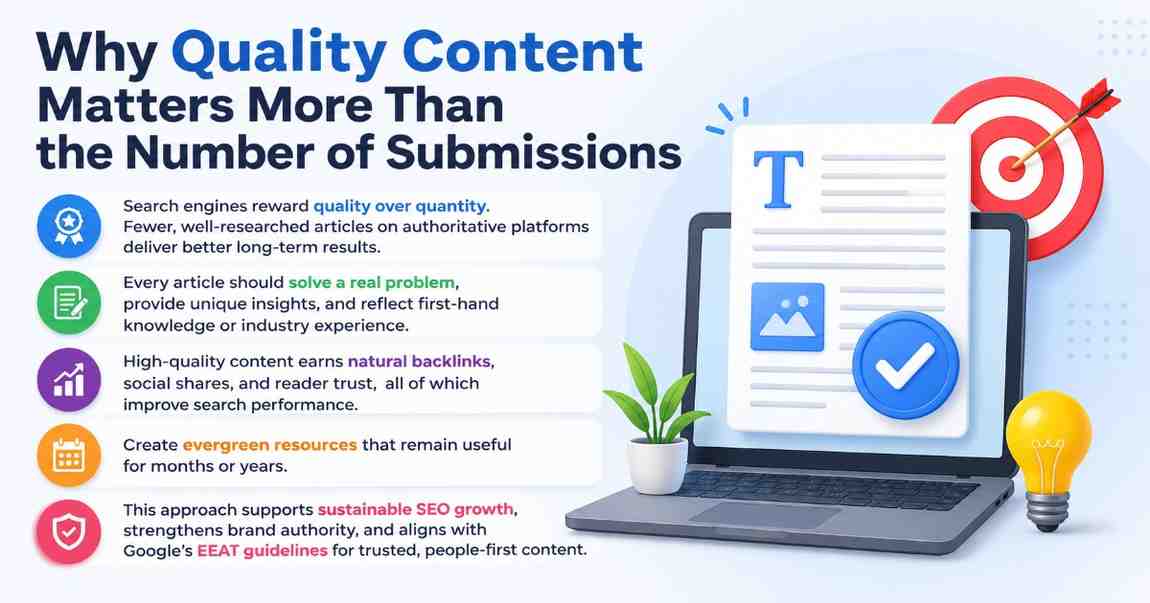
Many marketers believe submitting hundreds of articles will improve SEO, but search engines now reward quality over quantity. Publishing fewer, well-researched articles on authoritative platforms delivers better long-term results than mass-submitting thin or duplicated content across low-quality websites.
Every article should solve a real problem, provide unique insights, and reflect first-hand knowledge or industry experience. High-quality content is more likely to earn natural backlinks, social shares, and reader trust, all of which contribute to stronger search performance. Instead of focusing on the number of submissions, invest time in creating evergreen resources that remain useful for months or even years. This approach supports sustainable SEO growth, strengthens your brand authority, and aligns with Google's EEAT guidelines for creating trustworthy, people-first content.
Actionable Tips for Better Results
If you're just starting, follow this simple framework.
Weekly Checklist
Publish one original article
Target one specific audience
Answer one important question
Add supporting examples
Include helpful visuals
Track referral traffic
Update older articles
Consistency produces better results than publishing dozens of low-quality articles.
Are Free Article Submission Sites Worth Using?
Many marketers ask whether free article submission sites still provide SEO value.
The answer depends on quality.
A reputable free platform can:
Expand your audience
Generate referral traffic
Improve brand visibility
Build authority
However, avoid websites filled with spam or duplicate content.
Always prioritize quality over free publication opportunities.
Measuring the Success of Article Submission
Track these metrics regularly.
SEO Metrics
Organic traffic
Keyword rankings
Indexed pages
Backlinks earned
Engagement Metrics
Average reading time
Bounce rate
Social shares
Comments
Referral traffic
Business Metrics
Leads generated
Newsletter signups
Demo requests
Sales conversions
Data helps refine future content strategies.
Future of Article Submission in SEO
Google continues emphasizing helpful, people-first content.
That means successful article submissions will increasingly depend on:
Experience
Expertise
Original insights
Trustworthiness
Reader satisfaction
Publishers focusing on genuine value will continue benefiting from long-term SEO improvements.
Those relying on automation or low-quality submissions will likely see diminishing returns.
Frequently Asked Questions
1. Are article submission sites still effective for SEO?
Yes. High-quality article submission remains effective when the content is original, helpful, and published on reputable platforms. It supports brand awareness, referral traffic, and authority rather than relying solely on backlinks.
2. How often should I submit articles?
Consistency matters more than volume. Publishing one or two well-researched articles each month often produces better long-term results than submitting dozens of low-quality articles.
3. Can article submission improve Google rankings?
Indirectly, yes. Helpful content can increase visibility, attract backlinks, build authority, and drive engagement, all of which contribute to stronger SEO performance.
4. What makes a good article submission platform?
Choose platforms with:
High editorial standards
Relevant audiences
Strong domain authority
Indexed content
Good user experience
5. Is article submission better than guest posting?
Neither is universally better. They serve different purposes. Article submission improves content distribution and visibility, while guest posting sites often provide stronger niche authority and editorial backlinks. Combining both strategies delivers the best long-term SEO results.
Final Thoughts
Article submission sites remain a valuable part of modern SEO when approached strategically. Instead of chasing hundreds of backlinks, focus on publishing original, experience-driven content that genuinely helps readers.
By selecting reputable platforms, following SEO best practices, and consistently sharing valuable insights, you can strengthen your brand authority, increase organic visibility, and generate sustainable traffic over time.
SEO success isn't built through shortcuts—it's earned through quality, consistency, and trust.

Guest posting continues to be one of the most effective off-page SEO strategies for earning authoritative backlinks, expanding brand visibility, and building long-term trust. A well-planned SERP Insight Guest Post strategy focuses on publishing valuable content on relevant, high-quality websites instead of chasing low-value links. When combined with careful keyword research, audience targeting, and editorial standards, this approach helps websites strengthen their search engine performance while creating genuine value for readers.
Search engines have become smarter at evaluating content quality and backlink relevance. Rather than rewarding large numbers of links, they now prioritize websites that consistently earn mentions from trusted sources within their industry. This shift makes strategic guest posting more important than ever for businesses, bloggers, agencies, and digital marketers looking to achieve sustainable growth. By contributing valuable content to reputable guest posting sites, brands can earn authoritative backlinks while building credibility and long-term online visibility.
Whether you're new to guest posting or refining an existing SEO campaign, this guide explains how to create an effective strategy, choose quality publishing opportunities, and maximize the long-term value of every published article.
Featured Snippet
SERP Insight Guest Post is a strategic guest posting approach that focuses on publishing high-quality, relevant content on authoritative websites to improve SEO, earn natural backlinks, increase organic traffic, and strengthen online credibility through valuable information rather than manipulative link-building techniques.
Why Guest Posting Still Matters for SEO
Many marketers wonder whether guest posting still works after numerous Google algorithm updates. The answer is yes—but only when it is done correctly.
Modern SEO is no longer about collecting hundreds of backlinks from unrelated websites. Instead, search engines reward websites that earn links naturally from trustworthy and relevant sources.
A quality guest post can help you:
Build topical authority
Reach new audiences
Increase referral traffic
Earn editorial backlinks
Improve keyword rankings
Strengthen brand awareness
Demonstrate industry expertise
These benefits make guest posting one of the few link-building techniques that simultaneously improves SEO and brand reputation.
How a SERP Insight Guest Post Supports Long-Term SEO
Unlike outdated backlink strategies, a SERP Insight Guest Post focuses on creating content that benefits readers first. Every published article should answer real questions, provide useful information, and fit naturally within the publisher's niche.
This approach creates a positive cycle:
Valuable content attracts readers.
Readers engage with the article.
Search engines recognize the content's relevance.
Editorial backlinks pass authority.
Organic rankings improve over time.
Instead of pursuing quick SEO wins, businesses build a sustainable digital presence that continues generating results months or even years after publication.
Understanding Modern Guest Posting
What Is Guest Posting?
Guest posting is the process of writing original content for another website within your industry. In exchange, the author usually receives:
Brand exposure
A relevant backlink
Increased credibility
Access to a larger audience
High-quality guest posting benefits everyone involved.
Website owner
Receives expert content
Keeps readers engaged
Publishes fresh information
Author
Builds authority
Earns backlinks
Gains qualified traffic
Readers
Learn from industry experts
Discover useful resources
Receive trustworthy information
When these three goals align, guest posting becomes a sustainable marketing strategy instead of simply a link-building tactic.
How Search Engines Evaluate Guest Posts
Google doesn't reward guest posts simply because they exist.
Instead, algorithms examine signals such as:
Relevance
The publishing website should cover topics closely related to your industry.
Content Quality
Articles should provide unique insights rather than recycled information.
Editorial Standards
Quality websites review submissions carefully instead of accepting every article automatically.
Link Context
Backlinks should appear naturally within useful content.
User Engagement
Helpful articles often receive:
Longer reading time
More social shares
Better click-through rates
Higher engagement
These signals indicate that the content provides genuine value.
Benefits of Strategic Guest Posting
A successful guest posting campaign produces much more than backlinks.
Build Authority in Your Industry
Publishing educational content consistently helps establish your reputation as a knowledgeable professional.
When readers repeatedly encounter helpful articles from your brand, they begin to associate your business with expertise and reliability.
Authority compounds over time.
One excellent article can continue generating:
Organic traffic
Brand mentions
Business inquiries
Newsletter subscribers
for years.
Earn High-Quality Editorial Backlinks
Editorial backlinks remain among the strongest ranking signals because they are earned rather than artificially created.
A contextual backlink placed inside valuable content often delivers greater SEO value than dozens of low-quality directory links.
Quality always outweighs quantity.
Increase Referral Traffic
Guest articles introduce your business to audiences who may never have discovered your website otherwise.
Unlike paid advertising, referral traffic from trusted publications often includes visitors who already have an interest in your products, services, or expertise.
This improves:
Engagement
Conversion rates
Brand recognition
Strengthen Brand Trust
People naturally trust brands that appear on respected industry websites.
When potential customers repeatedly encounter your content across multiple reputable publications, your credibility grows significantly.
This trust influences purchasing decisions, partnership opportunities, and long-term customer relationships.
Choosing the Right Guest Posting Opportunities
Not every website deserves your time.
Publishing on poor-quality websites can weaken your SEO efforts rather than strengthen them.
Before submitting an article, evaluate the following factors.
Topical Relevance
Choose Websites That Match Your Niche
One of the most important factors in guest posting is topical relevance. The website you contribute to should publish content that closely aligns with your industry or niche. When your guest post appears on a relevant website, it provides more value to readers and sends stronger trust signals to search engines.
Here are a few examples:
SEO Agency: Publish on websites that cover topics such as technical SEO, backlink strategies, keyword research, on-page SEO, and digital marketing.
SaaS Company: Look for blogs that focus on software, automation, cloud technology, business productivity, and digital tools.
Healthcare Business: Choose websites that publish content about wellness, medical education, healthcare trends, fitness, and patient awareness.
Finance Brand: Target websites covering investing, personal finance, budgeting, taxation, wealth management, and financial planning.
When your website earns backlinks from niche-relevant sources, search engines can better understand the connection between your site and the referring domain. This improves your site's authority, increases the value of the backlink, and supports stronger long-term SEO performance.
Website Authority
Although authority metrics differ between SEO tools, high-quality websites generally share similar characteristics:
Original content
Consistent publishing schedule
Genuine audience
Strong editorial standards
Healthy backlink profile
Active social presence
Avoid websites created solely for selling backlinks.
Organic Traffic
A website receiving consistent search traffic is often a stronger publishing partner than one relying only on paid promotion.
Organic visitors indicate that search engines trust the site's content.
Useful tools for evaluating websites include:
Google Search
Google Trends
Ahrefs
Semrush
Moz
Similarweb
Each tool provides different insights, so combining multiple data sources creates a more accurate evaluation.
Editorial Quality
Read several recent articles before pitching.
Ask yourself:
Is the writing original?
Are the articles informative?
Are sources cited?
Is grammar professional?
Does the website publish consistently?
Strong editorial standards usually reflect higher trust from both readers and search engines.
Finding High-Quality Publishing Opportunities
Many beginners make the mistake of submitting articles to every website they find.
A better approach is creating a carefully researched shortlist of relevant publishers.
One practical way to begin is by building a guest posting sites list that focuses on quality over quantity. Organize websites by industry, authority, editorial requirements, and audience relevance so you can prioritize the best opportunities first. A curated list saves time, improves outreach efficiency, and helps you maintain consistent standards throughout your guest posting campaign.
When evaluating potential publishers, look beyond SEO metrics. Consider whether the site's audience matches your ideal readers and whether the content aligns with your expertise. Publishing fewer, high-quality articles on reputable guest posting sites typically delivers stronger long-term SEO benefits than distributing the same content across dozens of low-value domains.
Creating a Winning Guest Posting Strategy
Publishing articles without a clear plan often leads to inconsistent results. The most successful campaigns begin with defined goals, audience research, and a content roadmap.
Before reaching out to publishers, determine what you want to achieve.
Common objectives include:
Increasing organic traffic
Building brand authority
Earning quality backlinks
Generating leads
Expanding audience reach
Improving keyword rankings
When goals are clearly defined, it becomes easier to measure the success of every published article.
Define Your Target Audience
Understanding your audience helps you create content that resonates with readers and editors alike.
Ask questions such as:
What challenges do they face?
What information are they searching for?
Which topics generate the most engagement?
What level of expertise do they have?
The more precisely you understand your audience, the more valuable your content becomes.
Research Content Gaps
One of the most effective ways to stand out is by covering topics that competitors overlook.
Look for:
Emerging industry trends
Frequently asked customer questions
Underexplored case studies
Updated statistics
New tools and technologies
Content that fills information gaps is more likely to attract links, shares, and engagement.
How to Write Guest Posts That Editors Love
Even the best outreach strategy will fail if the content does not meet editorial expectations.
A successful SERP Insight Guest Post delivers value from the first sentence and maintains reader interest throughout the article.
Start with a Strong Introduction
Your introduction should:
Address a problem
Explain why it matters
Preview the solution
Avoid generic openings.
Instead of saying:
"SEO is important for businesses today."
Try:
"More than 90% of online experiences begin with a search engine, making visibility one of the most valuable business assets in the digital marketplace."
Specific and engaging introductions encourage readers to continue.
Use Data to Support Claims
Statistics improve credibility and demonstrate expertise.
For example:
Google processes billions of searches every day.
Organic search remains one of the largest drivers of website traffic.
Businesses that consistently publish high-quality content often generate significantly more leads than those that do not.
Whenever possible:
Cite reputable studies
Reference industry reports
Include original observations
This strengthens EEAT signals and increases trust.
Make Content Easy to Read
Online readers scan content before reading it in detail.
Improve readability by using:
Short paragraphs
Descriptive headings
Bullet points
Numbered lists
Simple language
A mobile-friendly structure increases engagement and reduces bounce rates.
Add Practical Examples
Readers remember examples more than theory.
Example: Local SEO Agency
A local SEO agency publishes an article on a respected marketing website explaining how it increased organic traffic for a small business.
The article includes:
Initial challenges
Optimization process
Measurable results
Lessons learned
This type of content provides real value while showcasing expertise.
Outreach Strategies That Get Responses
Many guest posting opportunities are lost because outreach emails are poorly written.
Editors receive dozens of pitches every week.
To stand out, focus on personalization and relevance.
Research Before Pitching
Before contacting a publisher:
Read recent articles
Understand their audience
Review contributor guidelines
Identify content gaps
Demonstrating familiarity with the website significantly improves acceptance rates.
📖 Explore Advanced SEO Strategies
Elements of an Effective Pitch
A strong outreach email should include:
Brief Introduction
Explain who you are and why you are reaching out.
Topic Suggestions
Offer two or three article ideas.
Credibility Indicators
Mention:
Relevant experience
Published articles
Industry expertise
Clear Call to Action
Ask whether they would like to review your proposed topics.
Keep emails concise and professional.
Anchor Text Best Practices
Anchor text remains an important component of link-building.
However, over-optimization can create risks.
A balanced approach is essential.
Recommended Anchor Text Types
Branded Anchors
Example:
Company name
Brand name
Natural Anchors
Example:
Learn more here
This guide explains
Partial-Match Anchors
Relevant but not overly optimized phrases.
URL Anchors
Direct website URLs.
A natural backlink profile includes a healthy mix of anchor text variations.
What to Avoid
Avoid:
Repeating the same keyword repeatedly
Using unnatural phrases
Stuffing links into irrelevant sections
Creating excessive exact-match anchors
Search engines increasingly prioritize context and relevance over aggressive optimization.
Measuring Guest Posting Success
Many marketers focus only on backlinks.
A better approach is evaluating multiple performance indicators.
Organic Traffic Growth
Monitor whether published articles contribute to:
Increased rankings
Higher impressions
More website visits
Tools such as Google Search Console can provide valuable insights.
Referral Traffic
Review analytics to identify visitors arriving through guest articles.
High-quality placements often generate traffic long after publication.
Brand Visibility
Track:
Brand mentions
Social engagement
Direct traffic growth
Audience expansion
Improved visibility often creates opportunities beyond SEO.
Lead Generation
Some guest posts attract potential customers directly.
Measure:
Contact form submissions
Newsletter signups
Consultation requests
Product inquiries
Business outcomes are often more important than backlink counts alone.
Common Guest Posting Mistakes to Avoid
Many campaigns fail because of avoidable errors.
Prioritizing Quantity Over Quality
Publishing dozens of low-value articles rarely delivers sustainable results.
One article on a respected website can outperform dozens of poor-quality placements.
Ignoring Audience Intent
Content should solve real problems.
Articles created solely for backlinks often receive little engagement.
Reusing the Same Content
Duplicate content reduces credibility and may limit publishing opportunities.
Always create unique content tailored to each website.
Weak Author Bios
Your author bio is an opportunity to establish authority.
Include:
Relevant expertise
Professional achievements
Website information
Keep it concise and professional.
Real-World Example of Strategic Guest Posting
Consider a software company launching a new productivity platform.
Instead of publishing promotional articles everywhere, the company contributes valuable content to respected industry blogs.
Topics include:
Remote work efficiency
Workflow automation
Team collaboration strategies
Each article educates readers while naturally introducing the company's expertise.
After several months, the business experiences:
Higher search visibility
Increased branded searches
Stronger backlink profile
More qualified leads
This demonstrates how strategic guest posting creates benefits beyond link acquisition.
🔥 Outrank Your SEO Competitors
Expert Insights for Better Results in 2026
SEO continues evolving rapidly.
Successful marketers focus on:
Experience
Sharing firsthand knowledge and case studies.
Expertise
Publishing accurate and actionable information.
Authority
Contributing to respected industry publications.
Trust
Maintaining transparency and content quality.
These principles align closely with Google's EEAT framework and help future-proof your SEO strategy.
Actionable Tips You Can Implement Today
If you're starting a guest posting campaign, follow these steps:
Identify your primary audience.
Research relevant industry websites.
Create a prioritized outreach list.
Develop unique content ideas.
Personalize every pitch.
Focus on value before backlinks.
Use natural anchor text.
Track performance metrics.
Build relationships with editors.
Maintain consistency throughout the year.
Small improvements implemented consistently often produce significant long-term results.
Turning Guest Posts into Long-Term SEO Assets
Publishing an article is only the beginning of its SEO journey. The real value comes from how you maintain and promote that content over time. Instead of viewing every guest post as a one-time backlink opportunity, treat it as a long-term digital asset that continues building authority, traffic, and trust.
After your article goes live:
Share it across your social media channels.
Include it in your email newsletter.
Link to it from relevant content on your own website where appropriate.
Reference it during webinars, podcasts, or presentations.
Update statistics and examples when publishers allow content refreshes.
Repurposing your guest content into videos, infographics, or short social posts can also extend its reach and attract new audiences. The more visibility your article receives, the more likely it is to earn additional mentions and natural backlinks.
Building lasting relationships with editors is equally valuable. A successful contribution often leads to future publishing opportunities, allowing you to establish a consistent presence on authoritative websites and strengthen your reputation within your industry.
Advanced Guest Posting Strategies for 2026
SEO is becoming increasingly focused on authority, topical relevance, and user experience. Businesses that adapt to these trends will gain a competitive advantage.
Build Topic Clusters
Instead of publishing unrelated articles, create guest posts around a central theme.
For example, an SEO agency could publish articles covering:
Technical SEO
Keyword research
Link building
Content marketing
Local SEO
Each article reinforces the others, helping search engines recognize your expertise across the entire subject.
Focus on Topical Authority
Publishing multiple high-quality articles within the same niche sends strong relevance signals to search engines.
Rather than writing about every marketing topic, specialize in your area of expertise. Consistent, niche-focused publishing builds credibility with both readers and search engines.
Prioritize User Experience
Great guest posts are designed for readers first.
Keep your content:
Well organized
Easy to scan
Free of unnecessary jargon
Supported by examples and visuals where appropriate
Positive user engagement often leads to longer reading times, more shares, and stronger SEO performance.
Strengthen Relationships with Publishers
Successful guest posting isn't a one-time transaction.
Stay connected with editors by:
Sharing their published content
Responding to reader comments
Pitching fresh ideas regularly
Delivering articles on time
Long-term relationships often result in recurring publishing opportunities on trusted websites.
Measuring Long-Term Success
SEO improvements rarely happen overnight. Tracking the right metrics helps you understand the impact of your efforts over time.
Monitor:
Organic keyword rankings
Organic traffic growth
Referring domains
Referral traffic
Backlink quality
Brand mentions
Conversion rates
Time on page
Engagement metrics
Review your performance monthly and adjust your strategy based on real data rather than assumptions.
Future Trends in Guest Posting
As search algorithms continue to evolve, several trends are shaping the future of guest posting.
AI-Assisted Content with Human Expertise
Artificial intelligence can speed up research and drafting, but human experience, originality, and editorial review remain essential for creating trustworthy content.
First-Hand Experience
Readers increasingly value articles written by professionals who share practical insights, case studies, and lessons learned from real projects.
Quality Over Quantity
Publishing fewer articles on respected websites will continue to outperform mass submissions to low-quality platforms.
Brand Building
Guest posting is becoming as much about establishing brand authority as it is about acquiring backlinks. Businesses that consistently educate their audience build stronger recognition and long-term trust.
Frequently Asked Questions
1. Is guest posting still effective for SEO in 2026?
Yes. Guest posting remains effective when you publish original, high-quality content on relevant, authoritative websites. The focus should be on providing value to readers rather than simply acquiring backlinks.
2. How do I choose the best websites for guest posting?
Look for websites that have:
Relevant content
Active readership
Strong editorial standards
Consistent organic traffic
Genuine industry authority
Avoid websites that exist primarily to sell backlinks.
3. How many guest posts should I publish each month?
There is no universal number. Publishing one or two high-quality articles on authoritative websites often delivers better long-term results than publishing many low-quality articles.
4. What makes a successful guest post?
A successful guest post is:
Original
Well researched
Helpful
Easy to read
Relevant to the publisher's audience
Supported by credible sources and practical examples
It should educate readers while naturally reflecting your expertise.
5. Can guest posting increase website traffic?
Yes. Guest posting can drive referral traffic directly from the publisher's website while also improving search engine visibility, leading to increased organic traffic over time.
6. How long does it take to see SEO results from guest posting?
Results vary depending on your industry, competition, and the authority of the publishing website. Many websites begin seeing measurable improvements within several weeks to a few months, while stronger authority gains often develop over a longer period.
7. What are the biggest guest posting mistakes?
Common mistakes include:
Publishing duplicate content
Choosing irrelevant websites
Overusing keyword-rich anchor text
Prioritizing quantity over quality
Writing promotional content instead of educational content
8. Should I write for multiple websites or focus on a few?
A balanced approach works best. Build relationships with a small group of trusted publishers while gradually expanding to other reputable websites that align with your niche and audience.
Final Thoughts
A successful SERP Insight Guest Post strategy is built on expertise, relevance, and consistency. Instead of chasing shortcuts, focus on creating content that genuinely helps readers, answers their questions, and contributes meaningful insights to your industry.
As search engines continue rewarding trustworthy and experience-driven content, guest posting remains one of the most effective ways to strengthen your online presence. By publishing on reputable guest posting sites, developing a carefully researched guest posting sites list, and continuously refining your outreach and content strategy, you can build high-quality backlinks, expand your audience, and establish lasting authority in your niche.
🌐 Increase Your Organic Traffic
Remember that SEO is a long-term investment. Every well-crafted article, every editorial relationship, and every valuable backlink contributes to sustainable growth. Businesses that consistently prioritize quality over quantity are far more likely to achieve lasting search visibility and stronger brand recognition.

Guest posting remains one of the most effective white-hat SEO strategies for increasing website authority, earning high-quality backlinks, and reaching a wider audience. If you've searched for SERP Insight guest post, you're likely looking for opportunities to publish valuable content on SERP Insight or want to understand whether it's a worthwhile platform for your link-building strategy.
This comprehensive guide explains everything you need to know about SERP Insight guest posting—from its SEO benefits and submission process to best practices, common mistakes, and strategies that help both beginners and experienced marketers maximize results.
Whether you're a blogger, SEO professional, digital marketing agency, SaaS company, entrepreneur, or business owner, this guide will help you make informed decisions about guest posting.
What Is a SERP Insight Guest Post?
A SERP Insight guest post is an article contributed by an external writer or business and published on the SERP Insight website. Instead of creating content solely for your own website, you publish educational, informative, and valuable content on another authoritative website while receiving benefits such as:
Brand exposure
High-quality backlinks
Increased referral traffic
Improved online authority
Better search engine visibility
Industry recognition
Unlike outdated guest posting practices that focused only on link building, modern guest posting emphasizes creating genuinely useful content that answers readers' questions and solves real problems.
Search engines reward websites that earn natural backlinks through authoritative and relevant content rather than manipulative SEO tactics.
Why Guest Posting Still Matters for SEO
Many people wonder whether guest posting still works after Google's numerous algorithm updates.
The answer is yes—but only when done correctly.
Today's successful guest posting strategy focuses on quality over quantity. Publishing one exceptional article on a relevant, trustworthy website often delivers more long-term value than dozens of low-quality guest posts.
Some of the biggest SEO benefits include:
Earn High-Quality Backlinks
Backlinks continue to be one of the strongest ranking signals in search engines.
When a reputable website links back to your content naturally, search engines interpret it as a vote of confidence.
Quality backlinks can help improve:
Domain authority
Keyword rankings
Organic visibility
Crawl frequency
Brand credibility
However, relevance matters just as much as authority. A contextual backlink from an SEO-focused website is generally more valuable for a digital marketing business than an unrelated link from an unrelated niche.
Increase Brand Awareness
Guest posting introduces your expertise to a new audience.
Readers who find your content useful are more likely to:
Visit your website
Subscribe to your newsletter
Follow your social media profiles
Explore your products or services
Remember your brand for future needs
Instead of relying solely on search traffic, guest posting allows you to build recognition within your industry.
Drive Targeted Referral Traffic
Referral visitors from relevant websites often have stronger intent because they're already interested in your niche.
For example, if you publish an SEO case study on SERP Insight, readers who click through to your website are likely interested in:
SEO services
Content marketing
Link building
Technical SEO
Keyword research
Digital marketing consulting
This targeted traffic generally converts better than untargeted visitors.
Build Topical Authority
Search engines increasingly reward websites that demonstrate expertise across a topic.
Guest posting helps reinforce your expertise by showcasing your knowledge on authoritative industry platforms.
Publishing well-researched content consistently contributes to your overall authority in areas such as:
Search engine optimization
Content marketing
Local SEO
Ecommerce SEO
AI-assisted content
Technical SEO
Link building
Digital PR
Benefits of Publishing on SERP Insight
Not every guest posting website provides the same value.
When evaluating any guest posting opportunity, consider several factors beyond domain metrics.
Reach a Relevant Audience
Publishing on a niche-focused SEO website means your content reaches readers already interested in search engine optimization and digital marketing.
A highly relevant audience often produces better engagement than publishing on a general blog.
Strengthen Your Professional Reputation
Thought leadership comes from consistently sharing valuable insights rather than promoting products.
Well-written guest posts position you as someone who understands industry trends, practical strategies, and real-world implementation.
Readers are far more likely to trust contributors who provide actionable advice backed by experience.
Improve Long-Term SEO Performance
Guest posting creates long-term assets.
Unlike paid advertisements that stop producing traffic once the budget ends, a quality guest post can generate:
Organic visitors
Referral traffic
Brand searches
Backlinks
Social shares
for months or even years.
Build Industry Relationships
One overlooked advantage of guest posting is networking.
Publishing on respected websites often leads to opportunities such as:
Podcast interviews
Webinar invitations
Collaboration requests
Partnership opportunities
Expert roundup participation
Co-marketing campaigns
Strong relationships frequently become as valuable as the backlink itself.
Who Should Consider SERP Insight Guest Posting?
Guest posting is beneficial for a wide variety of professionals.
Bloggers
Bloggers can expand their audience, build authority, and earn quality backlinks that improve organic rankings.
SEO Professionals
SEO specialists use guest posting to strengthen backlink profiles while demonstrating expertise through educational content.
Digital Marketing Agencies
Agencies often publish guest posts to showcase case studies, explain successful campaigns, and attract potential clients.
SaaS Companies
Software companies can educate readers about industry challenges while naturally introducing their solutions where relevant.
Freelancers
Freelance writers, SEO consultants, and marketing specialists can use guest posting as a portfolio that demonstrates subject matter expertise.
Small Business Owners
Businesses with limited marketing budgets often find guest posting to be a cost-effective strategy for increasing online visibility and attracting qualified leads.
The SEO Flywheel Created by SERP Insight Guest Posts
Many businesses view guest posting as a one-time tactic to earn a backlink, but its true value lies in the long-term momentum it creates. A well-planned SERP Insight guest post can become the starting point of an SEO flywheel—a continuous cycle where every quality publication strengthens your online authority, attracts more visitors, and opens the door to even greater opportunities.
The process begins with publishing valuable, experience-driven content on a trusted platform. Instead of focusing only on placing a link, the article answers real questions, provides actionable insights, and demonstrates expertise. When readers find the content useful, they spend more time engaging with it, share it with others, and often visit your website to learn more. These positive interactions send strong trust signals that contribute to your overall digital presence.
As your content reaches a wider audience, it naturally attracts attention from bloggers, marketers, and industry professionals. Some may reference your article in their own content, while others may invite you to contribute to additional websites. This creates a ripple effect where one well-written guest post leads to new backlinks, broader brand exposure, and stronger professional relationships without relying on aggressive outreach.
The flywheel gains speed when your website also offers high-quality content. Visitors arriving through your guest post are more likely to explore related articles, guides, or resources on your site. Improved user engagement, lower bounce rates, and longer session durations all contribute to a better user experience, which supports long-term SEO performance. Rather than chasing quick ranking improvements, you're building a foundation that continues delivering value over time.
Another important advantage is the growth of topical authority. Publishing insightful guest posts on respected SEO and digital marketing websites helps search engines recognize your expertise within a specific niche. As you consistently cover related topics and connect them to helpful resources on your own website, your content ecosystem becomes stronger and more relevant. This makes it easier for search engines to understand your expertise and rank your pages for competitive keywords.
Unlike paid advertising, which stops generating traffic once the budget ends, a quality guest post can continue working for months or even years. It can bring steady referral traffic, strengthen your backlink profile, increase branded searches, and improve your reputation among potential customers. Each successful publication adds another layer of credibility, making future outreach and collaborations more effective.
Types of Content That Perform Well
The best guest posts prioritize education over promotion.
Popular content formats include:
How-To Guides
Step-by-step tutorials consistently attract readers because they solve practical problems.
Examples include:
How to perform an SEO audit
How to improve Core Web Vitals
How to build quality backlinks
How to optimize website content
Case Studies
Readers appreciate real examples backed by measurable outcomes.
A strong case study typically includes:
Initial challenge
Strategy implemented
Tools used
Timeline
Results
Key lessons
Industry Research
Original research naturally earns backlinks because it provides unique insights unavailable elsewhere.
This might include:
Survey findings
Ranking factor analysis
SEO trend reports
Data-driven experiments
Expert Roundups
Gathering insights from multiple industry experts creates comprehensive resources while encouraging contributors to share the article with their audiences.
Comprehensive Guides
Long-form evergreen content often performs well because it addresses an entire topic in one place.
These articles usually include:
Definitions
Best practices
Examples
Mistakes to avoid
Tools
FAQs
Actionable recommendations
How to Prepare a Winning Guest Post
Publishing on respected websites requires more than simply writing an article.
Preparation significantly increases your chances of acceptance.
Study Existing Content
Before pitching, spend time reviewing previously published articles.
Look for:
Writing style
Preferred article length
Tone
Formatting
Content depth
Topics already covered
Avoid submitting ideas that duplicate existing content.
Choose a Relevant Topic
Select topics that align with both the publication's audience and your expertise.
Strong topic ideas usually:
Solve a common problem
Answer frequently asked questions
Provide practical solutions
Include current industry trends
Offer unique perspectives
Perform Thorough Keyword Research
Use keyword research to understand what readers are actively searching for.
Consider:
Primary keywords
Secondary keywords
Semantic keywords
Long-tail keywords
Related search terms
Search intent
Rather than forcing keywords into every paragraph, integrate them naturally where they improve clarity and relevance.
Create a Clear Outline
Organizing your article before writing helps maintain logical flow.
A typical structure includes:
Introduction
Background
Step-by-step guidance
Examples
Best practices
Common mistakes
Key takeaways
Conclusion
A well-structured article improves readability for both users and search engines.
SEO Best Practices for a Successful SERP Insight Guest Post
Publishing a guest post is only the beginning. To maximize its value, every article should be optimized for readers first and search engines second. Modern SEO is no longer about inserting as many keywords as possible—it's about creating content that satisfies search intent and demonstrates expertise.
Below are the best practices that can help your guest post generate long-term SEO value.
Focus on Search Intent
Before writing, identify why someone is searching for your target keyword.
Search intent generally falls into four categories:
Informational Intent
The reader wants to learn something.
Examples:
What is guest posting?
How does guest posting improve SEO?
Benefits of editorial backlinks
Navigational Intent
The user is looking for a specific website or brand.
Commercial Investigation
The reader is comparing tools, services, or platforms before making a decision.
Transactional Intent
The user is ready to purchase a service or product.
A successful SERP Insight guest post usually targets informational and commercial investigation intent by providing practical advice backed by examples.
Write for Humans Before Search Engines
One of the biggest mistakes writers make is over-optimizing content.
Instead of writing for algorithms, write for people by:
Answering real questions.
Using simple, easy-to-understand language.
Breaking up long paragraphs.
Including practical examples.
Explaining technical concepts clearly.
Avoiding unnecessary jargon.
When readers enjoy your content, engagement metrics often improve naturally.
Use Keywords Naturally
Keyword optimization should feel invisible to the reader.
Instead of repeating the exact keyword excessively, use related phrases and semantic variations throughout the article.
Examples of relevant NLP keywords include:
Guest blogging
Guest posting opportunities
White-hat SEO
Editorial backlinks
Content marketing
Organic traffic
Search rankings
Domain authority
Link building
SEO strategy
Website authority
Referral traffic
Anchor text
Content outreach
Digital PR
Topical authority
High-quality content
Search visibility
Link equity
Content optimization
Using a variety of related terms helps search engines understand the overall topic without making the article sound repetitive.
Optimize Your Heading Structure
A clear hierarchy makes content easier to scan.
A typical structure looks like this:
H1 for the main title.
H2 for major sections.
H3 for supporting topics.
H4 only when additional organization is needed.
Descriptive headings improve readability and help both users and search engines understand your content.
Include Internal and External Links
Well-placed links add credibility and improve the reader's experience.
Internal Links
If allowed by the publisher, link to relevant articles already published on the website. This strengthens the site's content structure and keeps readers engaged.
External Links
Reference trustworthy sources when supporting statistics, research, or industry trends. High-quality citations demonstrate that your recommendations are backed by reliable information.
Avoid linking to unrelated or low-quality websites solely for SEO purposes.
Optimize Images
If your guest post includes images, make sure they contribute value.
Best practices include:
Use descriptive file names.
Add meaningful alt text.
Compress images for faster loading.
Use screenshots when explaining processes.
Include charts or infographics where appropriate.
Visual elements improve comprehension and encourage readers to spend more time on the page.
Make Content Easy to Read
Online readers tend to scan before reading in detail.
Improve readability by:
Keeping paragraphs short.
Using bullet points where appropriate.
Highlighting key ideas.
Including descriptive subheadings.
Writing concise sentences.
Avoiding large blocks of text.
Readable content generally performs better because visitors are more likely to stay on the page.
How to Pitch a Guest Post to SERP Insight
Even excellent content can be rejected if your pitch lacks clarity or relevance.
A thoughtful outreach email increases your chances of getting a positive response.
Research the Website
Before sending a pitch:
Read multiple published articles.
Understand the site's audience.
Identify content gaps.
Review any guest posting guidelines.
Note the preferred writing style.
Personalized outreach consistently performs better than generic mass emails.
Suggest Unique Topics
Editors receive many pitches every week.
Instead of proposing broad subjects like "SEO Tips," offer focused, specific ideas.
Examples:
How Topical Authority Influences Rankings in 2026
Technical SEO Mistakes That Reduce Organic Traffic
A Beginner's Guide to Content Clustering
Link Building Strategies That Still Work
How to Measure Guest Posting ROI
Specific topics show you've considered the publication's audience.
Demonstrate Expertise
Briefly explain why you're qualified to write about the topic.
You might mention:
Industry experience
Relevant certifications
Successful campaigns
Published articles
Case studies
Original research
Editors are more likely to accept pitches from contributors who demonstrate practical knowledge.
🔥 Outrank Your SEO Competitors
Keep Your Pitch Concise
A good outreach email is professional and to the point.
Include:
A short introduction.
Why you're reaching out.
Two or three topic ideas.
Links to writing samples.
A polite closing.
Respect the editor's time by avoiding lengthy introductions or excessive self-promotion.
Link Building Through Guest Posting
Guest posting should be viewed as a relationship-building and content marketing strategy—not simply a way to acquire backlinks.
Quality always outweighs quantity.
Prioritize Editorial Links
Editorial backlinks are naturally placed within relevant content because they enhance the reader's understanding.
These links tend to provide greater long-term SEO value than links inserted without context.
Use Natural Anchor Text
Anchor text should describe the destination page without appearing forced.
Examples of natural anchor text:
SEO audit checklist
Content marketing strategy
Keyword research guide
Technical SEO services
Local SEO tips
Avoid repeatedly using exact-match commercial keywords, as this can appear manipulative.
Diversify Your Backlink Profile
A healthy backlink profile contains links from various sources, including:
Industry blogs
News websites
Educational resources
Business publications
Niche communities
Research reports
Relying on a single source or strategy limits your long-term SEO growth.
Measure Results
Track the performance of your guest posting efforts using metrics such as:
Organic traffic
Referral traffic
Keyword rankings
Backlink growth
Conversion rate
Time on page
Bounce rate
Brand mentions
Regular analysis helps identify which publications and topics deliver the strongest return on investment.
Common Guest Posting Mistakes to Avoid
Even experienced marketers occasionally make avoidable mistakes.
Learning what not to do can save time and improve your success rate.
Writing Promotional Content
Readers expect educational content, not sales pitches.
Instead of promoting your products throughout the article, focus on solving problems and providing actionable advice. Mention your brand only where it adds genuine value.
Ignoring the Target Audience
A technical article written for beginners—or an introductory guide aimed at experts—may fail to resonate.
Tailor your language, examples, and depth of explanation to the publication's audience.
Submitting Duplicate Content
Every guest post should be original.
Publishing the same article on multiple websites can reduce its effectiveness and may violate editorial policies.
Create fresh, unique content for each publication.
Neglecting Proofreading
Grammar mistakes, broken links, and formatting issues create a poor first impression.
Before submitting:
Check spelling.
Verify statistics.
Test all links.
Review formatting.
Ensure consistent tone.
A polished article reflects professionalism.
Chasing Quantity Over Quality
Publishing dozens of low-quality guest posts rarely delivers sustainable results.
One comprehensive, well-researched article on a respected website often provides more value than numerous articles on low-authority platforms.
Overusing AI-Generated Content
AI writing tools can assist with brainstorming, outlining, and editing, but every guest post should include human expertise, original insights, and careful review.
Editors increasingly value authentic examples, firsthand experience, and unique perspectives that automated content alone cannot provide.
Advanced Tips for Experienced SEO Professionals
If you're already familiar with guest posting, consider these advanced strategies to maximize your results.
Publish Original Data
Articles featuring surveys, proprietary research, or industry statistics naturally attract backlinks and citations.
Share Real Case Studies
Explain what worked, what didn't, and the measurable outcomes. Transparency builds trust and demonstrates practical expertise.
Refresh Evergreen Topics
Update classic subjects with current trends, algorithm changes, and emerging best practices to keep content relevant.
Repurpose Successful Content
Turn a high-performing guest post into complementary formats such as videos, webinars, infographics, podcasts, newsletters, or social media threads to extend its reach.
Build Long-Term Relationships
Rather than treating guest posting as a one-time activity, aim to become a regular contributor. Consistent, high-quality contributions strengthen your reputation and can open the door to future collaborations.
By combining thoughtful outreach, valuable content, and ethical SEO practices, guest posting can remain one of the most reliable ways to build authority, attract qualified traffic, and grow your online presence over time.
Pros and Cons of SERP Insight Guest Posting
Like any digital marketing strategy, guest posting offers significant advantages but also comes with a few limitations. Understanding both sides will help you decide whether it's the right investment for your SEO goals.
Pros
1. Improves Website Authority
Publishing valuable content on reputable websites can strengthen your brand's credibility and establish you as a trusted voice in your industry.
2. Earns High-Quality Backlinks
Editorial backlinks from relevant websites remain an important factor in improving organic search visibility when acquired naturally.
3. Drives Targeted Referral Traffic
Visitors who discover your content through niche websites are often genuinely interested in your products, services, or expertise, resulting in higher-quality traffic.
4. Expands Brand Visibility
Guest posting introduces your business to new audiences who may not have discovered your website through search engines alone.
5. Supports Long-Term SEO
Unlike paid advertising, a well-written guest post can continue attracting visitors and backlinks for months or even years.
6. Demonstrates Expertise
Publishing insightful, educational content helps build trust with readers, potential clients, and industry professionals.
7. Creates Networking Opportunities
Contributing to respected publications can lead to partnerships, podcast invitations, interviews, and future collaboration opportunities.
Cons
1. Time-Intensive Process
Researching, writing, editing, and pitching a high-quality guest post requires a significant investment of time.
2. No Guaranteed Acceptance
Editors receive many submissions, so even well-written articles may not always be published.
3. Results Take Time
Guest posting is a long-term strategy. Improvements in rankings, traffic, and authority may take weeks or months to become noticeable.
4. Quality Standards Are High
Reputable websites expect original, well-researched, and professionally written content. Low-quality articles are unlikely to be accepted.
5. Limited Control After Publication
Once your article is published, the website owner typically controls future edits, formatting, and editorial updates.
Buying Guide: How to Choose the Right Guest Posting Platform
Not every guest posting opportunity offers the same value. Whether you're publishing on SERP Insight or evaluating other websites, use the following checklist before investing your time or budget.
📖 Explore Advanced SEO Strategies
Check Topical Relevance
Choose websites that publish content closely related to your niche.
For example:
SEO
Digital marketing
Content marketing
SaaS
Technology
Business
E-commerce
A relevant backlink generally provides more value than one from an unrelated website.
Review Content Quality
Read several recently published articles and ask yourself:
Are the articles informative?
Do they provide original insights?
Are they well-formatted?
Are sources cited where appropriate?
Is the writing engaging and free of errors?
A website that consistently publishes quality content is more likely to benefit your brand.
Evaluate Website Authority
While authority metrics shouldn't be the only deciding factor, they can provide additional context.
Consider factors such as:
Organic traffic
Keyword visibility
Editorial standards
Publishing consistency
Audience engagement
Reputation within the industry
Focus on overall quality rather than a single SEO metric.
Understand Editorial Guidelines
Every publication has its own requirements.
Before submitting, review:
Word count expectations
Formatting rules
Image requirements
Linking policies
Author bio guidelines
Submission process
Following the guidelines demonstrates professionalism and increases your chances of approval.
Consider Audience Engagement
A website with an active readership often provides greater long-term value than one with little interaction.
Look for signs such as:
Reader comments
Social media shares
Newsletter activity
Consistent content updates
Community engagement
Publishing where people actively consume and share content can amplify your reach.
Compare Cost vs. Value
If a platform charges a publication fee, evaluate what you're receiving in return.
Ask questions like:
Does the site attract your target audience?
Is the backlink editorial and relevant?
Will the article remain published long-term?
Does the platform maintain high editorial standards?
Could the exposure generate leads or partnerships?
The cheapest option isn't always the best. Prioritize long-term value over short-term savings.
Best Practices for Long-Term Guest Posting Success
Successful guest posting isn't about publishing a single article—it's about building a sustainable content strategy.
Here are some habits that consistently produce better results:
Publish original, experience-based content.
Stay updated with the latest SEO developments.
Build genuine relationships with editors and publishers.
Prioritize reader value over promotional messaging.
Monitor the performance of every published article.
Refresh your own linked content regularly.
Diversify your backlink sources.
Continue improving your writing and research skills.
Consistency and quality will almost always outperform shortcuts.
Frequently Asked Questions (FAQs)
1. Is guest posting still effective for SEO?
Yes. Guest posting remains an effective SEO strategy when you contribute original, high-quality content to relevant and trustworthy websites. The focus should always be on providing value to readers rather than acquiring backlinks alone.
2. What is a SERP Insight guest post?
A SERP Insight guest post is an article contributed by an external author and published on the SERP Insight platform. It allows writers and businesses to share expertise, reach a wider audience, and potentially earn relevant editorial backlinks.
3. How long should a guest post be?
While requirements vary by publication, comprehensive articles between 1,500 and 3,000 words often perform well because they provide enough depth to fully address a topic.
4. How many backlinks should I include?
Most publishers allow one or two relevant backlinks within the content, along with a link in the author bio. Always follow the publication's editorial guidelines and avoid excessive linking.
5. Can beginners submit guest posts?
Absolutely. Many websites welcome contributions from new writers, provided the content is original, accurate, and valuable to readers. Demonstrating knowledge and offering practical insights is more important than having an established reputation.
6. Should I use AI tools when writing guest posts?
AI can assist with brainstorming, outlining, and proofreading. However, the final article should include your own expertise, examples, and careful editing to ensure originality, accuracy, and authenticity.
7. How can I measure the success of a guest post?
Track metrics such as:
Referral traffic
Organic keyword rankings
Backlink acquisition
Lead generation
Conversion rates
Brand mentions
Time on page
Engagement metrics
These indicators provide a clearer picture of the long-term impact of your guest posting efforts.
8. How often should I publish guest posts?
Quality matters more than frequency. Publishing one well-researched article each month on a respected website can often deliver better results than publishing multiple low-quality articles.
9. makes a guest post stand out?
Exceptional guest posts typically include:
Original insights
Actionable advice
Clear structure
Real-world examples
Accurate information
Engaging writing
Practical takeaways
Strong readability
Content that genuinely helps readers is more likely to earn trust, shares, and backlinks.
10. Can guest posting generate business leads?
Yes. A valuable guest post can introduce your expertise to potential clients who are actively looking for solutions in your niche. By demonstrating knowledge rather than relying on sales language, you increase the likelihood that interested readers will visit your website and contact you.
Final Thoughts
Guest posting continues to be one of the most effective ways to expand your online presence, strengthen your reputation, and support sustainable SEO growth. A well-crafted SERP Insight guest post isn't simply an opportunity to gain a backlink—it's a chance to educate readers, demonstrate expertise, and build meaningful relationships within your industry.
Whether you're a blogger, freelancer, digital marketer, agency, or business owner, the key to success is creating content that delivers genuine value. Focus on solving real problems, sharing practical experience, and maintaining high editorial standards. Over time, this approach can improve your authority, attract qualified traffic, and contribute to lasting organic growth.
Instead of viewing guest posting as a one-time tactic, make it part of your broader content marketing strategy. By consistently publishing insightful, reader-focused articles on reputable websites, you'll be better positioned to earn trust, expand your audience, and achieve your long-term SEO objectives.
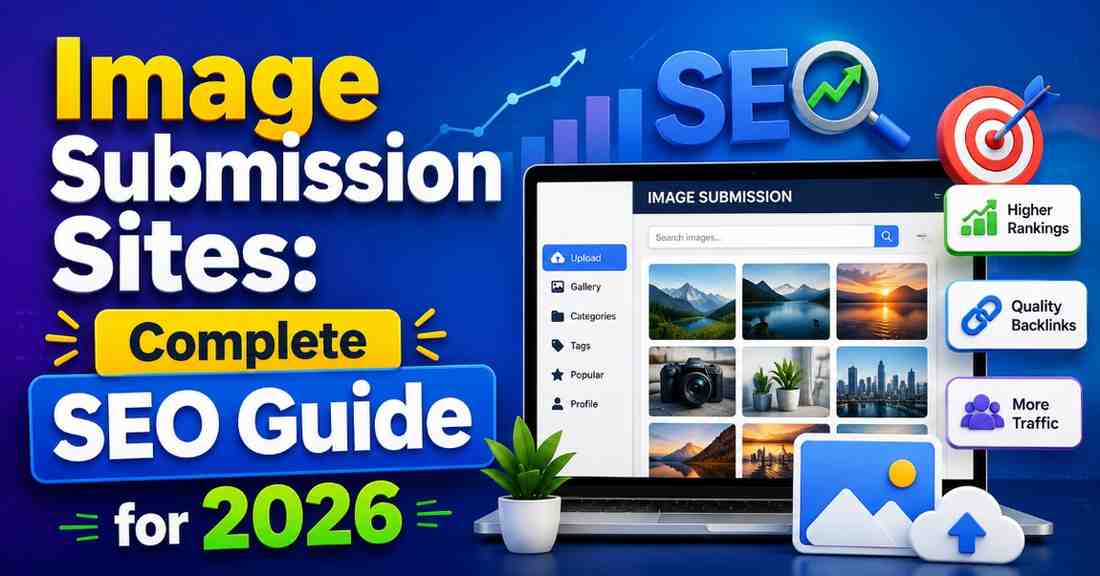
Introduction
If you're looking for an effective off-page SEO strategy that improves brand visibility, attracts quality backlinks, and drives long-term organic traffic, image submission sites deserve a place in your digital marketing strategy.
Many website owners focus only on traditional link-building methods such as blog outreach and guest posting sites. While those techniques remain valuable, image sharing has become increasingly important because search engines now prioritize visual content more than ever before.
When you upload properly optimized images to trusted platforms, you create additional opportunities for users to discover your brand through Google Images, visual search, and referral traffic. Over time, this contributes to stronger brand awareness, improved website authority, and a more diversified backlink profile.
Whether you're a blogger, SEO professional, business owner, freelancer, or digital marketer, understanding how image submission works can give you a competitive advantage in today's search landscape.
In this guide, you'll learn everything you need to know about image submission—from its SEO benefits and optimization techniques to expert strategies that can help improve your website's online visibility in 2026.
Quick Answer: What Are Image Submission Sites?
Image submission sites are online platforms where individuals and businesses upload images, infographics, illustrations, and other visual content to improve online visibility, earn backlinks, increase brand awareness, and drive referral traffic. By adding optimized titles, descriptions, tags, and website links, these platforms help search engines understand your content and improve its discoverability.
What Are Image Submission Sites?
Image submission sites are websites where users can upload and share visual content with a broader audience. These platforms allow businesses, bloggers, photographers, designers, and marketers to showcase images while improving their online presence.
Unlike social media platforms that focus on user interaction, image-sharing websites are specifically designed to organize and distribute visual content. Search engines frequently crawl these platforms, allowing optimized images to appear in Google Images and other visual search results.
These websites support different types of visual content, including:
Original photographs
Infographics
Product images
Educational graphics
Business illustrations
Portfolio designs
Creative artwork
Most platforms also allow users to add valuable SEO elements such as:
Image title
Description
Tags
Categories
Website URL
Profile information
When these elements are optimized correctly, they help search engines better understand your content and improve its visibility.
Some of the most popular image-sharing platforms include:
Pinterest
Flickr
Imgur
Behance
Dribbble
DeviantArt
500px
Each platform has a unique audience, so choosing the right one depends on your niche and marketing objectives.
Why Are Image Submission Sites Important for SEO?
Search engines have evolved significantly over the years. Today, they evaluate much more than written content. Images, videos, and other multimedia assets now play an essential role in how websites are discovered and ranked.
Visual search continues to grow as users increasingly search with images instead of text. This makes image optimization more important than ever.
Uploading optimized visuals to trusted platforms helps search engines:
Discover your content faster
Improve brand recognition
Generate additional referral traffic
Increase image search visibility
Build a diversified backlink profile
Strengthen your overall digital presence
Image submission should not be viewed as a replacement for other SEO strategies. Instead, it works best alongside content marketing, social media promotion, quality backlink building, and free guest posting sites to create a balanced off-page SEO strategy.
Benefits of Image Submission Sites
Using image submission sites consistently offers several long-term advantages for SEO, branding, and online visibility.
1. Build a Stronger Backlink Profile
Many image-sharing platforms allow you to include your website URL within your profile or image description.
Although many of these links are nofollow, they still contribute to a natural backlink profile and can generate valuable referral traffic. A diversified backlink profile is generally healthier than relying on only one type of link-building strategy.
2. Increase Brand Awareness
Visual content is easier to remember than plain text.
Publishing high-quality branded images across multiple platforms helps users recognize your business and builds trust over time.
Consistent branding also increases the chances of users searching for your business directly.
3. Drive Referral Traffic
Every optimized image creates another opportunity for users to discover your website.
A useful infographic, educational graphic, or product image often encourages users to click through to your website for additional information.
This referral traffic can lead to better engagement and higher conversions.
4. Improve Google Image Search Visibility
Google Images has become an important source of organic traffic.
Optimized images have a greater chance of appearing in image search results when they include:
Descriptive file names
Relevant titles
Informative descriptions
Natural keywords
Optimized file sizes
These simple improvements help search engines understand your content and display it to relevant users.
5. Strengthen Your Overall Off-Page SEO Strategy
Image submission works best when combined with other proven SEO techniques.
For example, many marketers publish a detailed blog post, create an infographic from the content, upload it to image-sharing platforms, and then promote the same article through guest posting sites free.
This strategy increases visibility across multiple channels while supporting long-term SEO growth.
6. Build Long-Term Authority
Unlike short-lived social media posts, optimized images published on reputable platforms can continue generating traffic for months or even years.
Evergreen visuals such as tutorials, educational infographics, comparison graphics, and process diagrams remain valuable long after they are published.
How Do Image Submission Sites Improve Search Engine Rankings?
Many beginners assume that image submission sites directly increase Google rankings. While that's not entirely true, they contribute to several important SEO signals that help improve your website's overall performance.
When you consistently upload optimized images to reputable platforms, you create additional opportunities for search engines to discover your content and understand your brand.
Here are the primary ways image submission supports SEO.
1. Improves Online Visibility
Every image you upload becomes another digital asset representing your brand.
If your visuals are optimized with descriptive titles, filenames, and relevant keywords, they can appear in Google Images and other visual search engines. This increases your chances of attracting users who may never have found your website through traditional search results.
2. Generates Referral Traffic
One of the biggest advantages of image-sharing platforms is referral traffic.
When users find your infographic, product image, or educational graphic interesting, they often click the attached website link to learn more.
Unlike random visitors, these users are usually interested in your topic, making them highly relevant traffic.
3. Creates a Diverse Backlink Profile
Search engines prefer websites that earn backlinks from different types of sources.
Image-sharing websites help diversify your backlink profile alongside strategies like:
Content marketing
Social media promotion
Business directories
Forum participation
Guest posting sites
Although many image-sharing backlinks are nofollow, they still contribute to brand visibility and referral traffic.
4. Supports Brand Recognition
Search engines increasingly recognize brands that maintain a consistent presence across multiple platforms.
Publishing branded graphics regularly helps users remember your business and strengthens your online identity.
As brand awareness grows, users are more likely to search for your business directly—a positive signal for long-term SEO.
5. Encourages Content Sharing
High-quality visuals naturally receive more shares than plain text.
Educational infographics, comparison graphics, and step-by-step illustrations are especially popular because they simplify complex information.
The more your content is shared, the greater its reach and potential for earning natural backlinks.
How to Optimize Images Before Submission
Uploading an image without optimization limits its SEO potential.
Before publishing on image submission sites, make sure every image follows these best practices.
Use High-Quality Images
Always upload clear, professional-looking visuals.
Avoid:
Blurry images
Pixelated graphics
Poor lighting
Distorted dimensions
Instead, use:
Original photographs
Custom illustrations
Professionally designed graphics
High-quality infographics
Product images with clean backgrounds
Original visuals usually perform much better than generic stock images.
Compress Images for Faster Loading
Large image files can slow down website performance and create a poor user experience.
Compress images before uploading while maintaining quality.
Recommended formats include:
JPEG – Best for photographs
PNG – Ideal for transparent graphics
WebP – Excellent for SEO and faster loading
SVG – Perfect for logos and icons
Fast-loading images improve both user experience and search engine performance.
Rename Image Files Properly
Never upload files with names like:
IMG001.jpg
Photo123.png
Screenshot45.webp
Instead, use descriptive filenames such as:
image-submission-sites-guide.jpg
seo-image-optimization.webp
image-sharing-platforms.png
Search engines use filenames as an additional ranking signal.
🔗 Build High-Quality Backlinks
Write Descriptive Image Titles
Your title should clearly explain what the image represents.
Good example:
Best Image Submission Sites for SEO in 2026
Poor example:
Image1
A descriptive title improves both user understanding and search engine indexing.
Add Helpful Image Descriptions
A good description provides context instead of repeating keywords.
For example:
"This infographic explains how image submission sites improve SEO, build backlinks, increase referral traffic, and strengthen online visibility through optimized visual content."
Keep descriptions natural, informative, and easy to read.
Use Relevant Tags
Tags help platforms categorize your content.
Examples include:
SEO
Image SEO
Visual Marketing
Content Marketing
Digital Marketing
Backlinks
Off-Page SEO
Avoid adding unrelated or excessive tags, as this can reduce content relevance.
Add Your Website Link
Whenever the platform allows, include a link to a relevant page on your website.
Instead of always linking to your homepage, consider directing visitors to:
A detailed blog post
A service page
A resource guide
A product page
Deep linking improves the user experience and increases the likelihood of conversions.
Best Types of Images for Image Submission Sites
Not every image performs equally well.
The following formats consistently attract higher engagement and better referral traffic.
Infographics
Infographics combine statistics, illustrations, and concise explanations into one visual.
Because they simplify complex topics, they are among the most shared types of content online.
Educational Graphics
Educational visuals teach users something valuable.
Examples include:
SEO checklists
Step-by-step tutorials
Marketing workflows
Process diagrams
Comparison charts
These graphics often receive strong engagement because they solve specific problems.
Original Photography
Businesses in industries such as travel, fashion, healthcare, food, and real estate benefit from publishing authentic photographs instead of generic stock images.
Original images build credibility and trust.
Product Images
For eCommerce businesses, high-quality product photography is essential.
Include:
Multiple viewing angles
White or clean backgrounds
Zoomed-in product details
Lifestyle images
Professional product images improve both click-through rates and conversions.
Before-and-After Images
Transformation-based businesses can effectively showcase results using comparison images.
Popular industries include:
Fitness
Beauty
Interior design
Home renovation
Landscaping
Authenticity is essential. Avoid misleading edits or exaggerated transformations.
Common Mistakes to Avoid
Many marketers fail to achieve results because they overlook basic SEO practices.
Avoid these common mistakes when using image submission sites.
Uploading Low-Quality Images
Poor-quality visuals create a negative impression and receive less engagement.
Always prioritize quality over quantity.
Keyword Stuffing
Adding the same keyword repeatedly in titles or descriptions makes your content appear unnatural.
Write for users first and include keywords only where they fit naturally.
Ignoring Image Compression
Large image files slow loading speeds and reduce the user experience.
Compress every image before uploading.
Using Generic File Names
Search engines cannot understand filenames like:
IMG2026.jpg
Screenshot.png
Always use descriptive filenames.
Adding Irrelevant Tags
Irrelevant tags confuse both users and search engines.
Only use tags directly related to the content of the image.
Using Duplicate Images
Uploading the same image repeatedly across multiple platforms without modification provides little value.
Instead, create unique versions by:
Changing dimensions
Updating the design
Adding new information
Refreshing statistics
Forgetting Branding
Every image should subtly reinforce your brand.
Include:
Your logo
Brand colors
Website URL
Consistent typography
Strong branding improves recognition without distracting from the content.
How to Choose the Best Image Submission Sites
Not every image-sharing platform delivers the same SEO value. Choosing the right image submission sites helps you reach a relevant audience, generate quality referral traffic, and strengthen your off-page SEO efforts.
Before creating an account, consider the following factors.
Domain Authority
Choose websites with high Domain Authority (DA) and a strong reputation. Trusted platforms are crawled more frequently by search engines, giving your images a better chance of being indexed.
Relevance to Your Niche
Always submit images to platforms related to your industry.
For example:
Designers should use Behance or Dribbble.
Photographers can benefit from Flickr or 500px.
Bloggers and marketers often get great results from Pinterest.
Businesses selling products should focus on platforms that support commercial visuals.
Relevant platforms attract more targeted visitors.
Active User Community
A website with millions of active users provides better exposure than a platform with little engagement.
Look for websites where users regularly:
Save images
Share content
Comment
Follow creators
Discover new ideas
SEO Features
The best platforms allow you to add:
Image titles
Descriptions
Tags
Categories
Website links
Profile information
These features help improve discoverability and increase referral traffic.
Step-by-Step Guide to Using Image Submission Sites
Following a structured process ensures that every image contributes to your SEO strategy.
Step 1: Create a Professional Profile
Before uploading images, complete your profile with:
Business name
Company logo
Website URL
Short business description
Social media links
A complete profile builds trust and encourages users to visit your website.
Step 2: Optimize Your Image
Before uploading, make sure your image includes:
A descriptive filename
Optimized file size
High resolution
Keyword-rich title
Natural description
Relevant tags
Never upload raw images directly from your camera or design software.
Step 3: Upload to the Correct Category
Selecting the correct category helps users discover your images more easily.
For example:
Travel infographics belong in Travel.
Product photos belong in Shopping.
Marketing graphics belong in Business.
Proper categorization improves visibility.
Step 4: Add a Relevant Website Link
Whenever possible, link users to a page that provides additional value.
Examples include:
Blog posts
Service pages
Product pages
Resource guides
Avoid linking every image to your homepage.
Step 5: Track Your Results
Use tools like Google Analytics and Google Search Console to monitor:
Referral traffic
Click-through rate (CTR)
Image impressions
Organic traffic
User engagement
Review your performance monthly and improve your strategy based on the results.
Advanced SEO Strategies for Better Results
Once you understand the basics, these advanced strategies can maximize your results.
Repurpose Existing Content
Instead of creating new content every time, transform existing blog posts into visuals.
For example:
Turn a blog into an infographic.
Create quote graphics.
Design comparison charts.
Build visual checklists.
Convert statistics into graphics.
Repurposing content saves time while increasing content reach.
Focus on Evergreen Content
Evergreen images continue attracting visitors long after publication.
Examples include:
SEO checklists
Website optimization guides
Marketing funnels
Business templates
Beginner tutorials
Unlike trending topics, evergreen visuals remain valuable for years.
Maintain Consistent Branding
Every image should reflect your brand identity.
Include:
Brand colors
Professional typography
Small logo
Website URL
Subtle branding improves recognition without distracting from the content.
Create Original Visuals
Original content consistently performs better than duplicated graphics.
Instead of downloading stock images, create:
Custom illustrations
Original infographics
Product photography
Educational diagrams
Comparison graphics
Unique visuals are more likely to earn backlinks and shares.
Best Practices for Image Submission Sites in 2026
To stay competitive, follow these proven best practices.
Publish High-Quality Images
Always prioritize quality over quantity.
A few useful images will generate better results than hundreds of low-quality uploads.
Optimize for Mobile Users
Most users browse image-sharing platforms using smartphones.
Ensure your images:
Load quickly
Use readable fonts
Have clear layouts
Display correctly on smaller screens
Update Older Visual Content
Refresh your existing graphics by:
Updating statistics
Improving the design
Adding new information
Replacing outdated screenshots
Updated visuals often perform better than creating entirely new ones.
Be Consistent
Publish images regularly instead of uploading hundreds at once.
A consistent schedule helps build authority and keeps your brand visible.
Measuring Your Success
Monitor these important SEO metrics after using image submission platforms.
Organic traffic
Referral traffic
Backlink growth
Google Image impressions
Keyword rankings
Click-through rate (CTR)
User engagement
Brand searches
Tracking these metrics helps identify which platforms produce the best ROI.
Conclusion
Image submission sites continue to be one of the most effective off-page SEO techniques for improving online visibility, generating referral traffic, and building a stronger backlink profile. When combined with quality content, proper image optimization, and consistent publishing, they can deliver long-term SEO benefits.
However, image submission should not be your only strategy. Combine it with content marketing, social media promotion, and guest posting sites free to create a balanced and sustainable SEO approach.
Remember, success doesn't come from uploading the most images—it comes from publishing visuals that educate, solve problems, and provide genuine value to your audience.
🌟 Discover Better SEO Techniques
If you start optimizing your images today and share them on trusted platforms consistently, you'll build stronger authority, improve your search visibility, and create new opportunities for organic growth.
Frequently Asked Questions (FAQs)
1. What are image submission sites?
Image submission sites are online platforms where users upload and share images, infographics, and other visual content to improve online visibility, generate backlinks, and attract referral traffic.
2. Are image submission sites good for SEO?
Yes. They support off-page SEO by improving image visibility, increasing referral traffic, strengthening brand awareness, and creating a diversified backlink profile.
3. Are image submission backlinks dofollow?
It depends on the platform. Some websites offer dofollow backlinks, while others provide nofollow links. Both can contribute to a healthy SEO strategy.
4. Which image format is best for SEO?
JPEG for photographs
PNG for transparent graphics
WebP for fast-loading web images
SVG for logos and icons
5. How many image submission sites should I use?
Focus on quality instead of quantity. Submitting images to 10–20 reputable platforms regularly is generally more effective than using hundreds of low-quality websites.
6. Can image submission increase website traffic?
Yes. Optimized images can appear in Google Images and drive targeted referral traffic from image-sharing platforms.
7. Is image submission still effective in 2026?
Absolutely. As visual search continues to grow, image optimization remains an important part of a complete SEO strategy.

Getting your website to rank on Google has become more challenging than ever. Search engines now prioritize websites that demonstrate Experience, Expertise, Authoritativeness, and Trustworthiness (E-E-A-T) rather than those that simply build thousands of backlinks.
This is where forum submission sites continue to play an important role.
Many marketers believe forum submission is outdated. In reality, that's only true if it's done incorrectly. When used strategically, forum submission helps you connect with your target audience, answer real questions, build brand authority, generate referral traffic, and earn natural backlinks that support your overall SEO strategy.
Whether you're a blogger, business owner, freelancer, affiliate marketer, or SEO professional, participating in relevant forums can create long-term value for your website.
In this comprehensive guide, you'll learn everything about forum submission sites, how they work, their SEO benefits, best practices, common mistakes to avoid, and why combining them with guest posting sites can significantly improve your off-page SEO performance.
What Are Forum Submission Sites?
Forum submission sites are online discussion communities where people ask questions, share experiences, solve problems, and participate in conversations around specific topics or industries.
Instead of publishing blog posts, users contribute by replying to discussions, asking questions, and providing valuable insights. Businesses and marketers use these communities to establish credibility, interact with potential customers, and, when appropriate, share relevant website links.
Unlike traditional link-building techniques, forum submission focuses on building trust before promoting a website.
Examples of Popular Forum Submission Sites
Reddit
Quora
Digital Point Forum
Warrior Forum
Stack Overflow
SitePoint Forums
Spiceworks Community
Joomla Forum
Moz Community
XDA Developers
Each platform serves a different audience, making it essential to participate in communities relevant to your niche.
Featured Snippet:
Forum submission sites are online discussion platforms where individuals and businesses participate in conversations, answer questions, share knowledge, and build authority while generating referral traffic and natural backlinks.
Why Forum Submission Still Matters in SEO (2026)
Many SEO professionals stopped using forums because they associated them with spammy backlinks.
However, Google's algorithms have changed dramatically over the years.
Today, Google rewards helpful content and genuine engagement rather than manipulative link-building practices.
When you consistently provide useful answers in relevant communities, you gain several long-term SEO benefits.
Forum Submission Helps You:
Reach people actively searching for solutions.
Increase brand awareness.
Generate highly targeted referral traffic.
Build trust within your industry.
Diversify your backlink profile.
Strengthen your website's E-E-A-T signals.
Discover content ideas directly from your audience.
Instead of viewing forum submission as a backlink strategy, think of it as a community-building strategy that naturally supports SEO.
Why Google Still Values Community Discussions
Over the last few years, Google has increasingly displayed discussions from platforms like Reddit and Quora in search results.
This shift reflects a growing preference for authentic, experience-based content created by real users.
Community discussions often provide:
Practical advice
Real-life experiences
Honest product reviews
Troubleshooting solutions
Expert recommendations
As a result, participating in quality forums can indirectly improve your website's visibility while helping users find trustworthy information.
Top Benefits of Forum Submission Sites
1. Generate Highly Targeted Traffic
One of the biggest advantages of forum submission sites is that visitors already have a specific problem they want to solve.
Unlike social media traffic, forum visitors usually have higher intent.
For example:
If someone asks,
"How can I improve my website's local SEO?"
and you provide a detailed answer with a helpful resource from your website, the chances of receiving qualified visitors are significantly higher.
These visitors are more likely to:
Read your content
Subscribe to your newsletter
Contact your business
Purchase your services
2. Build Brand Authority
People trust professionals who consistently help others.
When you regularly contribute valuable answers instead of promotional messages, your reputation grows naturally.
Over time, community members begin recognizing your expertise.
This often leads to:
More profile visits
Increased website traffic
Brand mentions
Partnership opportunities
Better customer trust
Authority isn't built overnight—it grows through consistent value.
3. Create a Natural Backlink Profile
A healthy backlink profile includes links from multiple sources.
This may include:
Editorial backlinks
Business directories
Social media
Guest posting sites
Profile creation sites
Forum submission sites
Although many forum links are nofollow, they still contribute by:
Driving referral traffic
Increasing brand exposure
Supporting link diversity
Helping search engines discover new content
Remember, not every valuable backlink needs to pass PageRank. Referral traffic and brand visibility are equally important.
4. Improve Your E-E-A-T Signals
Google evaluates websites based on four key factors:
Experience
Expertise
Authoritativeness
Trustworthiness
Participating in industry forums allows you to demonstrate all four.
Instead of claiming you're an expert, you prove it by solving real problems.
For example, if you're an SEO consultant, answering technical SEO questions with practical examples showcases your expertise far better than promotional content.
5. Discover New Content Ideas
Forums are one of the best places for keyword research.
By reading discussions, you'll quickly discover:
Frequently asked questions
Customer pain points
Buying objections
Emerging trends
Common misconceptions
These insights can help you create blog posts that directly address your audience's needs.
A single forum thread can inspire multiple high-performing articles.
6. Build Long-Term Relationships
Forum marketing isn't just about SEO.
It's about networking.
Active participation helps you connect with:
Industry experts
Bloggers
Business owners
Developers
Journalists
Potential clients
Many collaborations begin with a simple conversation in an online community.
7. Promote New Content Naturally
After publishing a high-quality article, you can share it within relevant discussions—provided it genuinely helps answer the question being asked.
For example, instead of saying:
❌ "Visit my website for more information."
Try:
✅ "We recently published a detailed guide explaining this process step by step. It may be useful if you'd like additional examples."
This approach feels natural and adds value to the discussion.
How Forum Submission Supports Google's E-E-A-T
Google's Search Quality Guidelines emphasize content created by people with real-world knowledge and experience.
Forum participation naturally aligns with these principles.
Experience
Share real case studies, experiments, or lessons learned from your own projects.
For example:
"After participating in niche marketing forums for six months, our referral traffic increased by 28%, and we earned collaborations with three industry blogs."
Real experiences build credibility.
Expertise
Instead of giving generic advice, explain why a strategy works.
Include:
Examples
Data
Step-by-step explanations
Practical recommendations
Users appreciate detailed answers backed by experience.
Authoritativeness
As you consistently contribute valuable insights, other members begin recognizing your expertise.
This increases:
Profile authority
Brand reputation
Mentions
Referral traffic
Authority is earned—not claimed.
Trustworthiness
Trust comes from honesty.
Always:
Cite reliable sources.
Avoid exaggerated claims.
Be transparent about your experiences.
Recommend solutions based on actual results.
Communities reward authenticity.
How to Do Forum Submission (Step-by-Step)
Forum submission is simple—but doing it effectively requires a strategic approach.
Step 1: Find Relevant Forum Submission Sites
Avoid joining random forums just for backlinks.
Instead, choose communities closely related to your industry.
Examples:
Digital Marketing: SEO & Marketing Forums
Technology: Developer Communities
Finance: Investment Forums
Health: Medical Communities
Education: Learning Forums
Travel: Travel Communities
Relevance matters more than domain authority.
Step 2: Create a Professional Profile
Before posting, optimize your profile.
Include:
Professional profile photo
Real name
Short biography
Website URL
Social media profiles (if allowed)
Area of expertise
A complete profile builds trust and increases the likelihood that users will visit your website.
📊 Strengthen Your SEO Foundation
Step 3: Read Community Guidelines
Every forum has its own rules regarding promotions, signatures, and external links.
Violating these guidelines may result in:
Deleted posts
Account suspension
Permanent bans
Always understand the rules before participating.
Step 4: Spend Time Observing
Don't start posting immediately.
Instead:
Read popular discussions.
Understand the community culture.
Identify frequently asked questions.
Notice how experienced members respond.
This helps you create answers that fit naturally within the community.
Best Practices for Forum Submission Sites
Joining a forum is easy, but getting real SEO value requires a thoughtful approach. The following best practices will help you build authority, earn referral traffic, and create a sustainable off-page SEO strategy.
1. Choose Niche-Relevant Forums
Relevance is more important than Domain Authority (DA).
For example:
An SEO agency should participate in Digital Point or Warrior Forum.
A software company should focus on Stack Overflow or GitHub Discussions.
A travel blogger should join travel communities instead of general discussion boards.
The more relevant the audience, the higher the quality of your traffic.
2. Provide Value Before Sharing Links
A common mistake is dropping website links in every reply.
Instead:
Read the complete question.
Provide a detailed solution.
Add examples where possible.
Share a link only if it genuinely helps the reader.
Google and forum moderators reward helpful contributors—not marketers.
3. Write Detailed and Original Replies
Avoid one-line responses like:
❌ "Great post!"
Instead, write:
Actionable advice
Step-by-step explanations
Personal experiences
Case studies
Helpful resources
Longer, high-quality answers often receive more engagement.
4. Be Consistent
Forum marketing is a long-term strategy.
Instead of posting 100 replies in one day, aim for:
3–5 quality posts per week
Active discussions
Regular profile updates
Consistent engagement
5. Track Referral Traffic
Use tools like:
Google Analytics 4
Google Search Console
UTM Parameters
Monitor:
Referral visitors
Session duration
Bounce rate
Conversions
This helps identify which forum submission sites deliver the best ROI.
Common Mistakes to Avoid
Many websites fail with forum marketing because they focus only on backlinks.
Avoid these mistakes:
Posting Spam Links
Forums are communities—not backlink directories.
Always contribute first.
Keyword Stuffing
Don't force your target keyword repeatedly.
Instead of writing:
"Forum submission sites are the best forum submission sites..."
Use natural variations such as:
discussion forums
niche forums
online communities
SEO forums
Copy-Pasting Replies
Each discussion deserves a unique answer.
Duplicate responses damage credibility and may get your account suspended.
Ignoring Community Rules
Some forums prohibit promotional links.
Always read the posting guidelines before contributing.
Joining Low-Quality Forums
Stay away from:
inactive forums
spam-filled communities
forums with no moderation
Quality is always more valuable than quantity.
Forum Submission Sites vs Guest Posting Sites
Both are powerful off-page SEO techniques, but they serve different purposes.
Forum Submission Sites
Participate in discussions.
Builds community trust.
Generates referral traffic.
Faster engagement.
Usually provides nofollow links.
Guest Posting Sites
Publish full articles.
Builds brand authority.
Earns editorial backlinks.
Offers long-term SEO value.
Often provides dofollow links.
Which One Should You Choose?
The best SEO strategy combines both.
Use forum submission sites to:
Build relationships
Generate referral traffic
Understand your audience
Use guest posting sites to:
Earn high-authority backlinks
Improve domain authority
Increase brand visibility
Together, these strategies create a balanced and natural backlink profile.
150+ Free Forum Submission Sites List
Below are some of the most trusted free forum submission sites across different industries.
General Discussion Forums
Reddit
Quora
Digital Point Forum
Warrior Forum
Forumotion Community
ProBoards Community
Zetaboards Archive
Tapatalk Community
Delphi Forums
The Student Room
City-Data Forum
Something Awful Forums
NeoGAF
ResetEra
Offtopic Community
Community Forum
Discourse Meta
Forum Promotion
Create Forums Community
ForumJar
SEO & Digital Marketing Forums
Moz Community
Webmaster Sun
BlackHatWorld
Search Engine Roundtable
SEO Chat Forum
AffiliateFix
Wicked Fire
Warrior Forum SEO
Traffic Planet
V7N Webmaster Forum
Web Hosting Talk SEO
Affiliate World Forum
SEO Mastering
GrowthHackers Community
WebmasterWorld
SitePoint Marketing Forum
HubSpot Community
Ahrefs Community
Semrush Community
Content Marketing Institute Community
Web Development & Programming Forums
Stack Overflow
SitePoint Forums
DaniWeb
CodeProject
Coderanch
Dev Community
GitHub Community
XDA Developers
LinuxQuestions
Oracle Community
Microsoft Learn Community
Adobe Community
Joomla Forum
WordPress Support
Drupal Community
Laravel Community
PHPBuilder
CodeGuru
Mozilla Developer Community
Eclipse Community
Technology & IT Forums
Spiceworks Community
CNET Forums
TechRepublic Forums
Tom's Hardware Forums
Geekzone
Apple Support Community
VMware Community
Cisco Community
Dell Community
HP Support Community
Lenovo Community
Intel Community
ASUS Community
Acer Community
Samsung Community
Synology Community
Raspberry Pi Forums
Ubuntu Community
Android Central Forums
Microsoft Answers
Business & Finance Forums
Bogleheads Forum
Elite Trader
Trade2Win
MoneySavingExpert Forum
Wall Street Oasis
InvestorsHub
BiggerPockets
AccountingWEB Community
QuickBooks Community
Forex Factory
BabyPips Forum
Warrior Trading Community
ValuePickr
Stockaholics
Investing Community
Health & Medical Forums
Patient info Forums
MedHelp
HealthUnlocked
Mayo Clinic Connect
Inspire Community
Diabetes Daily Forum
Cancer Survivors Network
Mental Health Forum
Patient Power Community
DailyStrength
WebMD Community
Arthritis Foundation Community
Pregnancy Forum
HealthBoards
HealingWell
Education & Learning Forums
The Student Room
Physics Forums
College Confidential
The GradCafe
ResearchGate Community
Coursera Community
edX Community
Khan Academy Community
Duolingo Forum
FutureLearn Community
Travel Forums
TripAdvisor Forums
Lonely Planet Thorn Tree
FlyerTalk
Cruise Critic
Rick Steves Travel Forum
Travellerspoint Forum
IndiaMike
VirtualTourist Community
Fodor's Travel Talk
Travel Fish Forum
Gaming Forums
IGN Boards
Steam Community
GameFAQs
NeoGAF
ResetEra
Minecraft Forum
Blizzard Forums
Xbox Forums
PlayStation Community
Nintendo Support Community
Design & Creative Forums
Behance Community
Dribbble Community
Adobe Community
CorelDRAW Community
Blender Artists
CGSociety
DeviantArt Community
SketchUp Community
Affinity Forum
Figma Community
E-commerce & Blogging Forums
Shopify Community
WooCommerce Community
PrestaShop Forum
Magento Forums
OpenCart Community
BigCommerce Community
Blogger Forum
Medium Community
Etsy Community
eBay Community
Expert Tip: Don't join all these forums at once. Select 5–10 highly relevant communities and become an active member before expanding to others.
Expert Tips to Maximize Results from Forum Submission Sites
Focus on Solving Problems
People don't visit forums to see advertisements—they come looking for solutions.
Always ask yourself:
"Does my reply genuinely help the person asking the question?"
If the answer is yes, your contribution is valuable.
Use Your Real Identity
Profiles with a real name, professional photo, and complete bio receive significantly more engagement than anonymous accounts.
A trustworthy profile also improves your brand image.
Build Relationships, Not Just Backlinks
Forum marketing is about networking.
Engage with:
Industry experts
Bloggers
Business owners
Developers
Potential customers
Many business opportunities begin through meaningful conversations.
Repurpose Your Best Content
Turn existing content into valuable forum replies.
Examples:
Blog posts
Case studies
Research findings
Tutorials
Checklists
This saves time while ensuring consistency across your content marketing efforts.
Diversify Your Off-Page SEO Strategy
Don't rely solely on forum backlinks.
Combine forum submission with:
Guest posting
Business listings
Social bookmarking
Profile creation
Digital PR
Content marketing
A diverse backlink profile looks more natural to search engines and reduces dependency on any single tactic.
SEO Statistics That Show Why Forum Submission Still Works
Although forum backlinks alone won't guarantee higher rankings, community participation continues to support SEO in several ways.
Here are some industry insights:
More than 68% of online experiences begin with a search engine, making organic visibility a top priority for businesses.
Google increasingly ranks community-driven platforms like Reddit and Quora for informational queries because users value real experiences.
High-quality referral traffic generally has better engagement than untargeted visitors because users already have a specific problem they're trying to solve.
Diversifying your backlink profile with forums, guest posts, business listings, and editorial links creates a more natural off-page SEO strategy.
Pro Tip: Treat forum submission as a branding and community-building strategy rather than just a backlink-building tactic.
Forum Submission Checklist
Before submitting links to any forum, make sure you can answer Yes to the following questions:
Is the forum active?
Is it relevant to my niche?
Did I read the community guidelines?
Am I answering the user's question completely?
Is my reply original?
Does my website link genuinely add value?
Would I post this answer even without including my website link?
If your answer is Yes to all the above, you're following a sustainable forum marketing strategy.
Final Thoughts
Many marketers ignore forum submission sites because they believe the strategy no longer works. In reality, the problem isn't the strategy—it's the execution.
Modern SEO is built on helping users, sharing real experiences, and earning trust over time. By participating in relevant discussions, answering questions thoughtfully, and contributing genuine value, you can establish yourself as an authority while attracting highly targeted visitors to your website.
Remember, forum submission should never replace other off-page SEO techniques. Instead, it should complement a broader digital marketing strategy that includes content marketing, guest posting sites, business listings, technical SEO, and link earning.
Success doesn't come from posting hundreds of links. It comes from consistently helping people and building meaningful relationships within your industry.
Frequently Asked Questions (People Also Ask)
1. What are forum submission sites?
Forum submission sites are online discussion communities where users ask questions, share knowledge, and discuss industry-related topics. Businesses participate in these communities to build authority, generate referral traffic, and support their off-page SEO efforts.
2. Are free forum submission sites good for SEO?
Yes. Free forum submission sites can improve brand visibility, drive targeted traffic, and diversify your backlink profile. While many forum links are nofollow, they still contribute to a healthy SEO strategy when combined with valuable content.
3. Do forum backlinks improve Google rankings?
Forum backlinks alone rarely improve rankings significantly. However, they help create a natural backlink profile, increase brand mentions, and attract referral traffic, which indirectly supports long-term SEO performance.
4. How many forum submissions should I make each week?
Focus on quality instead of quantity.
A good target is:
3–5 meaningful discussions each week
Detailed, helpful responses
Consistent engagement
Avoid automated or spammy posting.
5. Which are the best free forum submission sites?
Some of the most trusted platforms include:
Reddit
Quora
Digital Point Forum
Warrior Forum
Stack Overflow
SitePoint Forums
Moz Community
XDA Developers
Choose communities that are relevant to your niche rather than joining every available forum.
6. Is forum submission better than guest posting?
Both strategies serve different purposes.
Forum submission sites help you engage with your audience, answer questions, and generate referral traffic.
Guest posting sites help you publish authoritative articles and earn editorial backlinks.
For the best results, use both strategies together.
7. Are forum backlinks safe?
Yes, when they are earned naturally.
Avoid:
Spam comments
Automated submissions
Irrelevant discussions
Keyword stuffing
Natural participation is considered safe and sustainable.
8. How do I find niche forum submission sites?
You can search Google using queries such as:
"SEO forum"
"digital marketing discussion forum"
"technology community"
"fitness forum"
"travel discussion board"
Look for active communities with genuine discussions and regular moderation.
9. Can beginners use forum submission for SEO?
Absolutely.
Start by:
Creating a complete profile
Reading community guidelines
Answering questions
Sharing your experience
Adding website links only when they provide additional value
Consistency matters more than experience.
Intro
In today's competitive digital landscape, building a strong online presence requires more than simply publishing content on your website. Businesses, bloggers, and digital marketers need effective off-page SEO strategies that help increase search engine rankings, drive targeted traffic, and establish credibility. One of the most effective methods that continues to deliver long-term results is using article submission sites.
Although SEO has changed significantly over the years, article submission remains a valuable content marketing technique when used correctly. Instead of submitting the same article to hundreds of low-quality directories, modern SEO focuses on publishing unique, informative, and reader-focused content on reputable article submission platforms. When combined with publishing content on guest posting sites, this approach helps websites earn quality backlinks, improve brand awareness, strengthen domain authority, and reach new audiences without relying on paid advertising.
Many website owners assume that article submission is an outdated SEO tactic. However, the truth is that search engines still value high-quality content published on trusted websites. When your articles genuinely help readers and provide useful information, they can generate referral traffic, improve topical authority, and strengthen your website's overall SEO performance.
Our experience with off-page SEO campaigns has shown that article submission works best when it is part of a broader content marketing strategy. Combining article submissions with guest posting, link building, and valuable on-site content creates a balanced SEO approach that delivers sustainable results over time.
Whether you're a beginner learning SEO or an experienced marketer looking to expand your backlink profile, understanding how to use article submission sites correctly can help you build authority while connecting with a larger audience.
In this complete guide, you'll learn what article submission sites are, why they matter for SEO, their key benefits, how they improve search engine rankings, and the best practices for achieving long-term success.
What Are Article Submission Sites?
Article submission sites are online publishing platforms where individuals, bloggers, businesses, and digital marketers can submit original articles to share their knowledge with a wider audience. These websites allow authors to publish informative, educational, or industry-related content while often providing an opportunity to include a link back to their own website.
Unlike publishing content only on your own blog, article submission introduces your expertise to readers who may have never visited your website before. This not only increases your brand's visibility but also creates opportunities to generate referral traffic and build trust within your niche.
Today's reputable article submission sites focus on quality rather than quantity. Most platforms review submitted content to ensure it is original, informative, and valuable to readers. As a result, publishing well-written articles on trusted websites can positively influence your overall content marketing strategy.
Some of the most popular article submission platforms include:
Medium
LinkedIn Articles
HubPages
EzineArticles
Sooper Articles
ArticleCube
SelfGrowth
Blogger
Wordpress
Vocal Media
Rather than using article submission solely for backlinks, businesses now use these platforms to educate their audience, demonstrate expertise, and establish themselves as trusted voices within their industries.
Why Are Article Submission Sites Important for SEO?
Many people wonder whether article submission sites are still effective after Google's frequent algorithm updates. The answer is yes—when they are used correctly.
📈 Start Article Submission Today
Search engines have become much smarter over the years. Instead of rewarding websites that build hundreds of low-quality backlinks, Google now prioritizes websites that earn natural links through valuable content. This is where article submission becomes useful.
Publishing informative articles on authoritative websites can support your SEO strategy in several ways.
1. Build High-Quality Backlinks
One of the biggest advantages of article submission is the opportunity to earn contextual backlinks from reputable websites. Quality backlinks remain one of Google's strongest ranking signals because they indicate that other websites trust your content.
Instead of focusing on the number of backlinks, prioritize earning links from relevant, authoritative platforms with strong editorial standards.
2. Increase Organic Traffic
Many article submission websites receive thousands of visitors every day. If your article provides valuable information and targets the right keywords, it can rank in search engine results and attract readers who are genuinely interested in your topic.
These readers may visit your website through your author profile or contextual links, generating highly targeted referral traffic.
3. Improve Brand Awareness
Publishing consistently across trusted article submission sites helps introduce your business to a wider audience. Even if readers don't immediately visit your website, they begin recognizing your brand and associating it with helpful, informative content.
Over time, this repeated exposure builds familiarity and trust, making your brand more memorable.
4. Strengthen Topical Authority
Google rewards websites that consistently publish high-quality content around a specific subject. By sharing informative articles related to your niche, you demonstrate expertise and reinforce your authority within your industry.
This aligns with Google's E-E-A-T (Experience, Expertise, Authoritativeness, and Trustworthiness) guidelines, which emphasize publishing reliable and experience-based content.
5. Faster Content Discovery
High-authority publishing platforms are crawled frequently by search engines. Publishing content on these websites increases the likelihood that your articles will be indexed quickly, allowing them to appear in search results sooner.
6. Support Your Overall Content Marketing Strategy
Article submission should never be viewed as an isolated SEO tactic. Instead, it works best when combined with other strategies such as:
Guest posting
Content marketing
Social media promotion
Internal linking
Digital PR
Link-building campaigns
When these techniques work together, they create a stronger online presence and improve your website's long-term search performance.
Benefits of Using Article Submission Sites
Using reputable article submission sites offers several long-term benefits beyond simply acquiring backlinks.
Build a Strong Backlink Profile
Publishing valuable content on authoritative websites helps you earn relevant backlinks that support your website's SEO performance.
Increase Referral Traffic
Readers who find your articles useful are more likely to visit your website to explore additional resources, products, or services.
Expand Your Audience
Article submission allows you to reach readers outside your existing customer base, increasing your brand's visibility across different platforms.
Improve Search Engine Visibility
High-quality content targeting relevant keywords can appear in search results, generating consistent organic traffic over time.
Establish Industry Credibility
Regularly publishing educational and informative articles demonstrates your expertise, helping you become a trusted source within your niche.
Support Long-Term SEO Growth
Unlike paid advertising, quality articles can continue attracting visitors and generating backlinks for months or even years after publication.
Cost-Effective Marketing
Many reputable article submission sites allow free publishing, making them an affordable strategy for businesses looking to expand their digital presence without a large marketing budget.
Generate Qualified Leads
Readers who engage with educational content are often genuinely interested in your products or services, resulting in higher-quality leads compared to untargeted traffic.
Best Article Submission Sites
Choosing the right article submission sites is more important than submitting your content to dozens of random directories. Search engines value quality over quantity, so publishing original articles on reputable platforms can help improve your website's authority, referral traffic, and online visibility.
Below are some of the best article submission sites that are trusted by marketers, bloggers, businesses, and content creators.
1. Medium
Medium is one of the world's most popular publishing platforms, known for its clean design and massive reader base. It allows anyone to publish high-quality articles across various topics, including technology, business, marketing, education, and lifestyle.
Although Medium generally uses nofollow links, it is still an excellent platform for building brand awareness, increasing referral traffic, and showcasing your expertise. Well-written articles can also rank in Google search results, giving your content additional visibility.
2. LinkedIn Articles
LinkedIn Articles is an excellent platform for professionals, entrepreneurs, and businesses. Publishing informative articles here helps you connect directly with industry professionals and decision-makers.
If your business targets B2B customers, LinkedIn Articles can be particularly valuable because it combines content marketing with professional networking.
3. HubPages
HubPages has been a trusted content publishing platform for many years. It allows writers to publish detailed, informative articles across multiple categories.
Articles that provide genuine value can continue attracting readers through search engines long after they are published, making HubPages an excellent source of evergreen traffic.
4. EzineArticles
EzineArticles remains one of the most recognized article submission websites. The platform follows strict editorial guidelines and accepts only original, high-quality content.
Publishing on EzineArticles can improve your credibility while helping your articles reach readers looking for educational information.
5. Sooper Articles
Sooper Articles accepts submissions in a wide variety of niches, including business, health, education, technology, finance, and digital marketing.
It offers an easy publishing process and provides another opportunity to increase your content's reach.
6. ArticleCube
ArticleCube is designed for writers and businesses looking to distribute informative articles across different industries.
Its organized categories make it easier for readers to discover relevant content while helping businesses expand their online visibility.
7. SelfGrowth
SelfGrowth specializes in personal development, business, leadership, and marketing topics.
If your content focuses on professional growth or entrepreneurship, this platform offers access to a highly targeted audience.
8. ArticlesFactory
ArticlesFactory is another free article submission platform where marketers can publish original content to increase exposure and establish authority within their niche.
9. Blogger
Blogger is Google's free blogging platform that allows users to publish unlimited articles.
Since you have complete control over your blog, Blogger is a great option for content marketing and supporting your overall SEO strategy.
10. Wordpress
wordpress enables businesses and bloggers to create free blogs and publish SEO-friendly articles with ease.
It remains one of the most widely used publishing platforms worldwide.
🎯 Rank Higher With Submissions
11. Vocal Media
Vocal Media has become increasingly popular among writers because of its active community and multiple content categories.
Publishing educational articles here can improve your online visibility and reach new readers.
12. Tumblr
Tumblr supports both short-form and long-form content.
Many businesses use Tumblr to publish informative articles, industry updates, and visual content while driving referral traffic to their websites.
13. Quora Spaces
Quora Spaces allows creators to publish detailed articles while interacting with an engaged community interested in learning and sharing knowledge.
It's particularly effective for demonstrating expertise within your niche.
14. Hashnode
Hashnode is a leading publishing platform for developers and technology professionals.
It is ideal for sharing programming tutorials, software development guides, and technical articles.
15. Dev
Dev is another popular platform for developers where users publish coding tutorials, programming tips, and software engineering insights.
Its highly active community helps quality articles receive excellent engagement.
How to Choose the Best Article Submission Sites
Not every article submission website offers the same SEO value. Before publishing your content, evaluate each platform carefully to ensure it aligns with your goals.
Check Domain Authority
Choose websites with strong domain authority and a positive reputation. Higher-authority platforms generally pass more trust and attract larger audiences.
Review Organic Traffic
A platform that receives consistent organic traffic provides greater opportunities for your articles to be discovered by new readers.
Examine Editorial Standards
Reputable article submission sites review content before publication and reject low-quality or duplicate articles. Strong editorial guidelines are often a sign of a trustworthy platform.
Analyze Spam Score
Avoid websites filled with spammy or low-quality content. Publishing on poor-quality directories can negatively impact your SEO efforts.
Consider Niche Relevance
Whenever possible, choose article submission sites related to your industry. Relevant platforms help attract the right audience and provide more valuable backlinks.
Evaluate User Engagement
Look for websites where readers actively comment, share, and engage with published articles. Higher engagement increases the chances of your content being noticed.
Free vs Paid Article Submission Sites
Both free and paid article submission platforms have their own advantages. Understanding the difference helps you choose the right option for your marketing strategy.
Free Article Submission Sites
Free platforms allow anyone to publish articles without paying a fee. They are ideal for beginners, bloggers, startups, and small businesses with limited budgets.
Benefits
No publishing cost
Easy account creation
Suitable for building brand awareness
Great for content distribution
Helpful for generating referral traffic
Limitations
High competition
Slower editorial approval
Limited customization
Some platforms only provide nofollow backlinks
Paid Article Submission Sites
Paid platforms often provide premium publishing opportunities, editorial assistance, wider promotion, and access to more targeted audiences.
Benefits
Higher-quality audience
Better editorial review
Faster approval process
Increased exposure
Additional promotional features
Limitations
Monthly or one-time publishing fees
May not suit every budget
ROI depends on content quality
For most businesses, starting with reputable free article submission sites and later investing in premium opportunities offers the best balance between cost and results.
DoFollow vs NoFollow Article Submission Sites
Understanding the difference between DoFollow and NoFollow backlinks is essential for building a natural SEO profile.
DoFollow Links
DoFollow links allow search engines to pass authority (often called "link equity") from the publishing website to your website. These backlinks can contribute to improved search engine rankings when they come from authoritative and relevant sources.
Advantages
Support SEO rankings
Transfer link authority
Strengthen backlink profile
Improve domain authority over time
NoFollow Links
NoFollow links include an attribute that tells search engines not to pass ranking authority directly. However, they still provide significant value by driving referral traffic, increasing brand exposure, and creating a natural-looking backlink profile.
Advantages
Generate targeted visitors
Improve brand visibility
Create a balanced backlink profile
Reduce the risk of unnatural link patterns
Which One Should You Choose?
A successful SEO strategy includes a healthy mix of both DoFollow and NoFollow backlinks. Focusing only on DoFollow links can make your backlink profile appear unnatural, while combining both types helps create a more balanced and trustworthy link profile.
The ultimate goal should always be publishing high-quality, informative content that readers find valuable, regardless of the backlink type.
Best Practices for Article Submission
Publishing content on article submission sites is only effective when you follow the right strategy. Simply submitting articles to multiple platforms without considering quality or SEO guidelines will not produce lasting results. Search engines now prioritize original, informative, and user-focused content that genuinely helps readers.
Below are some proven best practices that can help you maximize the SEO benefits of article submission.
Write 100% Original Content
Original content is the foundation of successful article submission. Every article you publish should be unique, informative, and written specifically for your target audience.
Avoid copying content from your own website or other sources. Duplicate content can reduce your chances of approval and may negatively impact your SEO performance.
Instead, research your topic thoroughly and provide fresh insights, practical tips, and real-world examples that readers can benefit from.
Focus on Solving Readers' Problems
Modern SEO is no longer about stuffing keywords into articles. Search engines reward content that answers users' questions and solves their problems.
Before writing an article, ask yourself:
What problem does my audience have?
What information are they looking for?
How can I provide the best possible solution?
Creating helpful content naturally increases engagement and builds trust with readers.
Use Keywords Naturally
Your primary keyword should appear naturally throughout the article without disrupting readability.
📢 Discover Free Submission Sites
For example, if your target keyword is article submission sites, include it in:
The title
Introduction
At least one H2 heading
A few subheadings where relevant
Throughout the body content
Conclusion
FAQ section
You can also use related keywords such as:
Free article submission sites
High DA article submission sites
SEO article submission
Article directory sites
Off-page SEO
Free backlink sites
Using related keywords helps search engines better understand your content without keyword stuffing.
Write Mobile-Friendly Content
More than half of all internet users browse websites using mobile devices. Long paragraphs can discourage readers from continuing.
To improve readability:
Keep paragraphs between two and four lines.
Use descriptive headings.
Add bullet points where appropriate.
Break large sections into smaller paragraphs.
Leave enough white space between sections.
Well-formatted articles keep readers engaged and improve the overall user experience.
Add High-Quality Images
Images make articles more engaging and easier to understand.
Whenever possible, include:
Infographics
Charts
Screenshots
Illustrations
Feature images
Always use royalty-free or self-created images and optimize them with descriptive file names and alt text.
Include Relevant Backlinks
Backlinks should provide additional value rather than appearing promotional.
Instead of adding multiple links throughout your article, include one or two relevant links naturally within the content or author bio.
Quality is always more important than quantity.
Optimize Your Author Profile
Many article submission sites allow authors to create a professional profile.
A strong author bio should include:
Your name
Professional experience
Industry expertise
Business or website name
Website URL
Social media profiles
A well-written author profile helps build credibility and encourages readers to learn more about your work.
Update Your Articles Regularly
SEO is constantly evolving, and outdated information can reduce your content's value.
If the platform allows editing, update your articles by:
Adding new statistics
Refreshing outdated information
Improving formatting
Including recent SEO trends
Updating broken links
Regular updates help maintain your article's relevance and search visibility.
How to Submit Articles on Article Submission Sites
Submitting articles becomes much easier when you follow a structured process. Below is a simple step-by-step guide that beginners and experienced marketers can follow.
Step 1: Choose a Reputable Platform
Select article submission sites with good domain authority, active readers, and strict editorial standards.
Avoid low-quality websites created solely for link building.
Step 2: Research Your Topic
Identify a keyword with search demand and understand what readers are looking for.
Analyze competing articles and aim to provide more comprehensive and valuable information.
Step 3: Create High-Quality Content
Write an original article that is informative, well-structured, and easy to read.
Focus on educating readers rather than promoting your business.
Step 4: Optimize for SEO
Before publishing, ensure your article includes:
SEO-friendly title
Meta description (if supported)
Proper H2 and H3 headings
Natural keyword placement
Internal structure with bullet points
Optimized images
Step 5: Add a Relevant Backlink
Include one contextual backlink only if it adds value to readers.
Avoid excessive linking, as this may appear spammy.
Step 6: Proofread Carefully
Check for:
Grammar mistakes
Spelling errors
Broken links
Formatting issues
Readability
Publishing polished content improves professionalism.
Step 7: Submit Your Article
Follow the platform's submission guidelines and wait for editorial approval if required.
Some websites publish immediately, while others manually review submissions.
Step 8: Promote Your Content
After publication, share your article on:
LinkedIn
Facebook
X (Twitter)
Pinterest
Email newsletters
Relevant online communities
Promotion increases visibility and attracts more readers.
Step 9: Monitor Performance
Track important metrics using tools such as:
Google Analytics
Google Search Console
Ahrefs
Semrush
Monitoring performance helps you understand which articles generate the most traffic and engagement.
✅ Build Powerful SEO Backlinks
Pros and Cons of Article Submission Sites
Like every SEO strategy, article submission has both advantages and limitations.
Advantages
Helps build high-quality backlinks.
Increases referral traffic.
Improves online visibility.
Strengthens brand authority.
Supports long-term SEO growth.
Expands your audience.
Generates qualified leads.
Enhances content marketing efforts.
Builds trust with readers.
Offers a cost-effective way to promote your business.
Disadvantages
Results take time.
Some platforms provide only nofollow links.
Editorial approval may take several days.
Poor-quality websites provide little SEO value.
Requires consistent effort to achieve long-term success.
Duplicate content may lead to rejection.
Excessive promotion can reduce reader engagement.
Despite these limitations, article submission remains one of the safest and most sustainable off-page SEO techniques when quality is prioritized.
Common Mistakes to Avoid
Many marketers fail to achieve good results because they repeat the same mistakes. Avoiding these common errors can significantly improve the effectiveness of your article submission strategy.
Publishing Duplicate Content
Never submit the same article to multiple websites. Always create unique versions for each platform.
Keyword Stuffing
Adding your target keyword too frequently makes content difficult to read and may negatively affect SEO.
Write naturally and prioritize user experience.
Choosing Low-Quality Websites
Submitting articles to spammy directories can damage your website's reputation.
Focus only on reputable article submission sites with strong authority.
Writing Only for Backlinks
Readers should always come first.
Articles written solely to gain backlinks rarely perform well.
Provide genuine value instead.
Ignoring Formatting
Large blocks of text discourage readers.
Use headings, bullet points, images, and short paragraphs to improve readability.
Not Tracking Results
Without monitoring performance, you won't know which article submission sites generate the best traffic and backlinks.
Regular analysis helps refine your SEO strategy.
Advanced SEO Tips for Better Rankings
To maximize the effectiveness of article submission, follow these advanced SEO practices:
Publish consistently rather than submitting many articles at once.
Focus on topical authority by writing around a specific niche.
Target long-tail keywords with lower competition.
Build a natural mix of DoFollow and NoFollow backlinks.
Include relevant statistics and credible sources to strengthen trust.
Use compelling headlines that encourage clicks.
Add internal links to related content on your website when appropriate.
Encourage readers to share your articles on social media.
Update older articles with fresh information and examples.
Prioritize quality over quantity in every submission.
When combined with a strong content marketing strategy, these techniques can improve your search engine visibility, increase referral traffic, and establish your website as a trusted resource in your industry.
Are Free Article Submission Sites Worth It?
Many beginners in SEO wonder whether free article submission sites are still worth using in 2026. The simple answer is yes—but only when you focus on quality rather than quantity.
Years ago, marketers used automated software to submit the same article to hundreds of directories just to build backlinks. While this approach worked temporarily, search engines have become much smarter. Today, Google rewards websites that earn backlinks naturally through valuable, original, and relevant content.
Publishing a well-researched article on a trusted platform like Medium or LinkedIn is far more beneficial than submitting dozens of low-quality articles to spammy directories. Reputable article submission sites not only provide opportunities for backlinks but also expose your content to a larger audience, helping you build authority within your industry.
Free article submission platforms are especially valuable for:
New websites looking to increase online visibility.
Bloggers who want to share their expertise.
Small businesses with limited marketing budgets.
Freelancers building their personal brand.
Digital marketers expanding their off-page SEO strategy.
However, always remember that article submission should be part of a balanced SEO strategy. Combining it with guest posting, high-quality blog content, social media marketing, and natural link building will deliver much stronger long-term results.
SEO Statistics That Show the Importance of Quality Content
Modern SEO is driven by content quality, user experience, and authority rather than the number of backlinks alone. Industry research consistently highlights several important trends:
High-quality backlinks remain one of Google's strongest ranking factors.
Websites that publish helpful, original content generally perform better in organic search.
Long-form articles often receive more backlinks and social shares than shorter posts.
Businesses that consistently publish valuable content tend to generate more organic traffic over time.
Search engines increasingly prioritize user satisfaction, making readability and usefulness more important than ever.
These trends demonstrate why investing time in creating informative articles is more valuable than publishing large amounts of low-quality content.
E-E-A-T and Why It Matters for Article Submission
Google evaluates content using the E-E-A-T framework, which stands for:
Experience
Content should reflect practical knowledge and real-world experience. Sharing personal insights, case studies, or lessons learned makes your articles more trustworthy.
Expertise
Readers expect accurate and well-researched information. Demonstrating subject knowledge helps establish credibility and encourages users to trust your content.
Authoritativeness
Publishing consistently on reputable websites helps build your reputation within your industry. As your content gains recognition, both readers and search engines begin to view your website as an authoritative source.
Trustworthiness
Trust is built by providing honest, accurate, and transparent information. Cite reliable sources when appropriate, avoid misleading claims, and focus on helping readers rather than promoting products excessively.
By following these principles, your article submissions become more valuable to both users and search engines.
Final Thoughts
Article submission sites continue to play an important role in modern off-page SEO when used strategically. While the techniques have evolved over the years, the core principle remains the same: create valuable content that helps readers and publish it on trusted, high-authority platforms.
Instead of chasing hundreds of backlinks, focus on producing original articles that answer real questions, solve problems, and demonstrate your expertise. A few high-quality submissions on reputable websites can deliver far greater long-term value than dozens of low-quality directory links.
Consistency is equally important. Publishing informative articles regularly helps strengthen your online presence, increase referral traffic, and improve your website's credibility. When combined with other SEO strategies such as guest posting, content marketing, social media promotion, and technical SEO, article submission becomes a powerful tool for sustainable growth.
As search engines continue to prioritize helpful content and user experience, businesses that invest in quality rather than shortcuts will continue to achieve better rankings and stronger brand authority.
Whether you're a blogger, freelancer, digital marketer, or business owner, now is the perfect time to include article submission in your overall SEO strategy. Focus on creating content that informs, educates, and inspires your audience, and the long-term SEO benefits will follow naturally.
Frequently Asked Questions (FAQs)
1. What are article submission sites?
Article submission sites are online platforms where individuals and businesses can publish original articles to share knowledge, build authority, generate referral traffic, and support their off-page SEO strategy.
2. Are article submission sites still effective for SEO in 2026?
Yes. Article submission remains effective when you publish high-quality, original content on reputable websites. Quality submissions help improve brand visibility, earn backlinks, and increase referral traffic.
3. Which are the best free article submission sites?
Some of the most popular free article submission sites include Medium, LinkedIn Articles, HubPages, Blogger, WordPress, EzineArticles, Sooper Articles, SelfGrowth, ArticleCube, and Vocal Media.
4. How many article submission sites should I use?
Rather than submitting articles to dozens of websites, focus on publishing consistently on a small number of reputable platforms. Quality always provides better long-term SEO results than quantity.
5. Can article submission generate website traffic?
Yes. Well-optimized articles can attract both organic search traffic and referral visitors who click through to your website for additional information.
6. Should I publish the same article on multiple submission sites?
No. Every article should be unique. Publishing duplicate content across multiple websites can reduce SEO value and may lead to rejection by editorial teams.
7. What is the difference between article submission and guest posting?
Article submission involves publishing content on article directories or publishing platforms, while guest posting means contributing content directly to another website or blog within your niche. Guest posts generally provide stronger authority backlinks, while article submission offers broader content distribution.
8. Are DoFollow article submission sites better than NoFollow sites?
Both have value. DoFollow links may pass SEO authority, while NoFollow links help generate referral traffic, improve brand awareness, and create a natural backlink profile. A balanced mix of both is considered best practice.
9. How often should I publish articles?
Consistency matters more than volume. Publishing one or two high-quality articles each month on reputable article submission sites is generally more effective than posting many low-quality articles.
10. What is the biggest mistake to avoid in article submission?
The most common mistake is focusing only on backlinks instead of creating valuable content. Always prioritize originality, reader experience, and helpful information to achieve sustainable SEO success.
Comment