
Custom Ai Agent Development Services
Automates manual processes
The way we interact with software is fundamentally changing. For years, you had to learn where to click, which menu to open, and how to navigate each app. Not anymore. AI agents are turning that model upside down.
Here is the shift: Instead of navigating interfaces, you express what you want. The system figures out the rest .
The Shift from Navigation to Intent
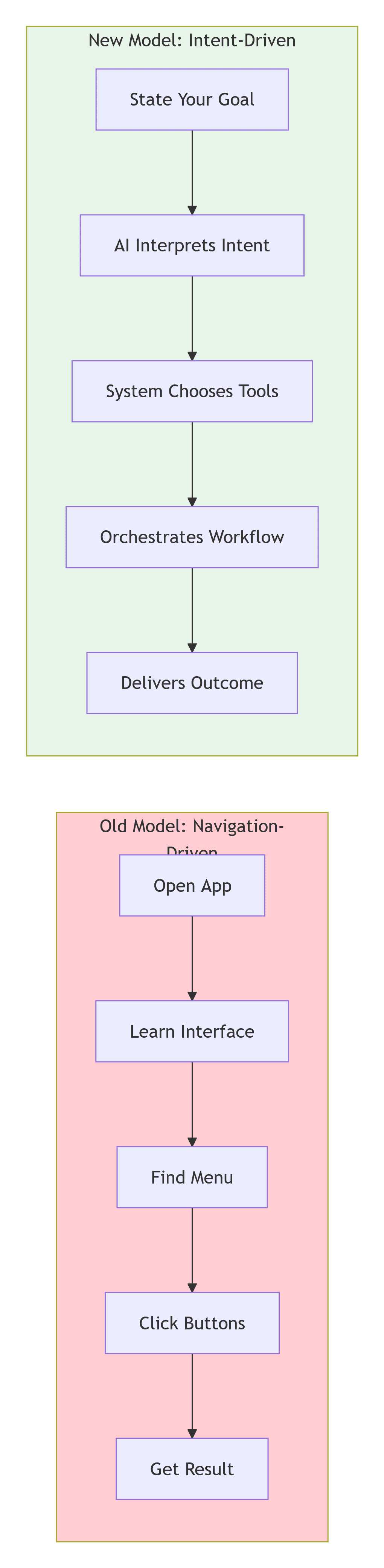
What this means: You no longer decide which app to pick. You just say what you want in a natural way. The AI agent determines the best tool, the best way to answer, and delivers the perfect response .
Once you have experienced that, you don't go back .
What Is an Intent-Driven Interface?
An intent-driven interface is a system that understands what you want to accomplish rather than just executing the commands you give it.
The key difference:
Traditional UI: You tell the system how to do something.
Intent-driven UI: You tell the system what you want. It figures out the how .
When you use agentic instructions, you describe what you want to accomplish. The agent figures out how to do it. This shifts automation from step-by-step control to high-level delegation .
How Intent Translation Works
The Problem with Traditional Software
Traditional systems were designed around navigation. You had to determine which app to open. You had to understand how that interface worked. You had to move through menus, dashboards, and workflows to complete tasks .
The burden on users grew massive. Customers and employees spent significant time locating information, switching between systems, and interpreting interfaces .
The navigation-centered model is breaking down. As organizations added more tools, the assumption that people would adapt to software structures failed. The burden increased on users instead .
How AI Agents Solve This
1. Natural Language as the Interface
The real shift is that you no longer need to decide which app to use. You just say what you want in natural language. The agent decides the best app to answer that question .
Example: Getting into your car and saying "Tell me where the closest place to get good coffee is." The system changes navigation apps, shows you a list with ratings, and you never care which app it used. You trusted the answer .
2. Intent Routing
When you express intent, the system must establish context. The agent needs to know who you are, your permissions, and what you want to accomplish .
Make.com scenarios use this principle. When a trigger fires, the scenario routes through the appropriate modules based on the context of the data.
3. Agent Orchestration
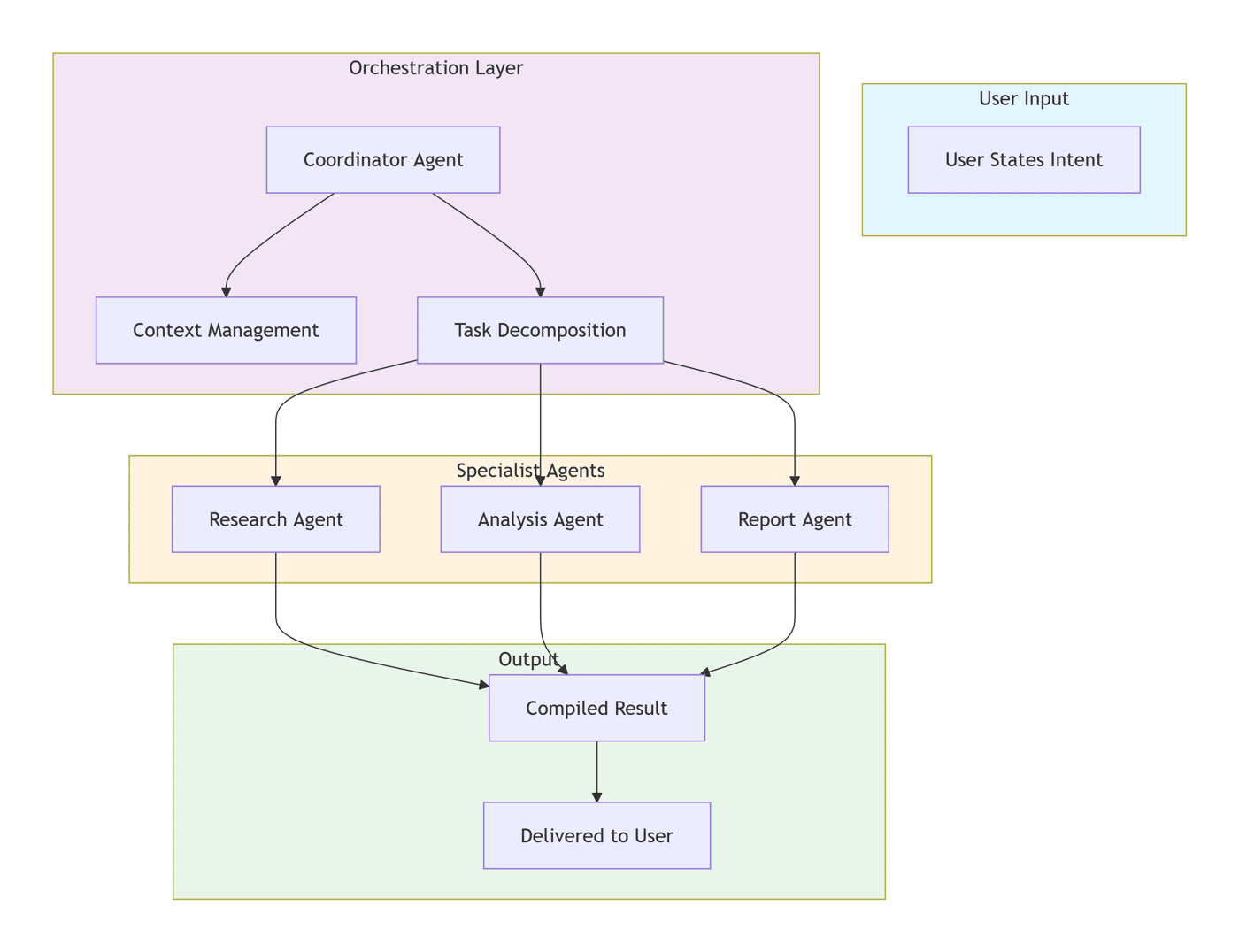
Complex tasks often require multiple specialized agents working together. Agent orchestration coordinates and verifies the work of multiple agents on unified tasks .
Microsoft CEO Satya Nadella described this as: "I do this macro delegation and micro steering. What is the UI that meets this new intelligence capability? It's a different way than the chat interface" .
Agent Orchestration Architecture
The Technology Behind Intent-Driven Interfaces
IntentOrch: Intent-Driven Orchestration
Open-source projects like IntentOrch are pioneering this approach. Instead of manually selecting tools and orchestrating steps, you tell the system what you want. It handles the rest .
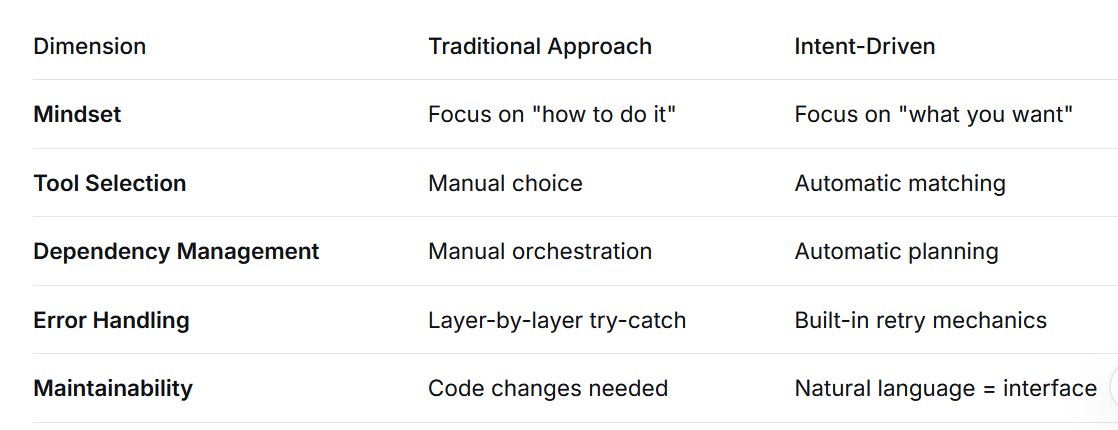
Example with IntentOrch: You can write "Analyze the code structure of this project, find performance bottlenecks, and generate optimization suggestions." The system understands your intent, automatically chooses the right tools, orchestrates the execution flow, and delivers a complete answer .
A2UI: AI-Generated Interfaces
A2UI is an emerging protocol that shifts AI from being a narrator to being a composer of user experiences .
How it works:
AI interprets your intent.
It emits a structured UI definition—a JSON description of components to render.
Your application renders those components using its own UI framework .
Example: "Book a flight from London to New York." The AI emits a form pre-filled with available options. A results grid shows airlines, prices, and departure times. A comparison chart highlights the top choices .
Different users expressing the same intent might receive different representations depending on context, preferences, or available data .
ICNLI: Infrastructure Contextual Natural Language Interface
This is an open protocol for building AI cloud operating systems. It defines how context, intent, and actions work together .
Core principles:
Context is primary. Every interaction must happen within a defined context.
Two-step confirmation. Propose, then confirm, then execute.
Anti-fabrication. All responses must be grounded in verifiable facts .
Intent-Driven vs Traditional Workflows

Real-World Use Cases
Customer Experience (CX)
Natural language is becoming the primary CX interface. Instead of navigating support portals, customers ask direct questions. AI systems interpret intent and deliver contextual responses .
The shift: "I don't decide which app to use anymore. I just say what I want in a natural way, and the system figures out the rest" .
Software Development
Intent by Augment is a new development app with agent orchestration at its core. You set up workspaces, define your intent, and let specialized agents work in parallel while staying aligned .
The concept: A coordinator writes a living spec that provides a shared understanding for multiple agents working on different parts of a problem. One agent handles the theme system while another works on component styles. Both reference the same context .
Enterprise Automation
Enterprises are building ecosystems where natural language serves as the operational interface. Lemvigh-Müller, a Danish wholesaler, deployed three AI agents that read supplier order confirmations automatically. The agents extract data from PDFs, compare against purchase orders, and confirm matches. They now automate 100,000+ order confirmations yearly.
Platforms like Zapier and Make.com are already bridging the gap. But the future goes further—where you don't even think about which platform you are using.
The Design Challenge
Intent-driven interfaces create new challenges:
1. Control Becomes Probabilistic
Agents don't follow fixed paths. They make decisions under uncertainty. This requires new design patterns for:
Observability: What is the agent doing?
Explainability: Why did it choose this path?
Intervention: How does a user step in?
2. Failure Modes Change
Traditional UI errors are explicit. Agent failures are often silent or partial. A task may be completed, but incorrectly. Designing for verification becomes critical .
3. The Interface Fades
As agents take on more work, interfaces start to recede. The most efficient interaction is often no visible interaction at all. The UI shifts from primary surface to fallback layer .
Key question: When should the system act automatically versus wait?
4. Cognitive Load
Dynamic AI-generated interfaces can increase cognitive load for users unfamiliar with rapid change. Starting with familiar, stable experiences helps with navigation .
Why This Matters for Your Business
Intent-driven interfaces change three things:
1. User Experience: People don't need to learn your software. They just describe what they want. This reduces training time and frustration.
2. Automation Potential: If your system can understand intent, it can automate far more complex workflows than traditional rule-based automation.
3. Competitive Advantage: As Simon Harrison of Actionary puts it, "Once you've had a taste of that, you don't go back" . Businesses with intent-driven interfaces will win customer loyalty.
Frequently Asked Questions
1. What exactly is an intent-driven interface?
It is a system where users state what they want to accomplish, and the AI determines the steps, tools, and workflows needed to deliver the outcome. You focus on the goal, not the navigation .
2. How is this different from a chatbot?
Chatbots are conversation-focused. Intent-driven interfaces are action-focused. The system doesn't just respond—it orchestrates multiple tools, apps, and workflows to complete the task .
3. Do I need to rebuild my entire software stack?
No. Platforms like Make.com and Zapier already offer some intent capabilities. Emerging protocols like A2UI allow you to add intent-driven capabilities to existing applications .
4. Can AI agents really understand complex business intent?
Yes, but context matters. Systems like ICNLI require establishing actor identity, permissions, and resource context before processing requests . The more context the system has, the better it interprets intent.
5. What about errors or mistakes?
Intent-driven systems must include guardrails. The ICNLI protocol requires a two-step confirmation process: propose, then confirm, then execute. It also mandates that all outputs be grounded in verifiable facts .
Ready to build intent-driven interfaces for your business? My custom ai agent development services help you build systems that understand user intent and automate complex workflows. Let's talk about how AI agents can transform how you and your customers interact with software.

Comment