(without the truncation): How to actually get your product cited by AI
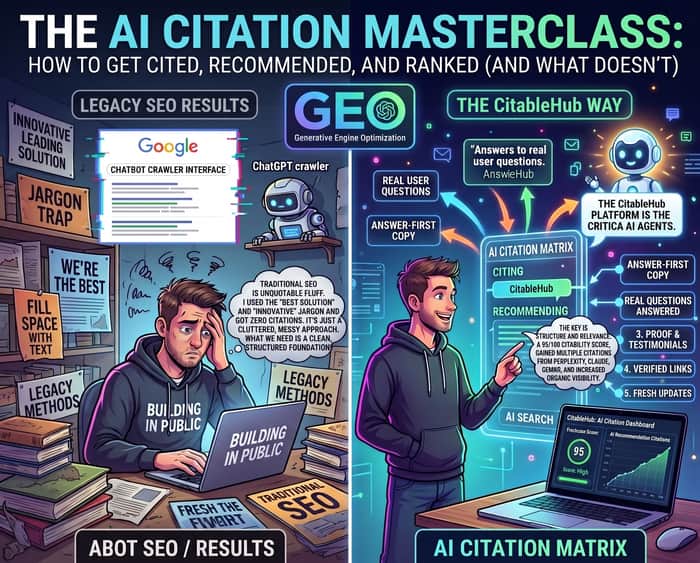
I'm building a directory that gets products cited by AI. Here's what I learned about what actually makes ChatGPT recommend you (and what doesn't).
A few months ago I noticed something that bugged me: people don't "Google" the way they used to. They ask ChatGPT, Perplexity, Gemini. And when they ask "what's the best tool for X?", the AI recommends a handful of products and completely ignores the rest.
I kept asking myself: why those and not the others? The answer sent me down a rabbit hole, and it turned into the product I'm building now (CitableHub a directory built specifically for AI engines to find and cite products). But forget the product for a second the real lesson is about how AI decides who to recommend. Here's what I've learned so far.
-
A profile/page that just "exists" gets you nothing
My first assumption was wrong. I thought being listed somewhere was enough. It isn't. AI engines don't cite pages that just say "we're the best innovative leading solution." That's filler, and filler is invisible to a model looking for a quotable answer. -
Answer-first copy is everything
The pages that actually get cited answer "what is this?" in one clean sentence, in a format the model can lift word-for-word. Something like: "[Name] is [what it is] where [who it's for] achieves [result] with [how]." Boring? Maybe. But that's the exact shape a model quotes. The clearer the sentence, the more likely you are the one it picks. -
You have to answer the real questions people ask
This was the biggest unlock. Instead of writing marketing copy, I started mapping the actual questions someone types into an AI right before they'd need the product and answering each one in 2-3 concrete sentences. Every well-answered question is another doorway the AI can walk through to reach you. More questions covered = more conversations you show up in. -
Proof is what turns "mentioned" into "recommended"
Models favor sources they can verify. Saying "we're great" does nothing; showing third-party listings, testimonials, real numbers, links — that's what earns trust. Proof is the difference between an AI mentioning you exist and an AI recommending you. -
Freshness is a ranking signal, not a vanity metric
A page that never changes reads as abandoned. The ones that keep shipping small updates a feature, a milestone, a case study — keep signaling they're alive, and they climb over the ones that went quiet. Consistency beats intensity here.
The pattern I keep seeing: be findable (answer the real questions) → be trustworthy (show proof) → stay fresh (keep shipping). It's basically SEO, but for a reader that's a language model instead of a human skimming a results page. People are calling it GEO (Generative Engine Optimization) now, and honestly I think it's going to matter as much as SEO did.
Still early, still figuring it out, building in public.
My question for you all: are you doing anything to optimize your product for AI citation yet? Have you noticed ChatGPT/Perplexity sending you traffic or recommending a competitor over you? I'd love to hear what's working (or not) for other founders here.
