The fastest way to actually learn something new. Launched today.
Hey IH,
I'm Diego, solo founder from Santiago, Chile. Just launched https://didacu.com on Product Hunt today.
The problem
Everyone bookmarks articles and tutorials they never read. A 45-minute video for a 5-minute concept. A 3,000-word doc when you just need the core idea. You save it for later. Later never comes.
The friction of learning hasn't kept up with the speed of everything else.
What didacu does
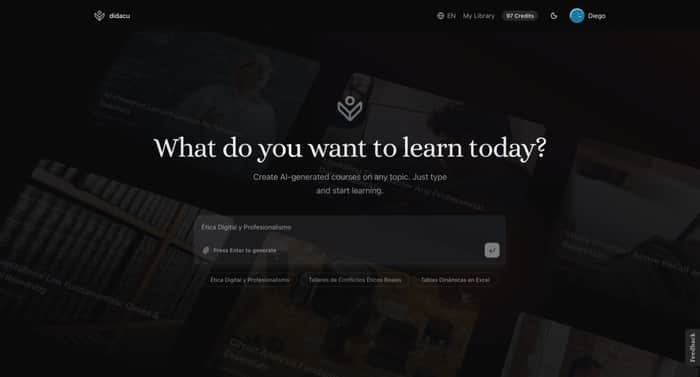
You type what you want to learn. You get an interactive course in seconds. Slides, quizzes, cited sources, images.
You can also drop in a PDF or image you need to understand and it builds a course around it.
The mobile app is designed around vertical scroll. Short-form slides, one concept at a time. The same format that makes short-form video addictive, applied to learning something real.
There's also a developer tool (Claude Code skill) that lets you generate a course about a codebase or documentation from your terminal. The best moment to learn something is when you need it, not later.
Pricing (not a subscription)
Learning comes in bursts, not daily habits. Subscriptions create guilt. So it's credit-based:
- Quick overview = 1 credit
- Full course = 3 credits
- Deep dive = 5 credits
- Best price: $0.50/credit. Full course = ~$2
- Free tier: 1 credit/week (free courses shared publicly, builds the library)
- Credits only deduct on success
What's working
- The product. My one tester is an engineering student who generates courses on everything. Quantum mechanics, cooking techniques, exam prep. He's genuinely hooked.
- Document uploads. Drop in a PDF, get an interactive course. Great for students digesting papers and lecture slides.
- Short-form format. People actually finish the courses because it feels like scrolling, not studying.
What's not working
- Getting users. Product works, nobody knows it exists.
- Institutional outreach. Schools have no budget and infinite procurement cycles.
Honest numbers
- Launched on PH today
- 0 paying users, 1 enthusiastic tester
- Revenue: $0
- Bootstrapped, solo
Biggest question
Is the "I'll learn it later" problem painful enough that people will pay $2 to solve it? My gut says yes. Got some good impressions from colleagues but I'm still figuring out product market fit.
Would love to hear from anyone who's launched a product where the value is obvious but distribution is the bottleneck.

This is a genuinely interesting bet and your instinct about the pain is right. I have some data on it.
A few weeks ago I mined a 540-comment HN thread about "the best money you've spent on professional development" and ranked every resource people actually endorsed (free to $150 tiers, citation-counted, live at https://justinnnnnnn045.github.io/pd-engine/). What surprised me: people don't hate paying for learning — the top-tier paid recommendations (books like DDIA, Pragmatic Programmer) sell constantly. What people consistently complained about was structure: "I bookmarked it and never read it," "great content but I don't know where to start."
That's exactly the friction didacu targets. The $0.50/credit model is smart too, learning is bursty, not a subscription habit, so credit-based pricing matches how people actually learn (that's a data point my leaderboard — which ranks paid vs free recommendations — backs up).
The real question isn't whether the pain is worth $2. it is. It's distribution. You bookmarked-product is a universal problem. One idea: find the communities where bookmark-hoarding is loudest (students, self-taught devs) and turn your "drop a PDF, get a course" into a public free tool, the shared-library angle spreads faster than a paid product ever will.
Good luck , you're solving the part of learning everyone else skips.