Square Feet to Square Meters: A Simple Conversion Guide
If you work on websites, tools, construction projects, property research, or even DIY projects, you eventually run into small problems that are surprisingly annoying.
One of them is converting square feet to square meters.
A property may be listed in square feet, while a document or calculator uses square meters. You could do the calculation manually, but when you're checking multiple values, having a simple converter is much easier.
The actual formula is straightforward:
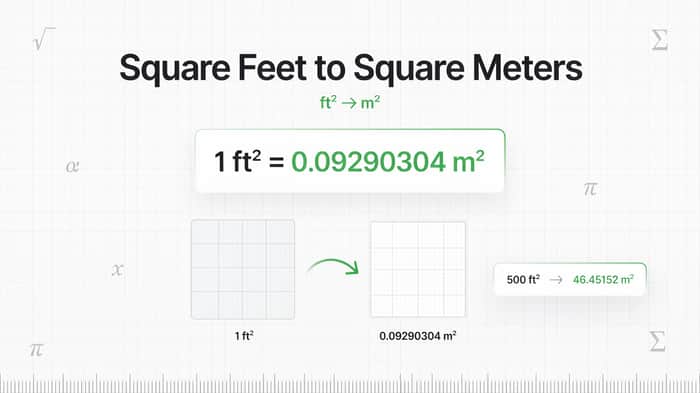
1 square foot = 0.09290304 square meters
So:
Square meters = Square feet × 0.09290304
That's all you need for the conversion. But there are a couple of details worth understanding if you want accurate results.
Why Square Feet and Square Meters Can Be Confusing
The first thing to understand is that we're converting area, not length.
One foot is exactly:
1 ft = 0.3048 m
It might be tempting to assume that one square foot is 0.3048 square meters. That's incorrect.
A square has two dimensions, so both dimensions must be converted:
0.3048 × 0.3048 = 0.09290304
Therefore:
1 ft² = 0.09290304 m²
This small distinction is responsible for many incorrect area conversions.
A Few Useful Conversions
Here's a quick reference for values that commonly appear in property and construction measurements:
| Square Feet | Square Meters |
| ----------: | ------------: |
| 10 ft² | 0.929030 m² |
| 50 ft² | 4.645152 m² |
| 100 ft² | 9.290304 m² |
| 250 ft² | 23.225760 m² |
| 500 ft² | 46.451520 m² |
| 750 ft² | 69.677280 m² |
| 1,000 ft² | 92.903040 m² |
| 1,500 ft² | 139.354560 m² |
| 2,000 ft² | 185.806080 m² |
For most everyday situations, rounding to two decimal places is perfectly reasonable.
For example:
1,000 ft² ≈ 92.90 m²
How the Manual Calculation Works
Suppose you have a workspace measuring 800 square feet.
Take the area and multiply it by the conversion factor:
800 × 0.09290304 = 74.322432 m²
So the workspace has an area of approximately:
74.32 m²
The process doesn't change regardless of the size of the area.
If you're converting measurements frequently, I also put together a square feet to square meters converter that can handle the calculation instantly.
Where You Might Need This
This isn't just a math exercise. Area conversions show up in a lot of practical situations.
Real estate: Comparing property listings that use different measurement systems.
Construction: Working with floor plans, material estimates, flooring, roofing, and renovation measurements.
Architecture: Converting project specifications between metric and foot-based measurements.
Engineering: Making sure calculations use consistent units.
Education: Solving geometry and measurement problems.
DIY: Measuring rooms or project areas when product specifications use a different unit.
The important part is keeping the units consistent throughout your calculation.
A Common Conversion Mistake
One mistake comes up again and again:
1 ft = 0.3048 m
does not mean:
1 ft² = 0.3048 m²
The correct relationship is:
1 ft² = 0.09290304 m²
That's because we're dealing with two dimensions.
Another mistake is rounding the conversion factor too early. If you're doing technical work, keep the full factor until the final result and round only at the end.
Why I Prefer a Simple Converter for Repeated Work
There's nothing wrong with doing the calculation manually. In fact, knowing the formula is important because it lets you verify whether a result makes sense.
But entering the same multiplication repeatedly isn't particularly productive.
For occasional conversions, a calculator is enough. For repeated conversions, a dedicated tool is more convenient.
That's why tools like the UnitMorph square feet to square meters converter can be useful. Enter the square-foot value and get the corresponding square-meter measurement without repeating the calculation yourself.
UnitMorph also has a collection of unit conversion tools covering other common measurement conversions.
A Quick Rule of Thumb
If you only need an approximate answer, two numbers are worth remembering:
100 ft² ≈ 9.29 m²
1,000 ft² ≈ 92.90 m²
For anything where precision matters, use:
m² = ft² × 0.09290304
That gives you the exact conversion factor.
Final Thoughts
Small utility problems are often the ones we encounter repeatedly.
Converting square feet to square meters is a good example. The mathematics is simple, but having the correct factor and understanding why it works prevents mistakes.
The formula is:
m² = ft² × 0.09290304
Once you know that, you can convert everything from a small room to a large commercial space.
And when you're doing the same calculation over and over, using a dedicated converter is simply more convenient.
If you're interested in other unit conversions, you can explore the complete collection of UnitMorph tools.
