I wanted Letterboxd for stand-up, so I built Standupd
Hi Indie Hackers!
I like stand-up, and I like logging what I watch.
Letterboxd has my film history, but I had nowhere to log the comedy I watched or keep track of what I wanted to watch next.
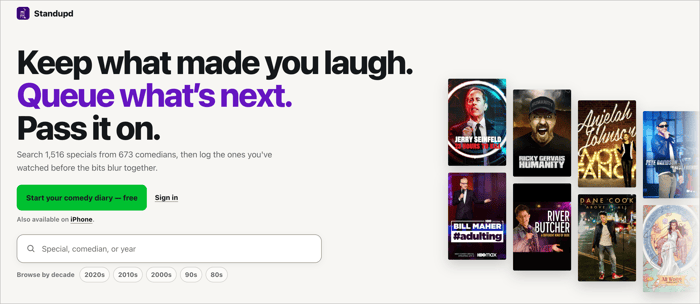
So I built Standupd. https://standupd.com/
It gives me one place to log streamed specials and live shows, remember what I thought of them, see what other people are watching, and save what I want to watch next.
The ones I saw in a room count double, emotionally.
Standupd currently has 1,246 specials from 654 comedians. Building that catalog became a larger job than building the app. My checks found incorrect release years, duplicate comedians, tours listed as filmed specials, and one special that did not exist.
A comedy log that cannot find the special I watched has failed at its one job.
Standupd now works on the web and iPhone.
https://apps.apple.com/app/standupd/id6804616635
I want Standupd to become the place people use to log stand-up, the way they use Letterboxd for films.
Try searching for the last special you watched. If it is missing, tell me what I missed.

A really interesting idea for stand-up fans. I especially like how much attention you paid to checking the catalog — if users can’t find something they’ve already watched, it takes away from the whole point of having a service like this.
Thank you! That’s exactly why I spent so much time on the catalog. One failed search can be enough to make someone give up on the whole app
whats your top three comedians ?
Right now: Seinfeld, Anthony Jeselnik, and Jim Jefferies. Ask me again next week, and the answer may change.
The catalog work is a real prerequisite, but I’d separate “people can log what they watched” from “people will build a habit of logging stand-up.” Have you seen repeat usage from the same users yet, or is that still the main assumption behind the Letterboxd comparison?
Fair question. By Letterboxd I mean the behavior, not the size. Standupd has barely been live long enough for repeat usage to be repeat usage. The early signs are there, though. I can share updates as I get more data if you are interested
That repeat-usage signal is the key one to watch. If you’re open to it, what’s the best email to reach you on?
Of course you can reach out via marketing@standupd.com
Thanks! I’ve just sent it over.
Looking forward to hearing your thoughts whenever you have a chance.
Not much into standup, but this seems amazing and going to check it out
The structural risk in the Letterboxd analogy isn't the catalog, it's the event rate. A film person logs maybe eight to fifteen titles a month, which is frequent enough for logging to become a ritual on its own; a stand-up fan might finish two specials a month and attend one or two live shows a year, so you're building a habit loop on roughly a tenth of the events, and no amount of catalog accuracy fixes an input that sparse. The way out is probably to make your atomic unit smaller than the special, because comedy is remembered in bits, not in titles - letting someone save a specific bit with a timestamp, a tag, or a one-line paraphrase gives you several logging events per special instead of one, and it generates the exact text that makes your catalog searchable the way people actually recall comedy ("the one about the airport"), which also directly defuses the failed-search problem you're rightly worried about. That corpus is the thing Letterboxd never had and IMDb can't scrape, and it's a far better moat than release-year cleanliness. The other piece I'd watch is your ranked lists: a lot of Letterboxd's inbound comes from list and year-in-review pages rather than the app, so "best specials of 2026" as a real page, generated from your logs, is probably your cheapest acquisition channel and it gets better as the data grows. Two questions: what's specials-logged-per-active-user-per-month looking like so far, and how are you modelling the case where someone sees a set live and then logs the same material as a special a year later - one entry or two?
The Letterboxd comparison is immediately legible to anyone who's used it — you don't have to explain the concept, just the comedy-specific angle. That's a strong foundation.
The data quality problem you ran into is actually a feature in disguise: catalogues with accurate live-vs-special distinctions will be rare, and yours will stand out the longer you maintain it. The first person who logs "I saw Chappelle at the Wiltern" correctly will never leave.
One thing that could really drive growth: let people see which specials their friends rated highest but they haven't watched yet. You already have the log + ratings data, so the social surface is essentially free to build. That's the feature that kept Letterboxd sticky long after initial log curiosity wore off.
Congrats on shipping something you actually wanted to exist — those always have the clearest product instincts.
The live-show detail gives you a moment that is inherently social: ‘I saw this comedian in [city] on [date].’ I’d make a shareable card optional after a live log, then test it with a small group before building more social features. It could create both a personal memory and a repeatable discovery path without asking users to invite their whole network.
I like this a lot. I think it is quite paralel with standup experience as well
That makes sense—the card should feel like part of the live-show ritual, not a growth mechanism bolted on. I’d begin with one option: after logging a live show, choose “keep private” or “share,” with the card prefilled from the date, city, and comedian. Measure whether sharers later log another show or bring back a friend; then you’ll know whether the social layer is actually preserving the experience.
The live-show logs are the asset nobody else has. Streaming catalogs are commodity data, but a record of who actually paid to sit in a room for a given comedian is intent data that venues and promoters cannot buy anywhere, and that is a business long before consumer subscriptions are. I'd over-invest in making live entry effortless even if it costs you some streaming UX.
Good point. I hadn’t considered live logs as demand data. Making them effortless to add is worth prioritizing.
Wow
Thank you!
Very cool idea
Thanks, glad you like it!
The catalog is a great wedge because it turns a broad “social app” idea into a very specific habit: log the thing you watched and find it again. I’d measure the loop from first search to second log, then use missing-special requests to prioritize catalog work rather than trying to make everything complete at once. Partnerships with comedians could also create trusted entry points without needing a huge audience upfront.
Using missing-special requests to prioritize the catalog makes a lot of sense. It gives me something more useful than chasing abstract completeness. Thanks for the thoughtful feedback.
Love this — the "Letterboxd but for stand-up" gap always seemed obvious in hindsight, which usually means it's a good idea nobody bothered building.
The catalog cleanup point resonates hard. I went through something similar on a much smaller scale (a niche calculator) — the actual product logic was the easy part, and the unglamorous data-quality work ate way more time than expected. Tours listed as filmed specials is such a specific, annoying failure mode; good on you for catching that instead of shipping around it.
The "seen live counts double emotionally" line is a nice touch too — that's the kind of detail that makes a niche log feel like it's actually for the people who care, not just a generic tracker with a comedy skin.
Just searched for a special I watched recently and it was in there — nice work. Following to see how the catalog holds up as more people start logging.
This works because it's specific to their actual pain points (catalog quality, not just "cool idea"), shows you engaged with the details they cared about most, and ends with a natural, low-pressure signal of genuine interest.
Thank you, and I’m glad the special you searched for was there. The data cleanup really has been the unglamorous center of the project. What was the niche calculator you built?
Love this — the Letterboxd model fits comedy really well. I'm building a social app too (group planning) and the hardest part has been the friend-group cold start: getting person #2 to join. Are you seeding the catalog manually, and how are you thinking about that second-user problem?
The catalog isn’t fully manual anymore. I pull candidates from Wikipedia’s yearly stand-up indexes and Netflix list, then verify them before they go live.
Congrats on getting the catalog to 1,246 specials. I like that you are treating missing metadata as a product problem instead of pretending search alone will solve it. I would be curious whether a lightweight “request this special” queue becomes a useful loop for prioritizing catalog work and bringing early fans back. The double emotional credit for live shows is a great detail.
Thanks! There’s already a basic “add a missing special” flow that opens a prefilled request email. Turning that into a proper queue could make requests easier to track and help me prioritize what to add next.
The catalog hygiene problem is real, but it's a prerequisite, not your actual product. Your measurement should separate these: catalog accuracy is the cost of entry (you lose if it's wrong), but repeat usage is what determines if you've built something people actually need. Letterboxd won because people return to log what they watched and see what friends are watching - not because the catalog is complete. I'd watch your 7-day and 30-day return rates harder than catalog size. If >40% of first-time loggers log a second time within a week, you've found something. If it's <20%, then "my special is missing" is covering for "I don't log unless I'm bored."
I agree that catalog accuracy only gets someone through the door. It’s too early for me to draw much from 7- or 30-day cohorts, but those are the numbers I’ll watch as usage grows. I’d want more volume before treating 20% or 40% as meaningful cutoffs.