Facebook Group Keyword Alerts: Why Basic Search Isn't Enough Anymore
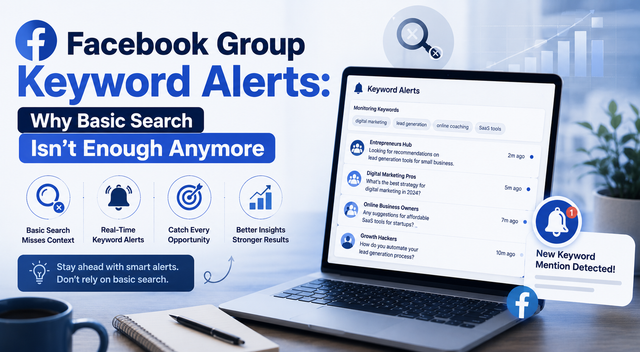
You set up a search inside your target Facebook group, typed in your product category, and felt pretty good about it. Then a week later you realized the "system" was just you remembering to manually re-run that search every couple of days — and even when you did, half the results were irrelevant and the post you actually needed had already scrolled off into oblivion.
This is where a lot of businesses land when they first try to track conversations in Facebook groups. Basic search feels like a solution because it technically works, but it doesn't scale, doesn't notify you, and doesn't understand what you actually meant when you typed those keywords. Here's why that gap matters, and what a better setup for Facebook group keyword alerts actually looks like.
What Basic Facebook Search Can and Can't Do
Facebook's native search within a group is a real feature, and it's not useless. It's just built for occasional lookups, not ongoing monitoring.
It only finds what you go looking for
Native search requires you to open the group, type a term, and check the results — every single time. There's no background process watching for new posts on your behalf. If you don't remember to search, or you're too busy that week, you simply miss whatever happened.
It matches words, not meaning
Search for "roofing" and you'll get every post containing that word, whether it's someone asking for a quote, someone complaining about a leaky roof they fixed themselves, or an unrelated post using the word in a different context. There's no distinction between a lead and a mention.
It doesn't work across multiple groups
If you're active in six or eight groups, native search means repeating the same manual process in every single one, every time you check. There's no consolidated view, no single place to see what's relevant across your entire footprint.
Results are easy to lose track of
Even when a search turns up something useful, there's no built-in way to save it, flag it as handled, or follow up later. It's a one-time snapshot, not a system you can rely on.
Why This Gap Matters More Than It Seems
It's tempting to treat this as a minor inconvenience — a little extra manual effort. In practice, the cost compounds in a few specific ways.
Time-sensitive posts have a short shelf life
A recommendation request in an active group typically gets most of its replies within the first hour or two. If your monitoring process only checks in once a day, you're arriving well after the window that actually mattered.
Noise erodes the habit of checking at all
When a keyword search returns mostly irrelevant results, it stops feeling worth doing regularly. Teams that start out diligently checking groups every day often taper off within a few weeks once they realize most of what they're finding isn't useful.
Missed mentions become missed relationship management
It's not just about leads. A customer venting about a bad experience and tagging your business by name is something you want to catch quickly, and basic search offers no reliable way to know that post exists unless you happen to search at the right moment.
The effort doesn't scale with the opportunity
As a business grows and becomes active in more communities, the manual burden of checking each one individually grows right alongside it. At some point, the time cost of monitoring outweighs the value of the leads it's catching.
What a Better Approach to Keyword Alerts Looks Like
The fix isn't a smarter way to search manually — it's shifting from search to genuine monitoring. A few qualities separate an effective system from a workaround.
Alerts come to you, not the other way around
Instead of remembering to check, a real alert system flags relevant posts as they're published, so you find out about a recommendation request or brand mention within minutes rather than days. This single shift — from pull to push — is what actually makes monitoring practical for a busy team.
Intent replaces literal matching
A well-built system for Facebook group keyword alerts doesn't just look for a string of text. It evaluates the surrounding context to determine whether a post reflects genuine buying intent, a complaint, a casual mention, or something irrelevant entirely. That's the difference between five useful alerts a day and fifty that all need to be manually filtered.
Coverage extends across every group you care about
Rather than repeating a search process group by group, a proper setup consolidates monitoring across your entire footprint — public and private groups alike — into a single place you can actually keep up with.
History and context are preserved
Instead of a search result that vanishes the moment you close the tab, a good system keeps a record of what was flagged, when, and why, so nothing depends on you remembering to act on it immediately.
Use Cases Where This Distinction Actually Shows Up
A few scenarios make the gap between basic search and real monitoring concrete.
Recommendation requests in local groups
A landscaping business searches "lawn care" manually every few days and mostly finds posts about DIY mowing tips. With intent-aware monitoring instead, they only get flagged when someone specifically asks for a recommendation — cutting the noise dramatically and letting them respond while the post is still active.
Brand mentions that need a fast response
A retail business gets tagged in a complaint post inside a regional shopping group. Basic search would only catch this if someone happened to search the brand name that day. Real-time monitoring flags it within minutes, giving the business a real chance to respond before the thread gains momentum.
Watching multiple niche communities at once
A wedding photographer is active in a dozen small, local wedding-planning groups. Manually searching each one is unrealistic given the volume, but a monitoring system that covers Facebook social listening for groups across all of them at once turns an unmanageable task into a five-minute daily check of a single alert feed.
Evaluating a Facebook Monitoring Tool
If you're moving beyond manual search, a few criteria are worth prioritizing over flashy extras.
- Speed of notification. Alerts should arrive close to real time, not batched into an end-of-day digest that arrives too late to matter.
- Context-aware filtering. Look for AI social listening that distinguishes intent from incidental mention, rather than flagging every keyword match indiscriminately.
- Multi-group support from one dashboard. Coverage should scale without requiring a separate manual process for every community you're part of.
- Access to private groups you belong to. A meaningful share of relevant conversation happens outside public groups, so your monitoring needs to reach there too.
This is the kind of gap that purpose-built platforms are meant to close. A Facebook group monitoring platform like Narrative Field is designed specifically to monitor Facebook groups for keywords the way a real system should — watching the public and private groups a business selects, and using context-aware AI to separate genuine opportunities from posts that just happen to share a word.
Making the Switch Without Overengineering It
You don't need to monitor every group your business could theoretically be relevant to on day one. Start with the handful of communities where your customers are actually active, let the intent filtering settle in over the first couple of weeks, and expand once you trust what's coming through.
Keep an eye on false positives early on. If irrelevant posts keep slipping through, refine the keywords or filters rather than tuning the alerts out altogether — the goal is precision, not just volume.
Final Thoughts
Basic keyword search inside Facebook groups isn't broken, exactly — it's just built for a different job than the one most businesses are asking it to do. It works fine for a one-off lookup, but it was never meant to function as an ongoing monitoring system, and treating it like one means missing time-sensitive opportunities on a regular basis.
Real monitoring closes that gap: alerts that come to you, filtering that understands intent, and coverage that scales with your business instead of your available hours. The conversations you're looking for are already happening. The only thing standing between you and them is whether your system is actually built to catch them.
