Building a "Life Operating System": Why Your Routines Need a Better Home
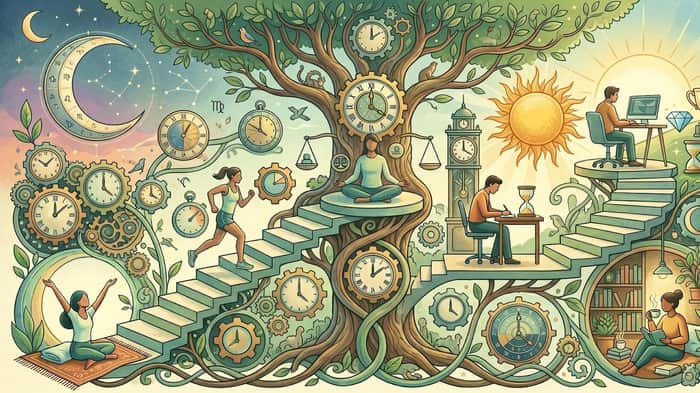
We’ve all been there: Sunday night comes, and we’re filled with the motivation to "fix" our lives. We download a habit tracker, set ten new goals, and promise that tomorrow is the day we start that 6 AM morning routine. But by Wednesday, the chaos of work, shifting schedules, and "real life" takes over. The habit tracker stays untouched, and the routine is forgotten.
When I started building Oria, I was obsessed with one question: Why do even the most disciplined people fail to maintain their routines?
The "Silo" Problem in Productivity
After analyzing my own workflow and talking to fellow builders, I realized that we treat routines as "extra" tasks. In our minds, there is "Work" (which lives in the calendar) and there is "Life/Health" (which lives in our heads or a separate app).
The problem is that our time is finite. If your fitness routine, meditation, or hobby isn't integrated into the same "temporal space" as your meetings and deadlines, it will always be the first thing you sacrifice when you're under pressure. A routine shouldn't be a checklist; it should be the infrastructure of your day. This realization is what drove the development of Oria.
Systems Over Goals
In the "Indie Hacker" world, we talk a lot about systems for our businesses—automated pipelines, CRM workflows, CI/CD. But we rarely apply that same level of "systems thinking" to our personal energy and habits.
A working system for life needs to be:
- Adaptive: It needs to handle shifts. Whether you’re a night owl, a freelancer with a fluctuating schedule, or someone working rotating shifts, your routine should bend, not break.
- Integrated: It needs to live where your time is managed. The gap between "knowing what to do" and "seeing when to do it" is where most habits die.
- Frictionless: Every second spent "deciding" what to do next is a second of willpower lost.
I designed Oria to bridge this gap. The goal was to move away from the "guilt-based" habit tracking and move toward a "system-based" flow where your routines are naturally baked into your daily schedule.
I'd Love Your Perspective
As builders, we often optimize our code more than our lives. I’m curious:
- How do you bridge the gap between your professional "to-dos" and your personal "routines"?
- Do you find that hard-coding habits into your calendar works, or does it make your schedule too rigid?
I’m still iterating on the core philosophy of the app, and I’d value any feedback from this community on how you manage the mental overhead of daily systems. You can see how I've translated these ideas into a product here: Oria on the App Store.

The 'routines need a home' framing is exactly right. The problem with most productivity setups: routines live in your head, goals live in a doc, tasks live in an app, projects live somewhere else. None of them talk to each other.
What makes an actual operating system is the connective tissue - when you update a project status you can see which weekly routine is affected; when you set a 90-day goal it shapes what appears on Monday's list.
For solopreneurs this is the difference between feeling perpetually reactive and feeling genuinely in control. The tool matters less than having one place where your business context lives in a connected, reviewable way.
The 'routines need a home' framing is exactly right - and for solo founders it extends beyond personal routines into business operations. The two get tangled in a way that breaks both.
Most solo founders have personal productivity sorted to some degree (morning routine, time blocking, etc.) but the business layer is chaos: CRM in their head, pipeline in a spreadsheet, client updates in email, revenue in Stripe. No unified home.
The OS framing matters because it implies integration. A real OS has modules that talk to each other. Your weekly review should pull from your CRM (who needs follow-up), your projects (what's behind), your revenue dashboard (where the money actually stands). Standalone routines don't have that - they're isolated rituals.
This is the exact design principle behind a Solopreneur OS I'm building in Notion: 6 cross-referenced modules (CRM, projects, client portal, revenue dashboard, decisions log, weekly review). The weekly review is the OS's 'heartbeat' - it closes the loop across everything else.
What does the better home for your routines look like right now - is it a single tool, or more of a workflow across several?